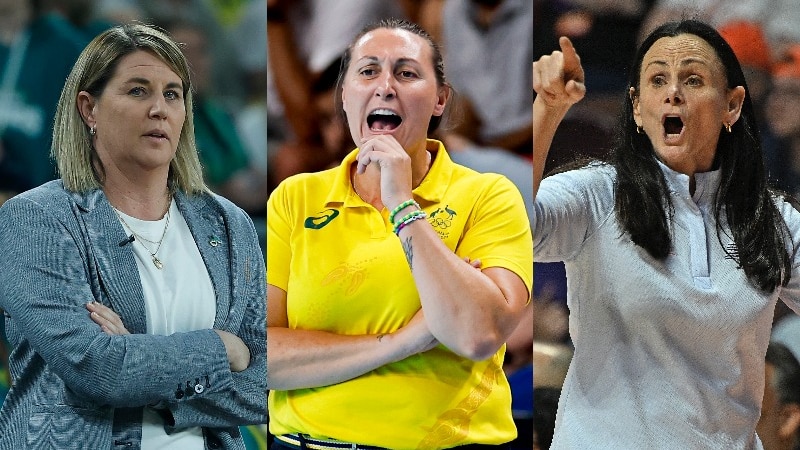
Stacey Marinkovich (Diamonds), Bec Rippon (Stingers), and Sandy Brondello (Opals) are three of the highest-profile female head coaches of Australian national teams. (Getty Images)
If you asked generative AI to create an image of a sports coach, it would likely serve up a middle-aged white man.
And while rooted in stereotypes, it would not necessarily be inaccurate.
The picture is slowly changing in some sports, although not substantial enough yet to disturb the algorithm.
The Australian Institute of Sport found the number of female head coaches in funded sports has nearly tripled since starting its Women in High Performance Coaching project in 2021.
The number now sits at more than 25 per cent, but AIS Director Matti Clements told ABC Sport that is still not good enough.
"Maybe we've had a history where we've just had male coaches coaching our best athletes," she said.
"We want to make sure the right people are coaching our athletes at the right time, female or male coaches."
AIS director Matti Clements says many female coaches still face key barriers. (ABC News: Peter Healy)
The AIS report found many women coaches have experienced bad behaviour, which was "in some cases appalling, misogynistic and abusive," as well as challenges managing careers alongside having a family, and difficulties even getting a foot in the door, let alone climbing the ladder.
It highlighted the need for leaders within the sporting sector to drive cultural change to address the barriers.
"As a system, we've had a real focus in the last couple of years of wellbeing being fundamental to high performance sport in this country," Clements said.
"If you look at wellbeing as a sustainable high-performance lever, that will encourage all different types of people to stay in our system, female coaches included.
"Perhaps historically, high-performance sport in this country has not been as welcoming for female coaches as it has been for male coaches."
Clements pointed out some of the strategies which have helped deliver positive results over the past four years include visibility of high profile coaches, having conversations at the highest levels, re-evaluating recruitment practices, and targeted development.