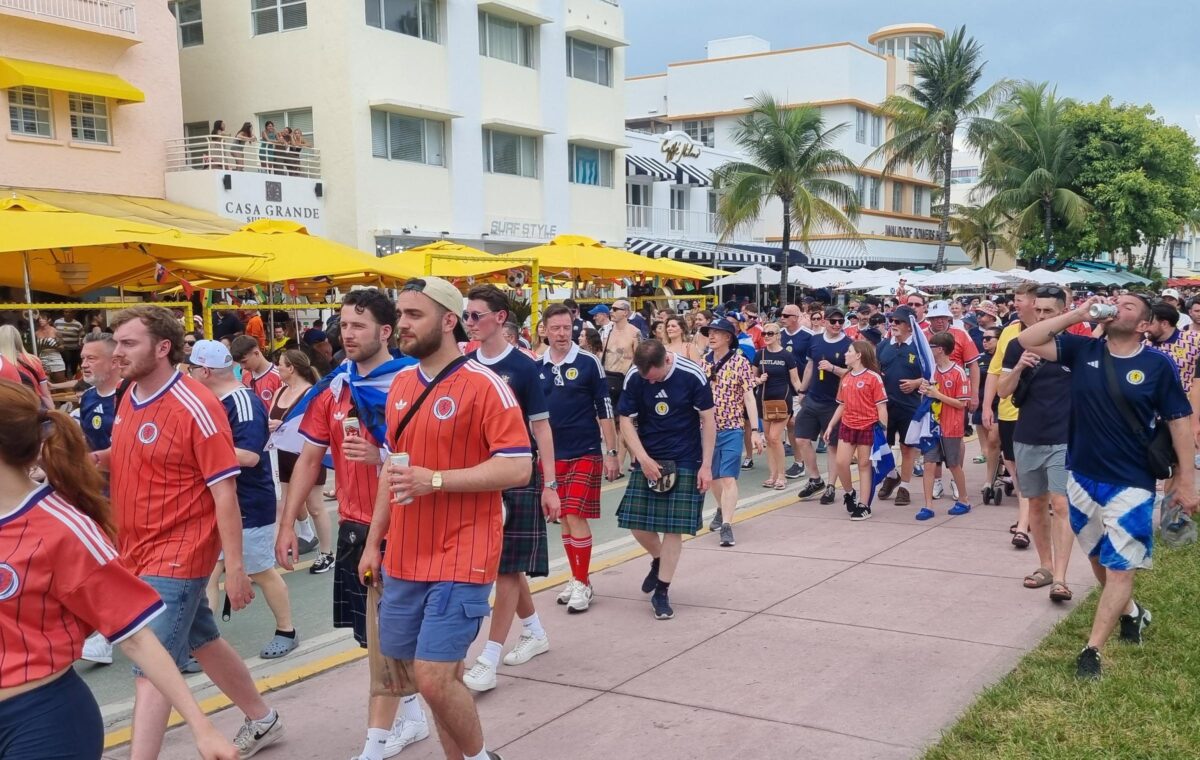
JD Sports Fashion sold more Scotland tops than any other jersey during the World Cup.
But the huge popularity of the kits sported by John McGinn and co, including the scarlet away strip that became synonymous with the Tartan Army in Boston and Miami this summer, was not enough to cheer investors in the sports retailing giant.
Shares in the company plunged by nearly 14% after it issued a profit warning, as strong sales of replica football kits and an improved performance of its outdoors business in the UK failed to offset continuing challenges in the US, now the retailer’s biggest market following a series of acquisitions in recent years.
The market reaction is unlikely to ease the pressure on chief executive Regis Schultz, who saw off an attempt by former chairman Andrew Higginson to oust him in April amid concerns over sales and performance in the US. Shares in the company, which closed up nearly 14% today at 80.44p, remain well adrift of their pandemic-era peak of 222.9p in November 2021.
JD reported today that like-for-like sales in the US had tumbled by 6.8% in the 13 weeks to August 1, with Mr Schultz stating that North America had seen the “most acute impact” of “incremental cost-of-living pressures” and “highly promotional” market conditions.
Mr Schultz said JD’s fortunes in the US were also impacted by a “slower quarter for high-heat footwear product and the timing of 'back-to-school' demand”.
The reverse in sales in North America, where JD owns the athletic fashion retailer Hibbett which it acquired for around $1.1 billion in 2024, contributed to an overall 3.1% fall in group like-for-like sales over the period.
Like-for-like sales in the UK edged up by 0.8%, with a spokeswoman confirming to The Herald that Scotland tops were the retailer’s “best-selling overall jersey” during the World Cup.
Sales in Asia Pacific rose by 1.4% but were down by 2.7% in Europe.
Scott McTominay in the current Scotland home jersey (Image: JD Sports Fashion)
The company is now anticipating profit before tax and adjusting items of £700 million to £800m for the full year, having previously guided on a profit range of £750m to £850m. Mamta Valechha, consumer discretionary analyst at Quilter Cheviot, said the updated “disappointed a little”, with sales “painting a fairly meek picture globally”.
“Today’s results aren't the biggest surprise, with the quarter dominated by the World Cup, where sales of football tops take over sales from lifestyle shoes,” she said.
“The latter is where JD Sports over-indexes. Additionally, JD remains under-indexed to categories that are doing well, such as performance football and running.
“We also had Adidas at the end of July flagging weakness in the wholesale market, with high levels of inventory and discounting, which led it to reduce sell-in to retailers. This likely means that brands which are doing well are protecting their full price sales by pushing them through their direct channels, with retailers likely missing out.”
Axel Rudolph, chief technical analyst at investing and trading platform IG, said that JD is “struggling to maintain its momentum, with weaker sales across most of its key markets pointing to a tougher trading environment”.