Overcoming data transfers’ thorniest problem
When you purchase through links on our site, we may earn an affiliate commission. Here’s how it works.
Transmitting data through the air often comes with a key problem: under a barrage of turbulent atmospheric conditions like wind and heat, the data can become distorted and corrupted, requiring great effort to piece it back together. It’s a big obstacle for long-distance internet and communications providers, yet a team of researchers think they’ve just solved this puzzle — and it could have massive implications for how you send data to and from your devices.
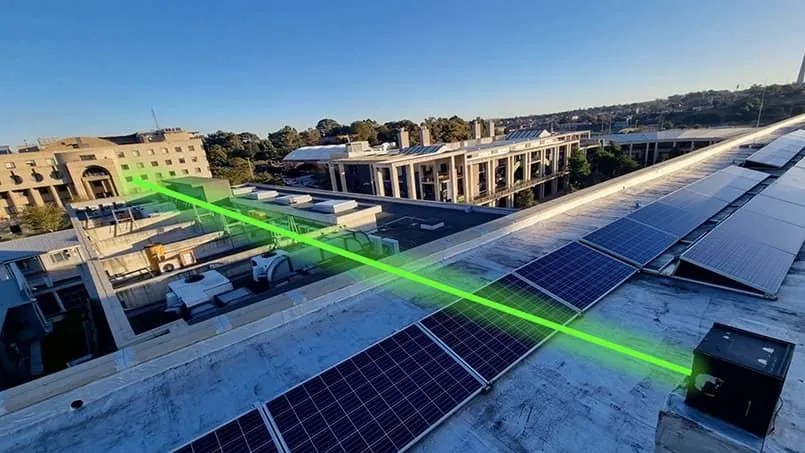
Researchers from Wits University in South Africa and the University of Bordeaux in France conducted an experiment that involved shooting a beam of light through the air. The light was encoded with optical data, and when they recovered it at the destination site, they found it had arrived with over 98% fidelity, only dropping to 86% fidelity in “the most severe conditions tested.”
How did they do it? According to a paper the team published in the journal Science Advances, the data was encoded into magnetic structures within light called skyrmions. These acted as a form of protective shielding that enabled the data to travel with the light, all without being altered by the surrounding environment.
It worked because the data was encoded into the light’s topological profile. Professor Andrew Forbes, Head of the Structured Light Lab in the Wits School of Physics, likened it to the comparison between a donut and a coffee mug: they both contain a round hole, and this factor remains constant if you reshape one into the other. In the same way, the light could be warped by heat and noise without garbling the data it was carrying.
This test wasn’t limited to short distances — the beam of light involved was transmitted over hundreds of meters, with plenty of heat, noise and wind present at the time. That means it therefore has a degree of applicability to real-world conditions.
Open air data transmissions have previously had to include constant real-time monitoring and correction of distortion, but if this latest research becomes usable on a wider basis, that might not be necessary for much longer. This technique could drastically reduce both the difficulty and cost involved in this kind of communication and has particular utility for space missions, where infrastructure like fiber-optic cabling is clearly not feasible.
High-speed satellite communications and quantum computing could also benefit from this technical advancement. And on a more prosaic level, it could improve communications without needing to build out costly fiber-optic networks. Think high-speed internet being beamed from the sky Starlink-style to rural communities that have long been underserved by traditional carrier systems.
Sign up for breaking news, reviews, opinion, top tech deals, and more.
“We envision that our results will pave the way towards seeing and transporting information through distortion by harnessing light’s innate, invariant properties for fast, reliable, and efficient communication,” the researchers concluded.
Follow TechRadar on Google News and add us as a preferred source to get our expert news, reviews, and opinion in your feeds.
➡️ Read our full guide to the best laptops1. Best overall: Apple MacBook Air 13-inch M52. Best budget: Apple MacBook Neo3. Best Windows 11 laptopMicrosoft Surface Laptop 13-inch4. Best thin and light:Lenovo Yoga Slim 9i5. Best UltrabookAsus Zenbook S 16
Alex Blake has been fooling around with computers since the early 1990s, and since that time he's learned a thing or two about tech. No more than two things, though. That's all his brain can hold. As well as TechRadar, Alex writes for iMore, Digital Trends and Creative Bloq, among others. He was previously commissioning editor at MacFormat magazine. That means he mostly covers the world of Apple and its latest products, but also Windows, computer peripherals, mobile apps, and much more beyond. When not writing, you can find him hiking the English countryside and gaming on his PC.
You must confirm your public display name before commenting