Eli Stark-Elster
| AAAS Mass Media Fellow
In the 1996 book Darwin’s Dangerous Idea, the philosopher Daniel Dennett argues that evolution might be the best idea anyone ever came up with. “If I were to give an award,” Dennett writes, “I’d give it to Darwin, ahead of Newton and Einstein and everyone else.”
Some physicists might disagree. Sure, evolution can explain how peacocks ended up with iridescent tail feathers and why chimpanzees look so much like humans. But can that really be called more significant than gravity?
In Dennett’s view, Darwinism triumphs over the rest, because evolution is what he calls a “universal acid”—wherever we find complexity in nature, evolutionary theories tend to burn through our other explanations and reshape them into their own, unreasonably effective image. “Darwin’s idea had been born as an answer to questions in biology,” Dennett writes in the book. “But it threatened to leak out, offering answers—welcome or not—to questions in cosmology … and psychology.”
In neuroscience, for instance, the universal acid has already eaten much of what stood in its path. A famous rule in the field, “neurons that fire together wire together,” posits that connections between neurons in the brain survive by repeating over time and outcompeting the less common paths—just as the theory of natural selection suggests that desirable traits in organisms outcompete less advantageous ones.
But what about on universal scales? Could evolution really explain questions in cosmology? Proponents of a niche perspective called “cosmological evolution” argue that the answer may be yes. They claim that the nature of the cosmos follows the same Darwinian principles that have helped us understand the nature of peacock tails.
Historically, scientists have viewed the cosmos as akin to a rock—complex, perhaps even beautiful, but formed through arbitrary events. Evolutionary cosmologists instead argue that universes, like living organisms, grow and reproduce, spinning off new universes with small variations from their progenitors. In doing so, these cosmic offspring are refined across generations into forms that maximize the number of universes yet to be born. Since the Big Bang, our universe, like any developing child, has been unfurling into an optimal shape.
Under this view, the universe is not a rock. It is an egg.
This analogy comes from Julian Gough, an Irish poet, novelist and musician best known for writing the short story that plays at the end of the video game “Minecraft.” He has recently become a public advocate for and scholar of cosmological evolution. Gough writes a Substack blog, The Egg and the Rock, where he publishes essays, personal updates and predictions about new data from the James Webb Space Telescope.
Over a decade ago, Gough began wrestling with the question of why the complexity of our universe has increased over time. “It goes from … a ball of hot gas to building out structures like stars and galaxies,” he says. From there come planets and, on at least one of them, biological life. “That’s a very strange thing for hot gas to do.”
Maybe, he wondered, the universe evolved into its current form. “It seemed to me an evolutionary explanation was the natural one,” he says. “In every sphere, when we discover a self-ordering, self-complexifying system, it turns out it’s had a previous evolutionary history. And why would that not apply to the universe itself?”
The multiverse is a hypothetical idea that our universe is just one of many that exist, and there may be an infinite number of universes. The concept has been explored widely in science fiction—from the Marvel franchise to the Academy Award-winning Everything Everywhere All at Once—but theoretical physicists have also been examining the idea to explain our reality.
Acknowledging his lack of expertise, Gough assumed someone else must have come up with the idea of an evolving cosmos before he did. A search through the scientific literature confirmed that someone had: Lee Smolin, a founding member of the Perimeter Institute for Theoretical Physics.
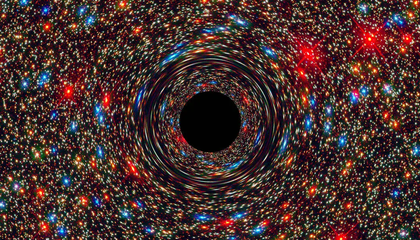
Smolin’s work was, in turn, inspired by physicists Bryce DeWitt and John Wheeler, who proposed that singularities inside black holes, the places where matter is crushed into a point of infinite density, might expand to produce new universes that follow different physics from the universes that produced them. Every universe—including our own—would, under this logic, have emerged from a Big Bang within a black hole.
Smolin realized that this hypothetical process would allow universes to reproduce, in a way, by making more black holes. And if those new universes could inherit the physics of their parents with small differences—just as new organisms inherit the genes of their parents with small differences—then universes could also evolve with each generation. Specifically, a form of cosmic natural selection would favor universes that make as many black holes as possible. Less fertile universes could persist, but they would produce far fewer offspring. So over time, an increasingly high proportion of universes would be optimized for black hole production—which would imply that our universe, given the odds, is one of those.