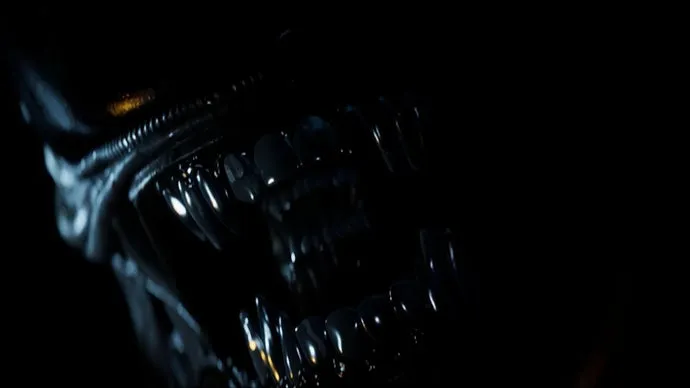
As I stand on the lee side of the wrecked haz lab, all I can hear is the rain pelt its metal roof and the feral wind howl about me. Planet LV-921 may have a breathable atmosphere, but it's not a safe planet. And that's before the xenomorph enters the scene and starts hunting the colonists living in Weyland-Yutani's Kurasaki mining station.
Alien: Isolation 2, the long-awaited sequel to Creative Assembly's 2014 horror game, moves the action out from the original's claustrophobic Sevastopol Station, but the developers have worked out ways to make the wide open spaces of LV-921 feel just as tense and trapping.
My Alien: Isolation 2 demo fades up to reveal I'm sitting in the back of a gloomy rover, its worn vinyl seats lit in the orange glow of the CRT monitors and blinkenlights. Two colonists, Otto and Cole, bicker about the storm that's beginning to pick up outside, and there's a rocking motion to the rover's interior that tells of the wind's strength as much as the road's unfinished surface. After waiting 12 years for an Alien: Isolation sequel, the confidence on show and the familiarity of the scene makes it seem like the team rolled straight from making the first game into the second, still firing on all cylinders.
Cole slams on the brakes when he hears a roar overhead followed by an explosion that shakes the rover. Your character, Blake, newly arrived after an eight-month journey from Earth, announces we need to investigate the noise. Cole says we must be quick, the storm sounds bad now but it's only due to get worse.
The original Alien: Isolation constrained its action to the narrow corridors and restrictive rooms of a space station, so to be stood in an open, muddy forest speckled with dead trees is a marked departure. The rover's headlamps cast long shadows and pick up the pouring rain drops. In the distance, smoke and the glow of a large fire hints at the location of the explosion. While Cole and Otto will try to find a route to the site in the vehicle, I'm to make my way through the dead wood alone, armed only with a flashlight.
"The weather plays a big part of it," art director Ana Sopikova says of the differences between the original Alien: Isolation and its sequel. "The rain, the storm, the wind allow us to layer different gameplay experiences." This early in the game, the weather exists for atmosphere, but she tells me that later in the game I may "Go outside, and maybe the fog comes in and all of a sudden, you can't see more than a couple of metres in front of you. Or the rain starts, and it's really loud, and you can't hear your footsteps."
Though, principal environment artist Archie Whitehead points out that the same dampening of your senses will be happening for the alien: "It sees and it hears, it's not being fed secret information about where you are. The only thing to bear in mind with that is that it's really good at adapting. So if it can't hear you, it's going to try and find other ways to hunt you." He gives the example that it might get up high to a vantage point where it can better see you. Or, if it loses you in fog, it will be even more attuned to any noise you might make.
Blake's alone excep for some idle radio chatter and the sound of the rain thumping into the thick mud. She heaves herself up ledges and slips down channels of water cut into the soil. Through it all, the sounds of the approaching storm envelope me.
I reach a plateau and discover the rover; Otto and Cole found a route around the woods. Though neither of them are to be found and they don't reply to Blake's radio calls. So I hike to the crest of the hill, leaving the woods behind me. From there I can look down the other side. Before me is a great trench freshly cut into the ground, streaks of fire burning at its base. It's as though some angry god took a swipe at the planet. At the head of the trench, there is a piece of civilization: a space station module. It must have fallen from the sky and torn through the soft mud, trailing fire. It's come to rest just short of a raging river. 20 metres further and it would have been washed away. On a shelf below me, Cole and Otto are waving red flares to get my attention. They've found a way down to the crash site.
As we stand huddled together under the relative shelter of the haz lab's awning, Cole pleads to go back to the colony. The storm is almost upon us, the river is rising, and newcomer Blake doesn't know how bad it can get, he insists. But Blake outranks Cole and says they need to look inside. Otto just wants to know if he'll get a share of the salvage. I climb up to the outer door on the haz lab's side and heave it open before climbing inside.
Inside, the metal bulkheads, vinyl padded walls, and lo-fi computers are immediately familiar. It's like stepping back to 2014 and again walking the halls of Sevastopol Station – which itself felt like stepping onto the set of Ridley Scott's 1979 film. For the first time since the rover, the sound of the storm falls away. While it's not complete silence, it's now possible to hear something other than the rain, the wind, and shouted conversations: Blake's footsteps.
After so much noise, this sudden awareness of myself is deeply unsettling. But, I later learn I may come to crave these moments. "The Interiors are claustrophobic, you're in this pressure cooker with the alien very close and personal with you," Whitehead says, as you can hear the alien as it moves through the environment, but the exteriors are scary for the inverse reason. "If you're in a storm and the weather's hitting you really hard, you have no idea of where it is. If you're in the claustrophobic space and you know you're feeling that pressure, the first time a player steps outside they might be like 'Oh, this is great. A breath of fresh air. I feel fantastic. It's nice and open and I can see everything' And then you realise, 'Oh, shit, actually. I'm quite vulnerable, I'm exposed right now. Then the fog comes in and the weather comes, and you're dealing with all of that and you might be like 'I just want to go back inside'."
I'm too early in the came to be feeling that myself, right now I can just feel the walls of the lab closing in on me. An unpowered door bars my entrance to the science lab. To get it open, I'll need to fix the junction box so I can power up the module's systems. I pick through the detritus scattered in the crash, looking for components in the dark. While Blake may not know what's coming, I've seen Alien enough times that every time I root about in a pile of scraps I feel a prickling at my neck, as though the creature is ready to pounce.
Pieces collected and power restored, the blank CRT monitors and light panels begin to flicker on all around the space station module. The door into the lab opens and I discover a save station – the telephone boxes from the first game making a welcome return. I explore the station, looking for any indication of where it came from or what its purpose was. As I walk into a hallway, I jump as something grabs my leg. The camera twists and reveals a synth, cut in half at the torso, gripping onto my ankle. Blake kicks it free and, remembering how horrible the Working Joes were in the first game, I watch it die. Just to be sure.
I pass back through the room with the save station and dutifully log my progress. Then, when I turn around, somewhat unceremoniously, the xenomorph shows up. It just drops out of a ceiling panel with a thud. Granted, I don't hang about to criticise its lack of drama – I immediately squat down and crawl under a table – but, still, after all the build up, it does seem a shame to arrive with so little flair. From my hiding place, I wonder if things have been condensed for the purposes of the 30-minute demo.
Source: Read the original article on www.rockpapershotgun.com