Published: 14:56 BST, 3 September 2026 | Updated: 15:49 BST, 3 September 2026
It's a question that has been debated by historians for centuries: was Harold II really shot in the eye during the Battle of Hastings?
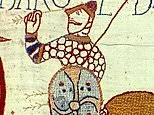
Some experts are certain he did, using a famous scene from the Bayeux Tapestry as evidence.
However, others have poured cold water on the theory, and are adamant that the king's death by arrow is a lie.
Now, as the Bayeux Tapestry goes on display at the British Museum, its curator has settled the debate once and for all.
Professor Michael Lewis, Curator of The Bayeux Tapestry and former Head of Portable Antiquities and Treasure at the British Museum has shot down the theory – and claims the arrow stitching in the scene was 'certainly' added later.
Speaking on BBC Radio 4's Today programme, he explained: 'It was certainly added later, in terms of what we have now.
'The tapestry has been heavily restored in the 19th century, and that arrow in the eye has definitely been added. The question is, was it ever there in the first place?'
It's a question that has been debated by historians for centuries: was Harold II really shot in the eye during the Battle of Hastings?
Now, as the Bayeux Tapestry goes on display at the British Museum, its curator has settled the debate once and for all
The Bayeux Tapestry is a 70–metre–long tapestry that depicts the events leading up to the Battle of Hastings and the Norman Conquest of England in 1066.
One of the most famous scenes shows the moment the Normans killed King Harold.
On the left of the scene you can see a man pulling an arrow from his eye, while on the right, you'll see a man being cut down by a Norman invader on a horse.
Alongside the scene is the phrase 'Harold rex interfectus est', which translates to 'King Harold is killed'.
Scholars have analysed the scene for years, and their theories can largely be split into three groups.