An ambitious mission to reveal the secrets of the least explored planet in the inner solar system is about to arrive at its cosmic destination after a lengthy journey.
The BepiColombo mission, a joint effort between the European Space Agency and the Japan Aerospace Exploration Agency, intends to use two complementary orbiters to reveal insights into how Mercury formed and evolved so close to the sun.
The mission launched on an Ariane 5 rocket from Europe's Spaceport near Kourou, French Guiana, in October 2018. Since then, it has traveled more than 6 billion miles (10 billion kilometers).
BepiColombo is named for Italian engineer and mathematician Giuseppe "Bepi" Colombo, who studied Mercury's peculiar rotation and proposed trajectories that enabled NASA's first flybys of the planet in 1974.
Earth is about 10 times closer to Mercury than it is to Jupiter, but BepiColombo has taken longer to reach the tiny planet than previous missions such as Galileo and Juno heading to the largest planet in our outer solar system.
"You can go faster to Mercury if you take a direct way to it," said Frank Budnik, flight dynamics manager for the BepiColombo mission at the ESA. "But the problem is we want to insert into an orbit with respect to Mercury. You have to bring the spacecraft to the same velocity as Mercury has, and this is a very energy-demanding transfer."
A combination of electric propulsion and gravitational boosts from a total of nine flybys of Earth, Venus and Mercury have aided BepiColombo in reaching the correct velocity on its long cruise.
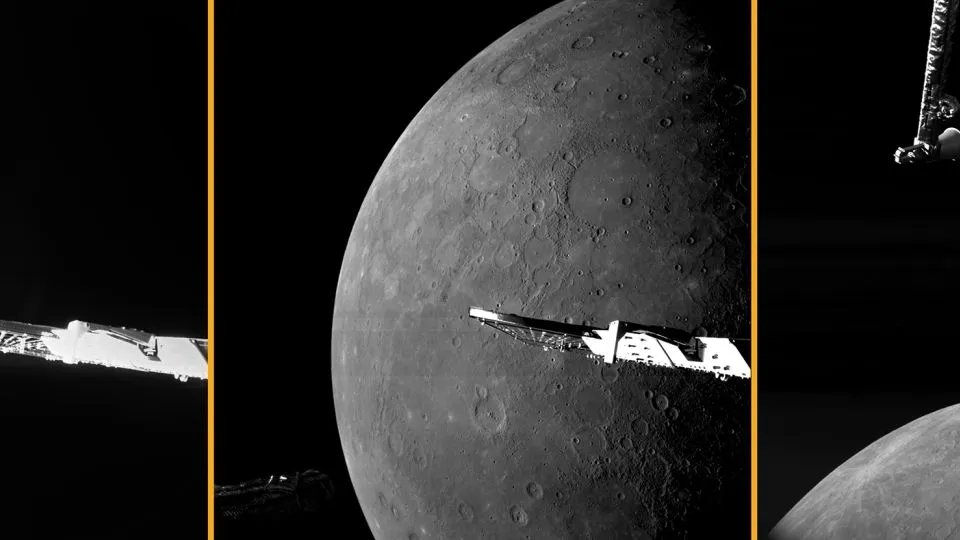
BepiColombo snapped images during its sixth Mercury flyby, used to adjust the spacecraft's velocity, in January 2025. – ESA/BepiColombo/MTM
But the steep challenges for BepiColombo aren't over yet. The Mercury Transfer Module, which has powered the multiyear voyage, will separate from BepiColombo's stack of two science orbiters at 8 a.m. ET Thursday.
The ESA will host a live broadcast beginning at 7:45 a.m. ET Thursday to share milestones of the nail-biting separation, and at 9:53 a.m. ET, the agency will conduct a safety check of the spacecraft to see how BepiColombo has fared so far in its mission.
"The separation of the transfer module will take place in conditions which are exceedingly challenging, and we will have to face a considerable risk that things don't go as planned," said Ignacio Tanco, head of Inner Solar System Mission Operations at the ESA.
"It's going to be equivalent to launching a new spacecraft, only this spacecraft happens to be around a different planet. We are going to see for the first time systems in operation that we have not been able to fully test."
And that's just the beginning of a complex process.
"Unlike in other missions, BepiColombo's arrival doesn't mean a single event," Tanco said. "We have about half a year of intense operations ahead of us."
After nearly eight years, the Mercury Transfer Module (bottom) has finished its part of the mission. – ESA/ATG medialab