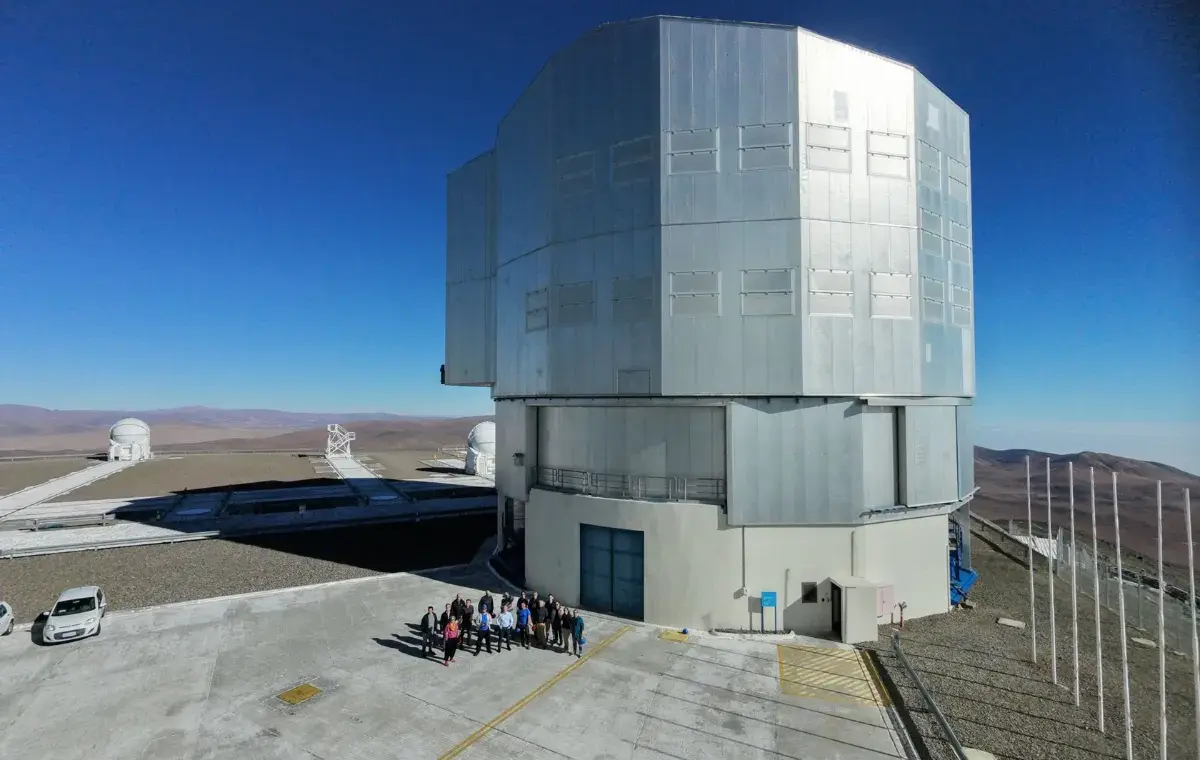
A new cosmic exploration has begun with the first observations from a major astronomy instrument developed in Edinburgh.
The Multi-Object Optical and Near-infrared Spectrograph, known as MOONS, was developed at the UK Astronomy Technology Centre in Edinburgh and has now captured its first observations at the European Southern Observatory’s Very Large Telescope in Chile.
MOONS installed on Unit Telescope 1 at ESOs Paranal Observatory 2. (Image: Supplied)
The instrument will help astronomers map and study millions of stars and galaxies, providing new information about how the Universe has formed and evolved.
MOONS can observe almost 1,000 stars or galaxies at the same time across visible and near-infrared wavelengths.
Rather than producing traditional images, it collects spectra from celestial objects. These detailed measurements of light can reveal information about their chemical composition, temperature, movement and distance.
First Light Target on Sky above ESOs Paranal Observatory. (Image: Supplied)
Its first observation focused on the centre of the Milky Way, demonstrating how its infrared capabilities can see through the thick clouds of cosmic dust that obscure the galaxy’s core.
The technology could open up new opportunities to study the formation and evolution of galaxies, while helping scientists investigate billions of years of cosmic history.
MOONS is the result of more than a decade of international collaboration involving partners across the UK, Italy, France, Portugal, Switzerland and Chile, as well as the European Southern Observatory.
MOONS first light spectra. (Image: ESO, MOONS team)
The instrument operates more than 2,600 metres above sea level and is housed inside a cryostat believed to be the largest ever built for a ground-based telescope.
Its optics are cooled to around -140°C, while its detectors reach approximately -230°C to allow them to detect extremely faint light from distant objects.
A robotic fibre positioning system also places 1,000 optical fibres with micrometre precision, allowing large numbers of targets to be observed simultaneously.
UK's largest escape room opens in Edinburgh with first kids-only venue