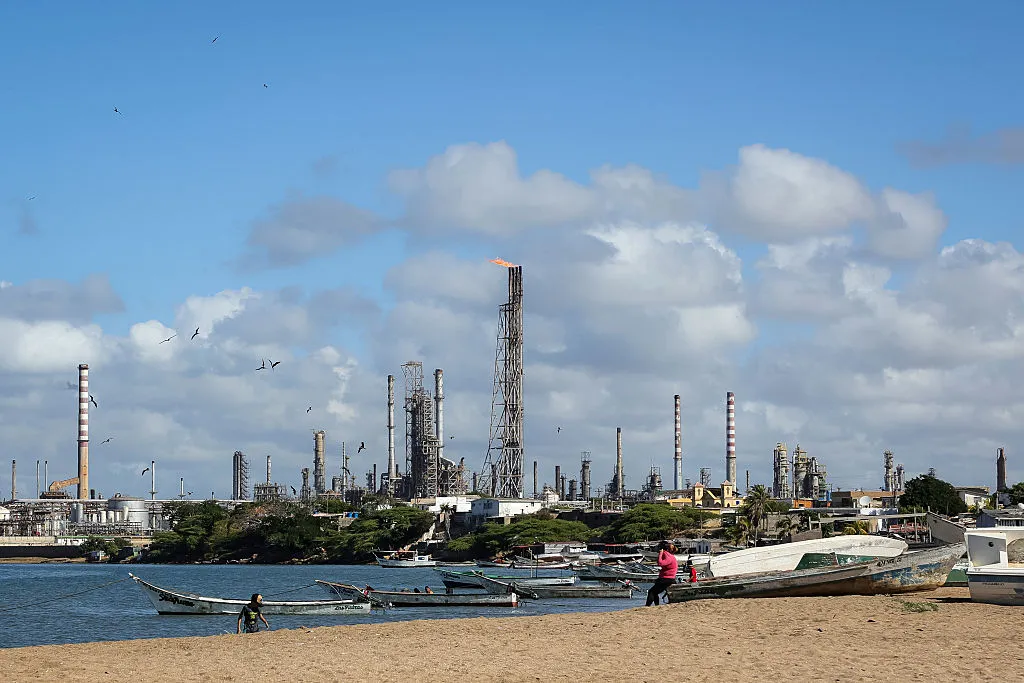
President Donald Trump announced Friday that the United States has entered a “historic” deal with Venezuela, saying that it gives the U.S. majority control over more than 65 billion barrels of oil reserves. Calling it the “BIGGEST OIL DEAL IN WORLD HISTORY” in a post on Truth Social, he said that the agreement would “substantially lower Gas Prices for all Americans.”
The Trump Administration has long expressed an interest in Venezuela, which boasts the world’s largest proven crude-oil reserves as of 2023—approximately 303 billion barrels, according to the U.S. Energy Information Administration (EIA).
But the President did not outline how soon, exactly, Americans can expect to feel relief at the pumps. TIME has reached out to the White House for comment on the expected timeline.
The answer is especially relevant amid the ongoing war with Iran. One of the linchpins of the conflict is a Tehran-imposed blockade on the Strait of Hormuz, through which one-fifth of the world’s oil had previously passed. The move has been consequential for the global economy. In the United States, the national average cost for a gallon of gas is $4.08 as of Saturday, according to the AAA, as compared to $3.20 one year ago.
Secretary of State Marco Rubio called the deal a “huge win” for America in a social media post on Friday, saying that it means “lowering gas prices here at home.”
Any eventual decline in gas prices could provide relief at a time when Americans are already contending with persistent inflation, which was the focus of remarks made by Federal Reserve Chair Kevin Warsh at the Jackson Hole Economic Policy Symposium in Wyoming on Friday.
However, it could be a while before the impact of the new deal with Venezuela is directly felt.
Much of what is known about the deal comes from a statement released on Telegram by acting Venezuelan President Delcy Rodríguez late Friday.
“It provides for the development of 17 strategic fields, with a proven potential of 65 billion barrels of oil, more than $100 billion in investment and more than $209 billion in tax revenue for the state,” the statement said. “These investments will contribute not only to the recovery and modernization of our industry, but also to our country’s economic growth, the energy security of our hemisphere and greater stability in international markets.”
Despite its vast oil reserves, the country only produced about 1.1 million barrels per day in July, according to a secondary-source estimate from the Organization of the Petroleum Exporting Countries.
The EIA has attributed Venezuela’s long-term production decline largely to “government mismanagement, international sanctions, and the country’s economic crisis,” which contributed to “a lack of investment and maintenance in the energy sector and a deteriorating infrastructure.” The agency found that Venezuela’s total energy production declined by an average of 8.2% annually between 2011 and 2021.
“The U.S. deal with Venezuela is very important strategically,” says Claudio Galimberti, the chief economist at Rystad Energy. “The new wave of investments that is about to come to Venezuela as a result of this deal will be crucial to turn around the country's aging oil infrastructure. Venezuela will be able to increase its production at a faster rate and unlock barrels that would otherwise have stayed underground.”
The agreement envisions private operators playing a central role in that effort. Rodríguez’s post explained that the agreement allows Venezuela to increase its oil production “through the participation of private operators,” without further elaboration.
A State Department official tells TIME that Rodríguez has granted a private company, which is “a joint project of the U.S. government and an experienced private operator in Venezuela,” 100-year rights to develop the fields, adding: “This new entity will be the second largest corporate holder of proven reserves after Saudi Aramco.”
The deal would give the U.S. 55% of the new company’s effective output, “split between equity ownership and guaranteed at-cost off-take,” the official says.