Just in case you hadn’t already realised how extraordinary the gigantic group of creatures known as invertebrates are, we’ve gathered together five facts that made our brains hurt (plus one more, because we couldn’t choose). Tell us your favourite extraordinary fact in the comments below
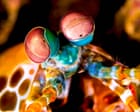
Did you know that the mantis shrimp can accelerate to strike its prey faster than a .22 calibre bullet. They can smash shells, and even crack aquarium glass with the power of the strike. “These impressive animals are armed with one hammer-like dactyl club on each side of its body. These clubs store energy in elastic, spring-like structures, which are held in place by latch-like tendons. When the latch is released, the stored energy, too, is released – propelling the club forward with explosive force,” says Nane Steinhoff.
The movement is so fast that it boils the surrounding water. This creates a cavitation bubble, which collapses, producing a second shock wave. Researchers only discovered recently that the shrimp only survives the blow itself because it has a “phonic shield”, a region of its body that filters out the stress waves.
For years it has been known that spiders can travel many miles by spinning a single strand of web that lifts them up.
Everyone thought they were travelling on the wind – and, yes, that is partly true. But recently Bristol researchers discovered that, in fact, they are using electrical fields for the uplift. “In a sealed chamber box with no air currents, spiders took off when an electric field was present, the repulsion on the charged thread providing the necessary lift. When the electric field was turned off, the spiders came back down. Spiders have tiny hairs called trichobothria that sense electric fields, like human hairs rising in response to static electricity. When a spider senses the field is strong enough, they will climb to a high twig or blade of grass, spin a silken line, and take off.”
Spiders can travel thousands of miles like this: sailors sometimes find them out at sea, riding the breeze.
Paper wasps are capable of a type of logical deduction, which was previously thought to be the reserve of animals with complex nervous systems. A study required wasps in a rectangular arena to choose between two regions, one a “safety zone” and the other that delivered a “slightly unpleasant” shock of 0.4 volts. The researchers painted the two arenas different colours in a strict order, and the wasps were able to infer eventually to a statistically significant degree which colours were more likely to indicate that the region was electrified. As the scientists told the New York Times, the implication was that the wasps “are organizing all those pairs into a linear hierarchy in their head”.
Sea urchins, which are essentially purple blobs with spines, can drill holes into rock with their teeth alone in order to make safer homes for themselves, according to a report in the New Scientist. They “literally eat through stone”, according to the University of Wisconsin-Madison. But, even more peculiar, the teeth never go dull – they are, a study by a UW-Madison professor found, “one of the very few structures in nature that self-sharpen”.
The urchin’s five teeth, which constantly scrape the rock they sit on, producing up to 200 tonnes of sediment per hectare, could one day be used to invent self-sharpening tools.
One invertebrate has shown that it can learn from experience even though it doesn’t actually have a central brain. Caribbean box jellyfish (Tripedalia cystophora) are tiny – about one centimetre in diameter – and swim near the surface of the ocean during the day, while sinking to the bottom at night.
A couple of years ago the New Scientist reported that researchers from Kiel University in Germany had “designed an experimental environment that mimicked the Caribbean box jellyfish’s native mangrove-rich habitat. They placed a fingernail-sized jellyfish in a round tank whose walls were painted with white and grey stripes to resemble the vertical mangrove roots through which the species manoeuvres in the wild.” Amazingly, by the end of the experiment, they had learned something about their tank and “had cut their crashes in half and quadrupled their successful swerves”.
Perhaps most amazingly of all, some fruit flies can be beheaded and still live normally for several days, because they turn out to have mini brains in each joint.
Researchers at the University of Pennsylvania looked into the responses to light of headless fruit flies, preparing CO2-anesthetised fruit flies, and shining a microscopic light on them, to which they squirmed in response. Another study proposed that light responsive cells enable larvae to sense light exposure and move out of danger. The headless flies maintain posture, walk around, entrain new circadian rhythms, and learn to avoid shocks (sometimes even faster than flies with heads). They were even able to fly in some cases.
It’s Invertebrate of the Year again! From 3-12 August, every day we’ll be profiling one of the thousands of amazing invertebrates that our readers have nominated. Then, when you have got to hear about all of them, we will open the voting so you can choose your favourite. Don’t hesitate to get in touch with thoughts and ideas: email us at environment.desk@theguardian.com with Invertebrate in the subject line.