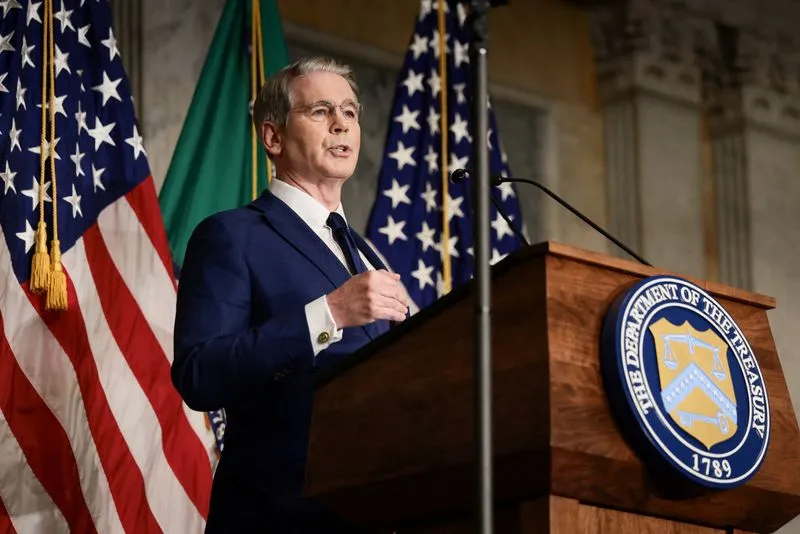
Aug 27 (Reuters) – Treasury Secretary Scott Bessent and Federal Reserve Chairman Kevin Warsh appear at odds over a question at the heart of U.S. financial policy. How hands-off can policymakers be when it comes to setting a price for money?
Warsh has advocated retreating from some of the central bank's longstanding communication policies in favor of letting markets do the heavy lifting, while Bessent has deployed a number of tools, some of them unusual, in the name of aiding market function.
The divide has come into view as the Trump administration steps up efforts to contain long-term borrowing costs — a push whose success appears unlikely to many analysts and portfolio managers without concrete steps to contain the sprawling U.S. fiscal deficit.
That contrast in approaches will come into focus on Friday morning, when Warsh is scheduled to speak at the Fed's annual event in Jackson Hole, Wyoming. He wants bond markets to play a bigger role in setting rates, a stance arguably at odds with Bessent's interventionism. Meanwhile investors are seeking assurance that Warsh will act decisively against inflation in his first year leading a divided Fed.
Bessent said last week Treasury would at least double buybacks of longer-dated debt, arguing that a rise in yields, which pushed 30-year rates to a 19-year high, didn't reflect fundamentals. Investors read it as a sign Washington won't let 10-year yields, which drive mortgage rates, approach 5% unanswered.
Many investors say Bessent is fighting the wrong fight. They say strong growth, sticky inflation, likely Fed hikes and heavy bond supply, including from AI-driven corporate borrowing, are what's pushing yields up, along with a widening fiscal premium tied to the deficit — not market dysfunction.
Billionaire investor Stanley Druckenmiller, a hedge-fund titan and workplace mentor to both men, called the plan "price management" rather than liquidity management and warned it could damage Treasury's credibility.
"There's very little evidence that Treasuries are oversold right now," said Will Compernolle, macro strategist at FHN Financial.
Traders say that pressure will surface elsewhere if bond yields aren't allowed to rise to a market-clearing price — including in a dollar that has slid since Bessent's announcement.
Bessent's strategy appears aimed at easing the economy's interest burden while preserving growth. He says Treasury has a large toolkit, but its influence over long-term yields is constrained by cash management, financing needs and that the U.S. will follow a predictable issuance schedule.
Some investors believe that the tools can't be ignored. Padhraic Garvey, head of global rates and debt strategy at ING, called using unscheduled buybacks a potential "bazooka" that could be expanded and amplify the impact of some Treasury efforts.
Beyond buybacks, Treasury can adjust its borrowing maturity mix and has backed efforts to strengthen banks' capacity to intermediate the Treasury market.
"Treasury can decrease long end auction sizes," said Molly Brooks, U.S. rates strategist at TD Securities. "I think that's probably the next move."
The Fed's instruments are more powerful. It sets short-term rates and can buy or sell securities to shape broader conditions. The twist is that Warsh has said he doesn't want to do that as much as the Fed has in recent years.
Warsh has long criticized the Fed's large-scale asset purchases, arguing such interventions should be reserved for genuine market dysfunction, with rate policy driving the employment and inflation mandates.