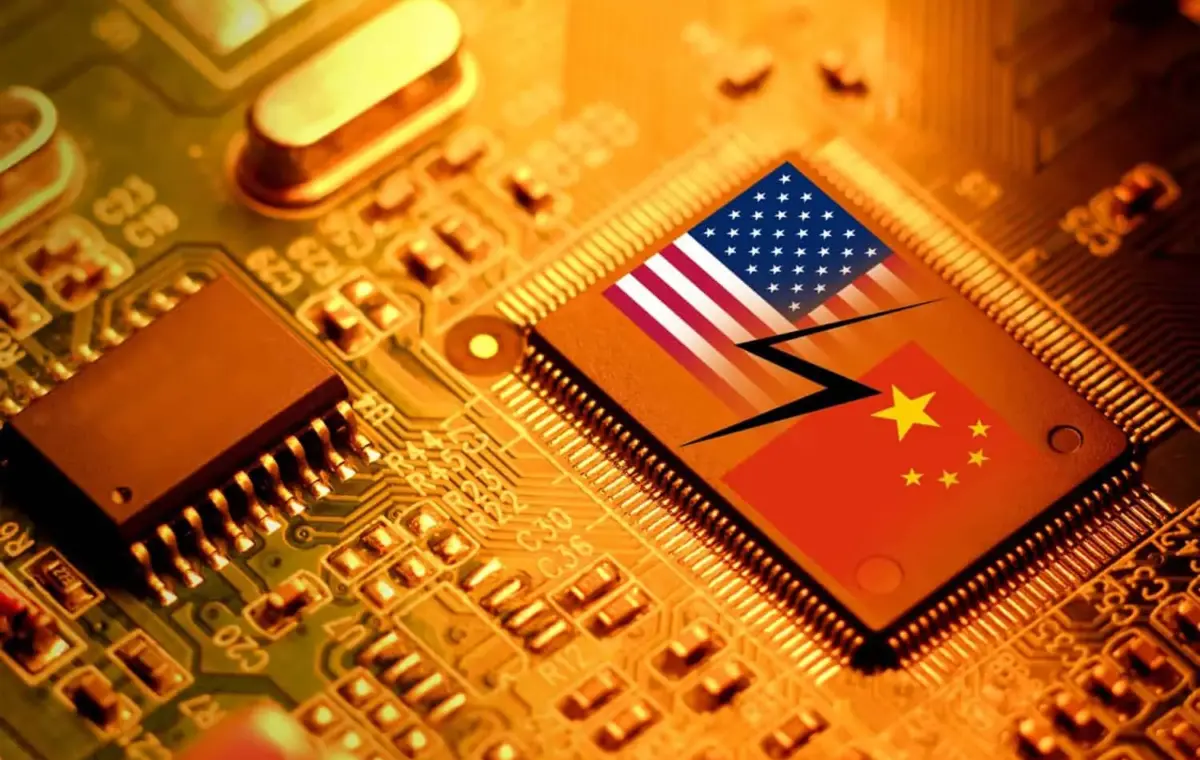
China has directed semiconductor manufacturers to use at least 50% domestically produced equipment when adding new capacity, according to a Reuters report citing people familiar with the policy. Fab projects that fail to meet that threshold are generally denied regulatory approval, although flexibility remains where no suitable Chinese tool is available. The requirement favors domestic equipment suppliers such as Naura Technology and AMEC over foreign companies and provides the context needed to understand China's newly announced immersion deep-ultraviolet lithography systems.
Reports that Shanghai Aishengna Electronic Technology Group has begun producing immersion DUV systems sent shares of ASML Holding (ASML) down sharply and contributed to weakness across semiconductor equipment stocks, including Applied Materials (AMAT). The initial reaction treated the development as evidence that China could begin replacing Western equipment across its semiconductor industry. That conclusion is directionally understandable, but the immediate effect on Applied Materials is being overstated.
Applied Materials does not manufacture lithography systems. A Chinese immersion DUV machine competes directly with ASML, not with Applied Materials' deposition, etch, thermal-processing, metrology, inspection and advanced-packaging systems. The greater risk is indirect and longer term: if domestic lithography becomes commercially usable, it fills one of the largest remaining holes in China's equipment supply chain and allows Chinese fabs to build production lines containing a higher percentage of domestic deposition, etch, cleaning and chemical mechanical planarization equipment.
For investors, the distinction matters. Five unproven Chinese DUV systems will not materially change Applied Materials' earnings in 2026. But the combination of China's 50% domestic-equipment requirement, rapidly growing local equipment companies, and expanding fabs at CXMT, SMIC and Hua Hong could reduce Applied Materials' addressable market in China over several years.
Applied Materials generated $2.095 billion from China during its fiscal first quarter of 2026, representing 29.9% of total company revenue. China remained the company's largest individual geographic market even though revenue declined 6.6% from $2.243 billion one year earlier.
Act now: the analyst who called NVIDIA in 2010 just named his top 10 AI stocks — and ASML didn't make the cut. Grab the names FREE today.
China exposure held close to that level in fiscal Q2: reported China revenue was $2.087 billion, or 26.4% of the quarter's $7.910 billion total. Across the first half of fiscal 2026, China generated $4.182 billion of Applied Materials' $14.922 billion in revenue — 28.0% of the total (Table 1).
These figures do not mean that all $2.087 billion of quarterly China revenue is threatened by CXMT or Chinese DUV. U.S. controls already restrict exports of specified semiconductor manufacturing equipment used to produce advanced chips in China. The thresholds include logic at 16/14nm or below, DRAM at 18nm calculated half-pitch or below, and advanced NAND.
Applied Materials' remaining China revenue therefore includes portions of the market it can still legally serve: qualifying mature-node fabs, specialty devices, packaging, display-related manufacturing, services and unrestricted customers. Its current China business should not be confused with the advanced memory and logic opportunities from which the company has already been partially excluded — exclusions that carry a real, quantified cost. Applied Materials has guided to roughly a $600 million revenue headwind in fiscal 2026 from expanded U.S. export restrictions, including $110 million in the fiscal fourth quarter alone.
China's domestic-equipment policy layers a second risk on top of that sanctions-driven one. Chinese fabs are being encouraged to buy local equipment even in markets where foreign tools remain legally available, putting Applied Materials' permitted China business under competitive pressure while it is simultaneously locked out of the country's most advanced capacity additions.
China's domestic equipment industry is no longer a collection of small development programs. Naura supplies deposition, etch, furnaces, rapid thermal processing and other systems. AMEC competes in etch and deposition. Piotech participates in deposition, while Hwatsing Technology supplies CMP equipment. ACM Research (ACMR), through its large Chinese operating presence, supplies wet cleaning, plating, furnace and packaging systems, although its U.S. headquarters and dual corporate structure distinguish it from purely domestic companies such as Naura and AMEC.
Combined sales from six major Chinese semiconductor equipment suppliers increased from $748 million in 2020 to $7.608 billion in 2025 — more than a tenfold increase in five years. Their adjusted worldwide WFE share rose from 1.2% to 6.5% over the same period. These companies collectively grew sales 29.9% in 2025, led by Piotech, AMEC and Hwatsing (Table 2).
Chinese equipment companies do not need to replace Applied Materials worldwide to affect its financial performance — they only need to gain share inside China, where Applied Materials still produces more than a quarter of its revenue. The 50% domestic-equipment requirement gives them a protected qualification environment, while U.S. export controls limit the foreign competition they face at advanced Chinese fabs.
Domestic DUV can accelerate this process even if the scanners initially perform far below ASML's systems. Lithography has remained one of the largest weaknesses in China's equipment ecosystem. Progress there makes it easier to assemble a complete Chinese production line rather than pairing Chinese deposition and etch systems with imported ASML scanners.
Shanghai Aishengna is reportedly targeting approximately five immersion DUV systems in 2026 and 20 in 2027. Initial deliveries are expected to go to SMIC, Hua Hong and CXMT. By comparison, ASML shipped 131 immersion DUV systems in 2025.