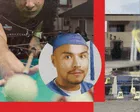
‘A child isn’t born to commit gun violence,’ Francisco Villarruel says
Francisco Villarruel and Gustavo Galvez sat in a park in Los Angeles reminiscing on their first boxing lesson together. They had gone to a big commercial gym, where they took turns hitting boxing pads and doing footwork exercises. They then started regularly training together.
For Villarruel, 40, working out together wasn’t really about boxing. It was about giving Galvez, 19, an opportunity to open up and to mentor someone whose pain he understands. “ I think a lot of the traumatic scenarios that he went through are very similar to mine in my upbringing,” Villarruel said.
Like Villarruel, Galvez grew up surrounded by gangs. He lost friends and classmates to gang-related gun violence, making him fear that he too would face a similar end. “Every day I think it’s my last day [on earth],” Galvez said. “Sometimes I still expect to be killed due to gun violence, even though I’m doing all these good things for myself.”
Thousands of Hispanic people in California are injured by guns each year, according to data from the state’s department of public health. Last year, half of the state’s 1,374 homicide victims were Hispanic. For many, shootings are the beginning of a cycle of violence; people who are victims of violent crime then become more susceptible to perpetrating violence themselves.
It’s one reason why mentoring – often through boxing lessons – has become part of Villarruel’s weekly routine. For years he worked with organizations in Los Angeles that help people recently released from prison reintegrate into society, and now, as a trained social worker, he’s built a name for himself as someone to call when a young gang member or a young person victimized by gang violence needs help. He doesn’t get paid for this work. But he says it’s important because he wants to help others break out of the cycle by unpacking the trauma that often steers them towards violence in the first place.
“ If a gang member commits a shooting in a community, how many generations will that affect?” Villarruel asked. “ If we’re going to find a way to subside that, intergenerational trauma definitely has to be addressed.”
Even before he was born, Villarruel’s life was shaped by gun violence. Villarruel’s father – also named Francisco – was a teenager during the Watts rebellion, the 1965 protests over police brutality in Los Angeles that escalated into days of rioting. The way the younger Francisco tells it, his family owned a bakery, and as rioters approached, his father and grandfather fired on them in a desperate attempt to defend their property. Rioters ultimately set the bakery on fire. These events had a profound impact on his family, Villarruel said; his father would later teach him that he could be hurt or killed if he failed to watch out for danger.
The first time Villarruel himself encountered a gun was when he was nine. He and his father were at a store when two robbers held them at gunpoint. The fear and helplessness he felt in that moment grew into trauma when his brother-in-law was shot and killed by gang rivals three years later. The thought of being killed like his brother-in-law hardened his resolve to be the one holding the gun.
Villarruel joined a gang as a teenager, and at 15 he went to juvenile hall for two years for gun possession and drug dealing. Not long after being released, he was sentenced to life in prison for kidnapping, carjacking and the use of a firearm. He served 17 years before being paroled in 2019. Villarruel said he wasn’t present at the scene of the crime, but under California law, gang members could be arrested and convicted for gang affiliation.
Villarruel recently told some of these stories at a gang rehabilitation workshop in Inglewood. The purpose of sharing his trauma, he says, is to help people understand the role it plays in community violence, and that gang members often turn to violence out of a lack of safety, belonging and self-esteem.
“A child isn’t born to commit gun violence,” he said.
Alein Haro-Ramos, an associate professor of public health at the University of California, Irvine, studies the link between early-life stressors and physical and mental health outcomes among Latinos in the US. Trauma, she said, can be passed down through parenting under stress created by community violence, economic distress and systemic neglect. While many different communities struggle with trauma that persists across multiple generations, this kind of reoccurring pain often happens amid a backdrop of inequality. Almost half of all Latino youths in major cities live less than a mile from where a gun homicide occurs, and these homicides in the US are clustered within certain census tracts marked by poverty and racial segregation.
While Villarruel fell into a common cycle of violence, he also figured out how to break it. When he was 25, he was alone in his cell and thought about how he might die in prison and never see his family again. “ It took that moment for me to question myself and question what I have been doing,” Villarruel said.
He left gang life behind at 30, became Christian and started therapy. He earned his GED in prison, enrolled in community college, earning his associates and bachelor’s degrees post-release. He also earned a master’s in social work from UCLA.