Published
Aug 25, 2026 8:53 AM EDT
Get the Popular Science daily newsletter💡
Breakthroughs, discoveries, and DIY tips sent six days a week.
On January 23, 1973, the 5,000 residents of the tiny Icelandic island of Heimaey—located in the Westman archipelago just four miles off Iceland’s southern coast—woke up to the Earth splitting open. In the dead of night, a mile-long volcanic fissure ripped through the ground just a half-mile from the town of Vestmannaeyjar, marking the birth of a new volcano named Eldfell.
Fountains of molten basaltic lava shot hundreds of feet into the sky, raining ash and glowing, golf-ball-sized rocks onto rooftops. Within hours, a makeshift fleet of local fishing boats evacuated almost the entire population to the mainland. The people were safe, but their town faced an existential threat.
The threat went far beyond a local crisis. Not only were the townspeople of Vestmannaeyjar completely reliant on the harbor, but all of Iceland depended on this tiny island’s fishing industry for a massive chunk of its exports. If the advancing lava choked off that narrow bay, it would deal a devastating blow to the entire nation’s economy.
As the lava advanced, Icelandic physicist Thorbjörn Sigurgeirsson proposed a radical idea. What if they just froze it? It sounded crazy, but basaltic lava offered a tiny loophole. While it erupted at a scorching 2,000 degrees Fahrenheit, it crawled forward relatively slowly. Sigurgeirsson hoped that if islanders sprayed enough cold seawater onto the leading edge, they could crust it over and stop its advancement.
Standing in the path of an eruption, though, is a daunting physics problem. The frozen artificial shell would act as a natural dam, forcing the liquid fire churning behind it to stall, stack up, or divert away from the harbor. The lava wasn’t just hot; it was a wall of rock weighing millions of tons that would bulldoze standard barriers like toothpicks. So they improvised. Local firemen dragged hoses to the edge of the crunching, glowing mass. They started spraying ice cold Atlantic ocean water on February 7—two weeks after the eruption.
The heat was so intense it singed their eyebrows, and the water instantly flashed into blinding clouds of steam and toxic gas. But it worked. The edge of the flow was slowed.
Realizing they had proof of concept, the Icelandic government went all in, urgently requesting heavy-duty pumps from the United States. On March 26, 1973, the first shipment of 32 high-capacity pumps touched down.
Before the pumps arrived, the islanders’ local gear could only manage 100 liters of water per second—not nearly enough pressure to reach the top of the steep, 100-foot-tall lava walls. Powered by the American diesel pumps, the new system unleashed a torrent of 1,000 liters of water per second through miles of heavy piping and hoses, carrying seawater all the way up the steep slopes to douse the top of the flow.
As the lava moved forward, its outer layers cooled and stacked up into an enormous wall of solidifying rock, driven forward by the liquid fire churning inside. Because standard barriers would crumble under that massive weight, cooling the outer shell with seawater was the only way to build a wall strong enough to stop it. Deployed right at Básakers Wharf, the massive American diesel engines vastly increased their output.
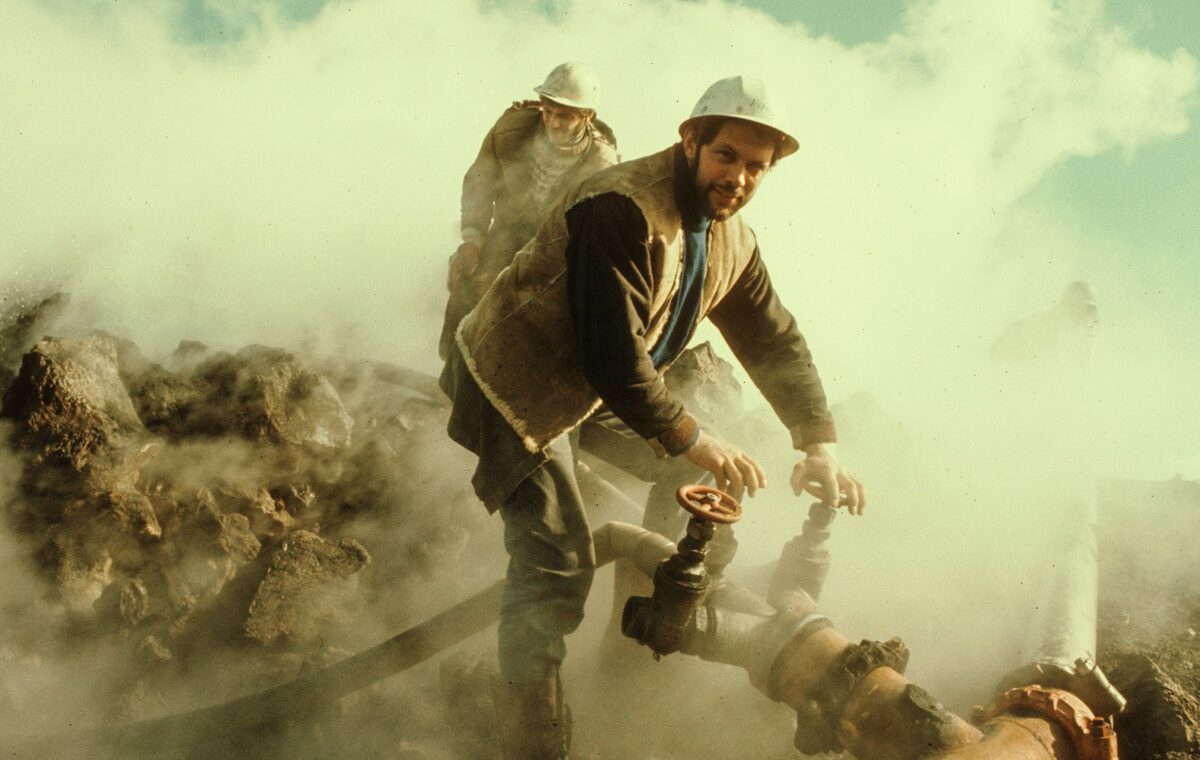
By March, the rescue effort had turned into a surreal, industrial battlefield. Teams of local volunteers, who grimly nicknamed themselves the “Suicide Squad,” took on the most terrifying job. They hiked directly onto the moving crust of the active Eldfell flow to lay miles of plastic pipeline, extending the water system right to the edge of the molten rock where fire hoses could douse the advancing front.
The scene was apocalyptic. The crust they stood on was often only a few inches thick. If someone stood still for too long, the rubber soles of their boots melted. If water stopped flowing through a pipe for even a second, the trapped water would flash-boil and explode.
Surrounded by choking sulfur gas and whiteout steam, the Suicide Squad and engineering crews pumped about 7.3 billion gallons of seawater over five months. It was a filthy, grueling slog, but the makeshift barrier held.