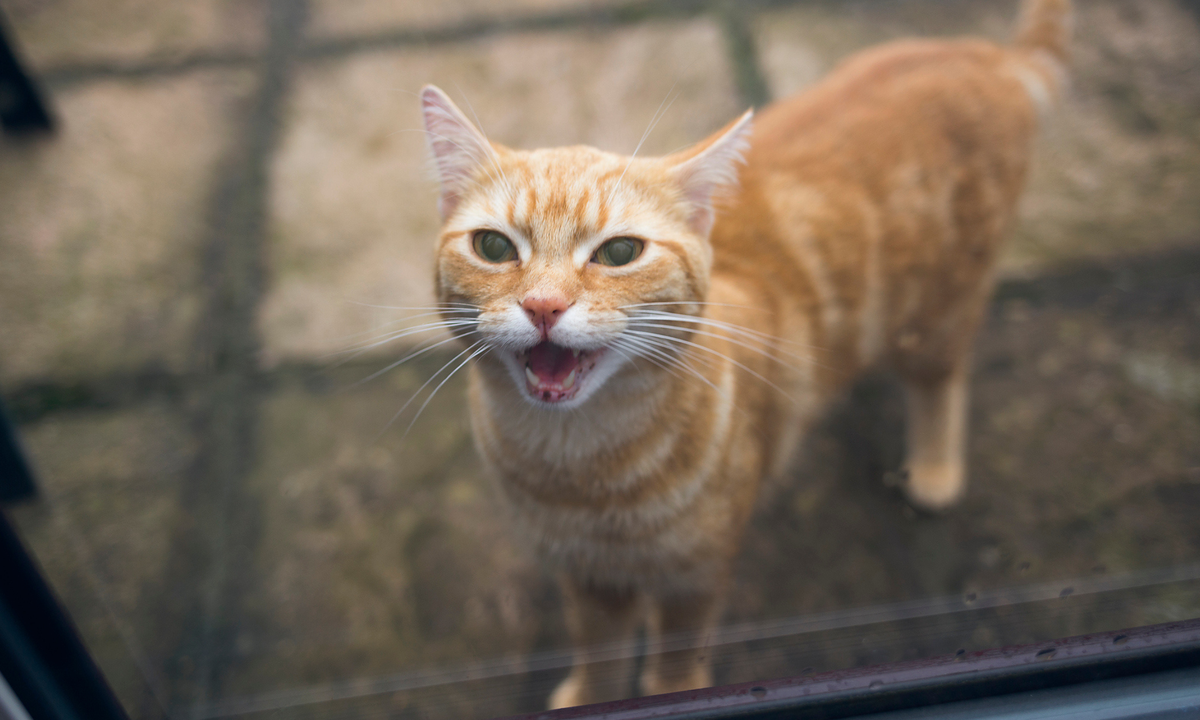
Understanding a cat’s yowl requires looking beyond the noise to the behavior and emotions behind it.
When you purchase through links on our site, we may earn an affiliate commission. Here’s how it works.
If you've ever been jolted awake by your cat letting out a long, mournful cry in the middle of the night, your sleep-deprived brain may wonder why, exactly, your cute little pet yowls all the time.
The answer isn't as simple as "they want food" or "they're being dramatic." The sound people commonly call a yowl can actually mean very different things depending on the situation, and even cat behavior experts don't always agree on exactly what qualifies as a yowl.
In veterinary medicine, the term often refers to loud, harsh vocalizations associated with aggression or mating between cats. But many pet owners use "yowling" to describe almost any loud cry their cat makes at home, she said.
That distinction matters, because context is often the biggest clue to what a cat is trying to communicate.
"If you're talking about a yowl in the strict sense, it's usually linked to a strong negative emotional state," said Charlotte de Mouzon, a cat behavior researcher and ethologist at Paris Nanterre University in France. "It represents an emotion that is intense and negative."
In other words, a true yowl is less like casual conversation and more like an emotional alarm bell.
That alarm bell may be older than the house cat (Felis catus) itself and likely predates domestication entirely, said Jay Schwartz, a professor of psychological sciences and head of the Evolution of Emotional Communication Lab at Western Oregon University.
The same vocalization shows up in the African wildcat (Felis lybica), the domestic cat's closest living relative that has been around far longer than our living room tigers — meaning cats were yowling at rivals long before they ever curled up on a human's couch, he told Live Science in an email.
Territorial vocalization of this kind is common across the animal kingdom, from a chickadee's warning whistle to a howler monkey's booming roar, Schwartz said. Establishing and defending territory is tied to food, safety and mating opportunities, so animals evolved loud, unmistakable signals to defend it without resorting to physical fights every time.
A yowling cat squaring off with a neighborhood rival, in other words, is running a very old evolutionary script.
Cats may yowl in altercations with other cats.
Beyond territory, cats may yowl when they're frightened, cornered or trying to make another animal, or person, back off.
"If someone approaches a cat that's yowling, I would think that cat is saying, 'Please don't come any closer,'" said Katherine Anderson, a board-certified veterinary behaviorist at the Cornell Duffield Institute for Animal Behavior at Cornell University.