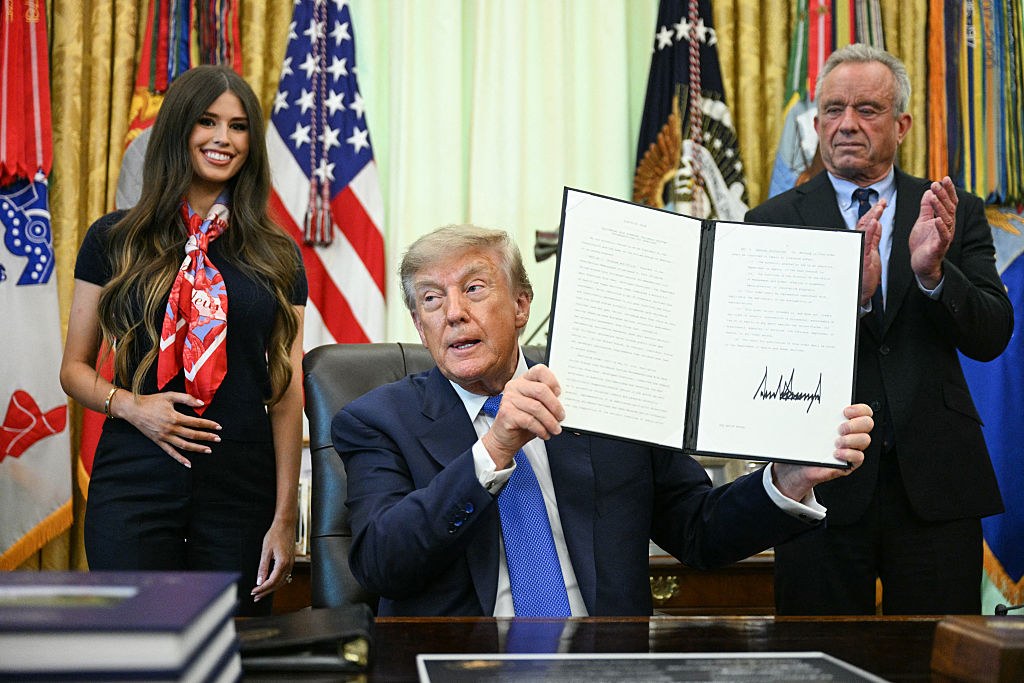
President Donald Trump has again taken aim at vaccines—this time in a new executive order. The directive, which Trump signed in the Oval Office on Aug. 10, calls for U.S. children to receive fewer vaccines and urges states to reconsider which vaccines they require for school attendance.
It also directs the U.S. Department of Justice (DOJ) to sue states that fail to provide religious and medical exemptions for mandated vaccines and orders the measles, mumps and rubella (MMR) shot—a combination vaccine that has been in use for more than 50 years—to be split into three separate jabs. “Today we’re proud to officially announce the United States of America’s gold-standard childhood vaccination recommendations,” Trump said during the signing ceremony.
Doctors and vaccine scientists have expressed dismay at the order, which they say is not backed by gold-standard science. "As measles cases reach a 35-year high in the U.S. and with cold and flu season quickly approaching, [the] executive order on vaccines is not only disheartening but dangerous,” Dr. Andrew Racine, president of the American Academy of Pediatrics (AAP), said in a statement. “There is no new evidence to justify significant changes to childhood immunization guidance.”
But will the executive order actually change what vaccines are available to children? Probably not, legal scholars and medical experts say.
Still, it could put pressure on states to change their vaccine recommendations and requirements. It could also have a chilling effect on vaccine uptake. “This is going to create confusion and chaos,” says Dr. Paul Offit, a pediatrician and director of the Vaccine Education Center at the Children's Hospital of Philadelphia.
The executive order calls for a significant overhaul of the federal childhood immunization schedule—the timeline of recommended vaccines for children and teens that influences insurance coverage guidelines, informs state-level school vaccine requirements, and guides clinical practice. But the order shouldn’t have the legal power to make those changes, says Dorit Reiss, a vaccine policy expert at the University of California College of the Law, San Francisco.
Executive orders are a way for presidents to communicate with federal agencies. They can instruct agencies on how to enforce existing laws, but they aren’t laws themselves, Reiss says.
Federal vaccine recommendations are also developed through a separate legal process, never by executive order.
Instead, it is the U.S. Centers for Disease Control and Prevention (CDC), following input from the Advisory Committee on Immunization Practices (ACIP), that determines the childhood immunization schedule.
In January, the CDC, prompted by an earlier presidential memorandum and under direction from U.S. Health and Human Services Secretary Robert F. Kennedy Jr., attempted to revise the childhood immunization schedule. The updated schedule reduced the number of routinely recommended childhood vaccinations from 17 to 11. The six vaccines no longer recommended to all children were for COVID-19, seasonal flu, hepatitis A, hepatitis B, respiratory syncytial virus (RSV), and rotavirus. The six vaccines were only recommended for children at high risk for the respective diseases, the guidelines said. Parents, however, could decide, after consultation with doctors about the benefits and risks of the vaccines, to inoculate their children against any of the six diseases.
A federal judge blocked the CDC’s schedule overhaul, which had been done without consulting ACIP, in March. The judge said it was unlawful for the CDC to unilaterally make those changes without ACIP’s involvement.
Trump in his new executive order called for similar changes to the childhood immunization schedule that the CDC tried to implement, and said he was “taking further action to reaffirm” the changes to the schedule in light of the ongoing litigation.
The CDC’s new director, Dr. Erica Schwartz, could face pressure to act on Trump’s executive order, Reiss says. Schwartz said in her Senate confirmation hearing that she believes in the safety and effectiveness of vaccines, though she wouldn’t commit to standing up to the president or Kennedy if she disagreed with them.
If Schwartz and the CDC attempt to change the schedule again, however, they will likely face similar legal challenges as before since the proper legal process again wasn’t followed, Reiss says.
“The executive order doesn’t have the rule of law behind it,” says Offit. “Nothing will come of this.”