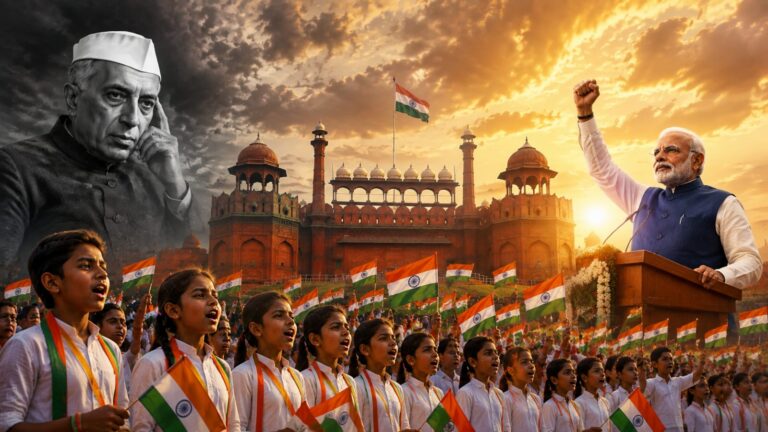
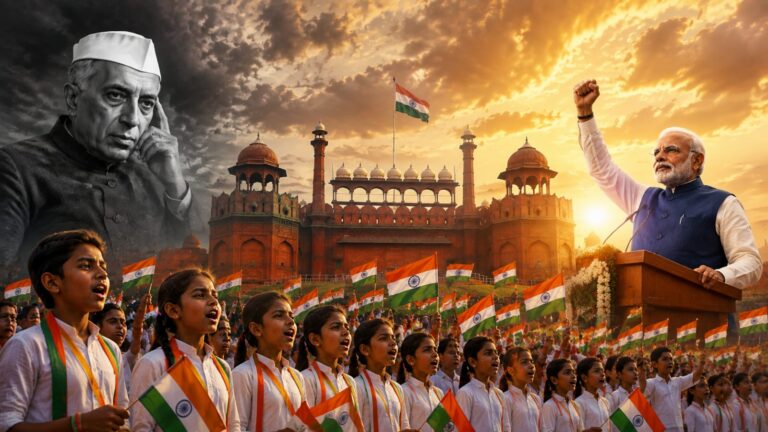
On one hand, while the country is celebrating the 150th anniversary of this timeless creation and the central Modi government is giving it respect equivalent to the national anthem and encouraging the collective singing of all its verses from the Red Fort to the entire country, on the other hand, the attitude of the Congress party remains the same today as it was during the freedom struggle.
This character of Congress has not changed even after decades. Whenever there is talk of singing Vande Mataram in its entirety or honouring it, Congress and its appeasement-driven allied parties stand in opposition.
The opposition that recently surfaced from Kerala has once again proven the extent to which hatred is filled within Congress leaders regarding the national song Vande Mataram, where its leaders are not hesitating to say that even if they are shot, they will not sing the full Vande Mataram.
The Full ‘Vande Mataram’ will resonate from the Red Fort, but fierce opposition from Congress in Kerala
On the historic occasion of India’s 80th Independence Day (15 August 2026), an unprecedented scene is going to be witnessed.
As part of the 80th Independence Day celebrations, for the first time ever, the National Song 'Vande Mataram' would be sung from the ramparts of Red Fort: Defence Ministry pic.twitter.com/tWNYJrdnho
— ANI (@ANI) August 10, 2026
According to information provided by the Ministry of Defence, for the first time in history, all the verses of the entire Vande Mataram will be sung upon the Prime Minister’s arrival at the ramparts of the Red Fort.
This year, the main theme of the Independence Day celebrations has been kept as ‘150 Years of Vande Mataram’ and ‘Youth Power for Developed India@2047’. Under this, as per the guidelines of the Ministry of Home Affairs protocol and the National Implementation Committee, the collective singing of all 6 verses of the national song is being ensured across the country.
Even on the invitation cards, its complete lyrics have been printed so that all citizens can sing along. But while the entire country is ready to witness this historic moment, the UDF-supported politics of Kerala and Congress leaders have opened a front against it.
Controversy erupted after Kerala Chief Secretary Vishwanath Sinha issued a circular on August 6, giving administrative instructions to sing Vande Mataram completely during Independence Day programs.
As soon as this directive came, panic spread between both the ruling party and the opposition in Kerala. Kerala Health Minister K Muraleedharan explicitly stated that all verses of the national song would not be sung during government programs in the state and only the traditionally sung initial two verses would be performed.
Going even further, senior Congress MP Rajmohan Unnithan made a controversial statement, saying, “We cannot accept the full singing of Vande Mataram in this lifetime. Even if Narendra Modi threatens to shoot us, ‘Vande Mataram’ will not be sung in full.”
He went on to allege that the Governor and Raj Bhavan are indulging in politics to weaken democracy. This entire sequence of events has exposed that for the Congress government and its leaders, the full singing of the national song is not an administrative directive, but an issue against which they are ready to go to any extent to oppose.
Why is there a problem with the final verses?
Opposition to the full singing of Vande Mataram is not new; rather, a long history of appeasement is hidden behind it. In the first two verses of Vande Mataram, the natural beauty of the land of India- Sasya Shyamalam, Malayaja Sheetalam, Sujalam, Sufalam- is venerated, to which no one has an objection.
The problem for opponents begins from the subsequent verses. In the later verses, Bankim Chandra Chattopadhyay depicted Bharat Mata as Durga, Lakshmi, and Saraswati and invoked the motherland as the power of Goddess Durga holding Shashtra in ten hands (Dasha Praharana Dharini).
In Kerala, the stand of Congress, CPI(M), and their political ally Indian Union Muslim League has always been that the latter parts include invocations, symbols, and religious imagery related to Hindu deities.
They have argued that in a secular state, verses containing such religious symbols should not be made part of official national singing. In reality, this opposition is not ideological but purely the mathematics of vote bank and appeasement.
To please Muslim fundamentalists, Congress and its leftist allies always crafted a narrative that the latter lines are against the principle of ‘Monotheism’ (one God).
Under the pressure of this Muslim League and fundamentalist vote bank, the UDF and Congress politics led by VD Satheesan appear subdued even today. CPI(M) and Pinarayi Vijayan also immediately started politics over this and accused the government of bowing down to the Sangh Parivar’s political agenda.
It is the result of this appeasement politics that advocating for pruning and making the country’s national song incomplete is being done openly by Congress even today.
Bankim Chandra’s timeless creation and Vande Mataram’s contribution to the freedom struggle
Vande Mataram is not merely a song; it is the life force of India’s freedom movement and the immortal voice of patriotism that ignited the flame of revolution in the hearts of crores of Indians.
This timeless creation was composed by Bankim Chandra Chattopadhyay on 7 November 1875 and was later included in his famous novel ‘Anandamath’. The time this song was composed was when British rule was expanding its roots in India and Indians were being pressured to sing the British national anthem ‘God Save the Queen’.
Bankim Chandra composed Vande Mataram, proclaiming the sovereignty and power of his motherland as a response to this colonial cultural imposition by British rule. Composed 150 years ago, this song united the entire country in no time.
In 1896, at the Calcutta session of the Indian National Congress, Gurudev Rabindranath Tagore himself set it to tune and sang it for the first time. After this, during the Partition of Bengal (1905), it became the biggest slogan and symbol of Indian resistance against the British.
During the freedom struggle, from heroines like Matangini Hazra to revolutionaries like Bhagat Singh, Rajguru, and Sukhdev, countless revolutionaries chanted Vande Mataram while facing British police batons and kissing the gallows.
This song became a symbol of India’s national unity, pride, and self-respect against colonial slavery. But the same song that inspired lakhs of youth to sacrifice themselves for the freedom of Mother India is being rejected by Congress leaders today.
Nehru and Congress’s hatred: How the National Song was made incomplete
This hateful and compromising character of Congress regarding Vande Mataram is not new, but its roots are hidden in the historical blunders of Jawaharlal Nehru and the then Congress leadership.
In 1937, when provincial elections were held in the country and Congress governments were formed in several states, the Muslim League and Muhammad Ali Jinnah raised strong objections to the singing of Vande Mataram.
In the pursuit of appeasing Jinnah and placating the Muslim League, Jawaharlal Nehru and the Congress leadership made a severe compromise with the national song.
At the 1937 Kolkata session, under the presidency of Nehru, the Congress passed a resolution to accept only the first two verses of Vande Mataram and to remove the remaining verses from official programs.
The logic given was that the later verses mention Hindu deities, which could hurt the sentiments of non-Hindus. This was the biggest beginning of appeasement politics in India’s freedom movement.
Moving forward, when it came to choosing the national anthem in the Constituent Assembly, Jawaharlal Nehru flatly refused to make Vande Mataram the national anthem.
He argued that the tune of Vande Mataram was not such that it could be played on a band or presented internationally as a national anthem. The song that had united the country in the freedom struggle could not get the status of the main national anthem due to this attitude of Nehru and the Congress, and it was cut down and limited to just two lines.
Dr Rajendra Prasad’s vision and Modi government’s Historic initiative
Contrary to this attitude of the Congress, India’s first President, Dr Rajendra Prasad, was the biggest proponent of full honour for Vande Mataram.
On 24 January 1950, the final day of the Constituent Assembly, Dr Rajendra Prasad made a historic statement clearly declaring that while ‘Jana Gana Mana’ would be the National Anthem of India, ‘Vande Mataram’, which played a historic role in the freedom struggle, would also be given equal status and honour as ‘Jana Gana Mana’.
However, subsequent Congress governments put this sentiment and order of Dr Rajendra Prasad on the back burner. For decades, Vande Mataram remained neglected, and controversies continued to be raised regarding its singing.
Years later, the central government led by Prime Minister Narendra Modi resolved to bring Dr Rajendra Prasad’s vision into reality on the ground. On the occasion of the national song completing 150 years, the Modi government decided to organise a special 10-hour discussion in Parliament on its history, significance, and contribution, where Prime Minister Modi himself initiated the debate.
Not only this, the central government brought ‘The Prevention of Insults to National Honour (Amendment) Bill, 2026’ in Parliament, which has been passed by the Rajya Sabha. Through this bill, Vande Mataram has been given legal and constitutional status equal to the national anthem.
Now, insulting Vande Mataram or creating an obstacle in its singing will be considered a serious criminal offence, providing for a jail term of up to 3 years and a fine.
Congress’s hateful attitude being exposed even today
Today, as the country celebrates the 80th anniversary of its independence and 150 years of Vande Mataram, the difference between nationalism and appeasement stands fully exposed.
On one hand, the current Modi government is committed to restoring lost constitutional honour to national symbols, the sacrifices of freedom fighters, and the sacred hymn Vande Mataram; on the other hand, Congress continues on its old path of appeasement.
The statement of the Congress MP in Kerala saying ‘Shoot us, but we will not sing the full Vande Mataram’ is not an accidental remark.
It is an extension of that decades-old mindset of Congress where vote bank politics is placed above national pride and respect for the national song.
The cycle of neglect and truncation towards Vande Mataram that started with Jawaharlal Nehru continues even in the era of Rahul Gandhi and his associates today.
This clearly proves that years passed, decades passed, power equations changed, but the character of Congress did not change. The Congress still harbours hatred for the national song that shook the foundations of the British during the freedom struggle.
While the echoing of the full Vande Mataram from the Red Fort is a symbol of self-respect and national renaissance for 140 crore Indians, the opposition to it by Congress proves that for them, the agenda of appeasement remains greater than the national interest even today.