Find this story in your account’s ‘Saved for Later’ section.
Spoilers ahead for the second season of X-Men ’97, the season finale of which, “Survival of the Fittest,” premiered on Disney+ on August 12.
In keeping with its origins in comic-book storytelling, where no absence is ever really permanent, X-Men ’97 has a flexible relationship with death. The first season began with X-Men leader Professor Charles Xavier presumed dead after one too many assassination attempts caused him to leave the planet; in fact, Charles was living among the Shi’ar alien race and engaged to a Shi’ar empress, and when her family demanded he wipe his memories of Earth, he refused and returned to his home planet to continue fighting for equality between mutants and humans. Gambit seemed very dead after season one’s genocide in mutant nation Genosha, but then in season two he was reanimated into an evil version of himself possessed by the mutant tyrant Apocalypse, before finally being saved by and reunited with the X-Men. Rogue chose to sacrifice herself to the celestial being Eson to revive Gambit, but in the final moments of season-two finale “Survival of the Fittest,” she realizes Nightcrawler took her place, willingly dying so that Gambit instead could live. In this universe, anything that’s been done can be undone, which is why it’s a safe bet Nightcrawler’s (notably off-screen) sacrifice will be somehow reversed in the already-confirmed third season. And while we’re reviving presumed-dead characters, I’m officially submitting my request that X-Men ’97 use its resurrection magic — or ghosts, or hallucinations, or whatever, I am fine with any option — to bring back Magneto.
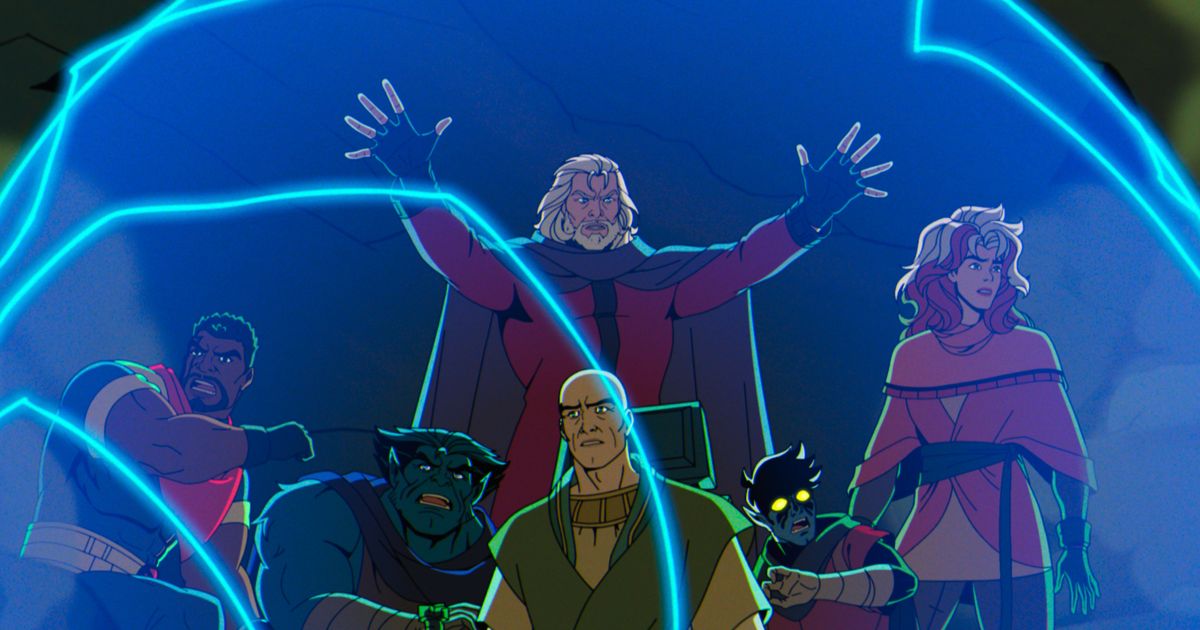
X-Men ’97’s second season was in purposeful conversation with previous plot points, either revealing new facets of them that audiences didn’t know, switching characters’ loyalties, or just flat out undoing them, like Gambit being brought back to life thanks to Rogue and Nightcrawler’s sacrifices. It’s great that Gambit can once again sling playing cards and drawl in that Cajun accent, but what about Magneto, who died early in season two? Can X-Men ’97 engineer a situation in which he rises again, too? The series is at its most complex and multifaceted when Charles and Erik “Magnus” Lehnsherr are both present in the narrative, representing different perspectives and moving between alliance and enmity. Without their dual presence, X-Men ’97 doesn’t feel fully itself.
X-Men ’97 has set up a world in which the decades-long friendship between Charles (voiced by Ross Marquand) and Erik (voiced by Matthew Waterson) is complicated — but no longer totally derailed — by their contrasting opinions on how mutants should interact with humans. This series is most complete with both of them as ideological guardrails, which is why its first season was such a swerve: Charles left the X-Men and his school to Magneto before bouncing off to space, and X-Men ’97 did a lot of character work through the understandably suspicious team butting heads with the uncompromising Magneto. Magneto’s methods of fighting violence with violence may have sometimes been unscrupulous, but his ideology was always compelling, to X-Men members and viewers alike. And even though Charles disapproved of Erik’s more ruthless approach, Magneto defended Xavier’s dream of a day “when humanity accepted our people” because both men, at their core, were trying to protect the oppressed and underprivileged mutants that no one else would.
Charles and Erik represent diverging paths forward for the mutants, but they always come back together. They are constantly letting each other down, and constantly forgiving each other, because of the lifelong bond they share, and that connection between the two men endures in season two. Charles and Erik end up in 3000 B.C. Egypt, with different tactics on how to deal with the world’s first mutant, En Sabah Nur, who later assumes the moniker Apocalypse. Magneto is intent on putting En Sabah Nur on a less-hateful path and using him to fulfill Charles’s dream of mutant/human harmony; to do so, he tells En Sabah Nur that he’s destined for an important future. Charles, however, is worried that any mistake they make now with En Sabah Nur could result in a crueller Apocalypse. This is a classic X-Men dilemma, a philosophical dispute that the two men could argue to death, which makes it so much more tragic when Magneto’s methods fail. He was trying to do things the right way — the Charles way — by guiding En Sabah Nur away from violence and pettiness, and by telling him that it’s not noble to, as a powerful mutant, crush a human. “As mutants, we must resist our darkest impulses if we’re ever to save humanity from itself … Only a coward feels mighty when stepping on ants,” Magneto had counseled. It doesn’t work. En Sabah Nur embraces retribution anyway, and he kills Magneto for what he considers his mentor’s betrayal.
The scene in fourth episode “Rise of Apocalypse: Part II” plays out like an operatic romantic tragedy. As Apocalypse restrains Magneto in front of Charles, he orders Charles to “Lie to him … Tell him it will be all right.” Magneto and Charles’s hands strain toward each other before Apocalypse obliterates Magneto with an infusion of purple electricity, and Apocalypse seems like he’s going to crush Charles, too, before he says, “Alas, only a coward feels mighty when stepping on ants.” Magneto’s words are said in spite to Charles, the man who will miss him the most — who cradles his helmet for hours after Apocalypse has gone, and who keeps reliving the memory of his death over and over again throughout the season. “Surviving without Magnus … after all these years, I’m not sure I know how to,” Charles says. You and me both, buddy!
The Charles-and-Magneto dynamic is so titanic that this franchise generally, and X-Men ’97 specifically, mimics its beats with various other pairs of characters. Jubilee and Magneto’s daughter Polaris bicker about which of their teams, the vigilante X-Factor or government-aligned X-Force, is actually helping mutants. Jean Grey and Scott Summers, Charles’s star pupils, follow his nonviolent approach, while their grizzled time-traveler son, Nathan, is set on assassinating all of Apocalypse’s generals. There’s an entire episode devoted to the faithful Nightcrawler defending his bigot half-brother, Graydon Creed, from the Acolytes of Magneto, another mutant group who see Magneto as a messiah. This second season is briskly paced and captivatingly animated, and more time spent with characters like Jubilee, Nightcrawler, and Polaris broadens the series’ ensemble (and allows for flashier fight sequences, thanks to their power sets). But none of these relationships has exactly the same juice as Erik and Charles, whose established and rich relationship defines X-Men ’97’s guiding narrative concern, about what it is to live as an outsider in a world that is purposefully attempting to eradicate you.
Charles and Erik were simultaneously rivals and allies, and even if you ascribe to the “They’re just brothers” heteronormative interpretation of their relationship, they’re definitely soulmates. (I cannot be the only person who clocked Charles’s tears when Apocalypse taunts him with “your beloved Magnus.”) And how can you keep a soulmate going without their other half? Maybe in X-Men ’97’s third season, Charles imagines Erik as an externalization of his conscience, like Louis did with Lestat in Interview With the Vampire’s second season. Maybe Erik ended up in some kind of alternate dimension and something triggers him to come back to Earth, like what happened with Angel in Buffy the Vampire Slayer. I’m open to more flashbacks to Charles and Erik in their earlier years, or Charles using his memories of Erik to externalize his essence into another body, or … you know, what if Erik had a secret twin all along? Anything X-Men ’97 wants to throw out there, I’ll accept! Magneto said it himself: “Dreams help us survive.” I’m holding onto mine for more Magneto.
By submitting your email, you agree to our Terms and Privacy Notice and to receive email correspondence from us.