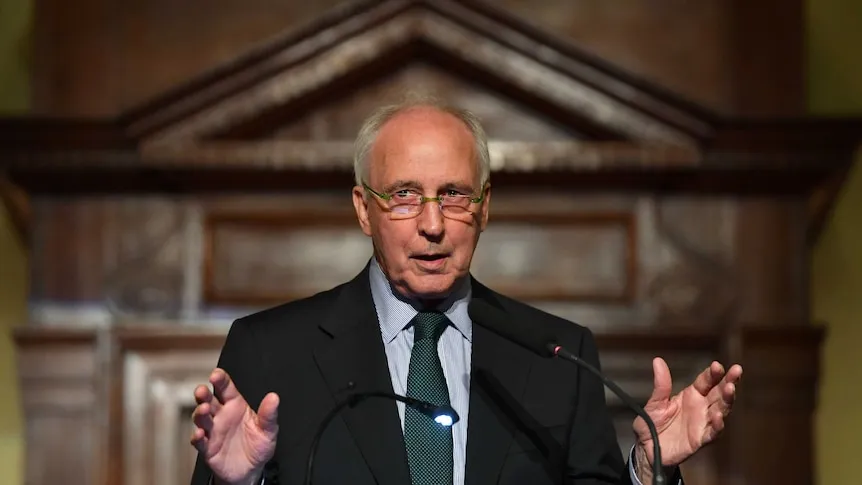
Paul Keating this week told an audience in Sydney that governments are "afraid of change". (AAP: Darren England)
This week's national accounts confirmed how stuck we are in a foul and pestilent congregation of vapours … to steal from English literature's greatest melancholy wobbler.
It's doubtful Hamlet ever dwelt on the state of Denmark's real net national disposable income (RNNDI) per capita.
But if he had he might have embraced what a downer it is.
RNNDI is one of those measures that helps explain why voters look desperate to try new and "dangerous" things, as the prime minister put it this week. He was referring to One Nation and its quickening political momentum around the country, where Pauline Hanson is eagerly harvesting the dark mood.
Anthony Albanese this week spoke about One Nation and its quickening political momentum around the country. (ABC News: Adam Kennedy)
The Australian Bureau of Statistics says RNNDI estimates the income a person derives from the economy that they can spend and save after the pernicious impact of inflation is taken into account.
It renders what's left in people's pockets after cost-of-living increases.
"This is a broader measure of prosperity than the commonly cited measure of real GDP," the bureau explains on its website.
"It more accurately reflects the average lived experience and prosperity of Australians."
In the June quarter, it shrank by 0.4 per cent from the previous three months. And from the same period a year earlier it was unchanged.
Over the last two years it has been either falling outright or pretty much flat.
By contrast for most of the last half century this measure has enjoyed steady gains with brief exceptions such as the early 1990s recession and the post GFC "secular stagnation" of the early and mid-2010s.
In the real world, this reflects how pretty much every generation since federation has secured a better quality of life, greater opportunity and choice than their parents.
But now, living standards and prosperity are headed in the wrong direction.