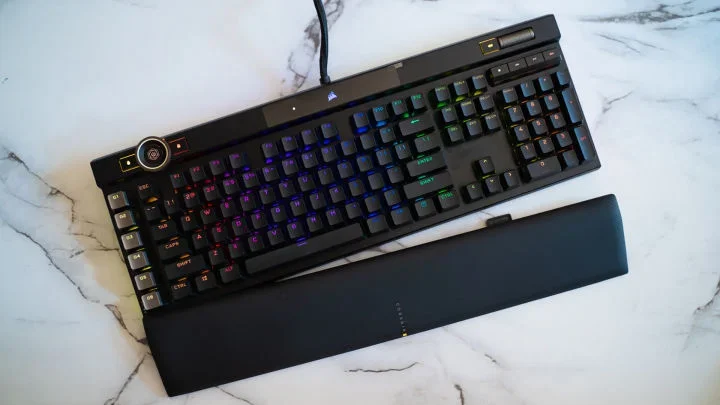
MX ULP remains one of the most interesting mechanical keyboard innovations I've used, yet it's baffling why the industry never ran with it.
Back in 2022, I reviewed a keyboard that I still think about more than most hardware that's passed through my hands since. The Corsair K100 Air Wireless was, at the time, one of the most expensive keyboards I'd ever tested, and I said as much in my verdict, but I also called it one of the best keyboards I'd used full stop, and I meant it. What made it special wasn't necessarily its RGB, the iCUE software, or even the versatile wireless connection on offer.
It was its clever Cherry MX Ultra Low Profile switches. Several years on from my first look, that same technology still hasn't gone mainstream, and dusting the K100 Air Wireless off again is a good reminder of exactly what's been left on the table.
It's worth saying upfront that "slim" gets used as a catch-all term far too often in this industry, lumping together products that are actually solving quite different problems. A low-profile keyboard and an ultra-low-profile one sound like a difference of degree, a few millimetres here or there. However, in practice, I think they're closer to two different categories of product that happen to share a marketing buzzword, and the K100 Air Wireless remains one of the best exhibitions of the technology to the point I'm surprised it's still so underappreciated.
The real kicker for the K100 Air Wireless was its inclusion of Cherry's MX Ultra Low Profile Switches. You might think I'm being facetious by saying that as low-profile mechanical keyboards aren't a new thing, but there is a vital difference between low profile and ultra low profile. Short low-profile switches, the kind you'll find in something like Corsair's own K60 RGB Pro Low Profile or Logitech's G915 X Lightspeed, are a meaningful step down from a full-height Cherry MX switch in size.
ULP switches work via a different design altogether to the usual mechanical switch mechanism that's just been downsized, using metal "wings" that pivot down onto the actuator rather than a plastic stem pushing straight onto a set of crosspoints. That mechanism let Cherry get the total switch height down to 3.5mm and total key travel to just 1.8mm, packed into a board only 17mm tall at its thickest point.
On paper, it doesn't sound like much, and to some it could be the recipe for a mushy keypress you'd hardly want to return to. This comes especially as the ULP switches were only available in tactile flavour, with either a bump or a click under finger, and 1.8mm of travel doesn't really leave much room.
However, it's the genius of these switches that it works beautifully. The tactile bump on Cherry's MX ULP Tactile switches is short and sharp rather than the rounder, more drawn-out feel of a full-height switch, but it's genuinely there, and genuinely satisfying. Even more surprising was the actuation force: at 65cN, these are about as heavy as one of my other favourites – the full-height MX Clear, which would normally leave your fingers fatigued over a long session. However, because the total travel of an MX ULP is so short, that fatigue never really materialises — your fingers simply don't have far enough to go for the extra weight to become a problem. It's a genuinely clever piece of engineering, and using it convinced me that ultra-low-profile was a feature to shout about in its own right.
Of course, none of this would have mattered much if the rest of the keyboard hadn't held up its end of the deal, and it has – wonderfully. At 780g, the K100 Air Wireless was still a substantial object despite its thinness, with an aluminium top plate that kept it feeling planted on a desk rather than skating around under a firm keypress the way genuinely lightweight and less well put together boards can sometimes do. Battery life, at around 50 hours, was more modest than Corsair's fuller-sized wireless boards, which is one of the honest costs of packing everything into such a thin chassis — there's simply less room for cell capacity once you've committed to 17mm, but it's still enough for a working week before charging.
The advent of the MX ULP switch came at a time when the mechanical keyboard industry was at a bit of a crossroads, and manufacturers went in all sorts of different directions. The previous couple of years had seen an explosion of a new breed of keyboard hobbyists, buoyed by the extra time they'd had during the pandemic, and it became the job of mainstream manufacturers to tempt new folks into the hobby.
Some brands went the way of intersecting traditional gaming keyboards with more enthusiast-grade features, such as the Asus ROG Azoth, while others stuck to their guns with traditional mechanical products, such as Cherry. Elsewhere, it's roughly at this time we saw the beginnings of optical switches transition to Hall effect ones in the gaming space, complete with the application of adjustable actuation points and rapid trigger powers for the utmost speed. This is the path that seems to be most common for gaming keyboards, and is a lot of where the industry has headed.
Corsair is the only brand that took the approach of opting for an entirely new product category with the K100 Air Wireless, and it's so far remained one of the only brands that has offered an MX ULP keyboard in the mainstream.
For reference, Cherry has its own KW X ULP, an office-centric product without some of Corsair's gaming bells and whistles, alongside a smaller form factor, wireless KW X ULP 2.0 MINI I'm yet to get my hands on, and boutique manufacturer Mistel is still flying the flag with its gorgeous AirOne, with a small form factor layout, slender aluminium case and a choice of either MX ULP Click or Tactile, which is increasingly rare.
The fact is that thinness wasn't the fight anyone was having when the K100 Air Wireless was first released. The fight was over hot-swap versus soldered switches, over 60% versus full-size, over wired latency versus wireless convenience. MX ULP answered a question from an entirely different conversation if you think about it. The one laptop manufacturers were having about fitting a genuinely mechanical typing feel into an increasingly slim chassis — and that's arguably the real reason it never found its footing on a desktop outside of the admittedly niche examples. It wasn't competing for attention in the argument the enthusiast and gaming markets were actually having with each other. It was solving a laptop problem that happened to also make a genuinely excellent desktop keyboard, almost as a side effect, and the desktop crowd never quite worked out where to file it.
Laptops have been the only place where we've seen MX ULP switches outside of those select desktop keyboards, with Alienware, Medion and Corsair itself putting them into their most premium offerings to offer a much stronger and more responsive typing feel than any membrane or scissor-actuated keyboard could.