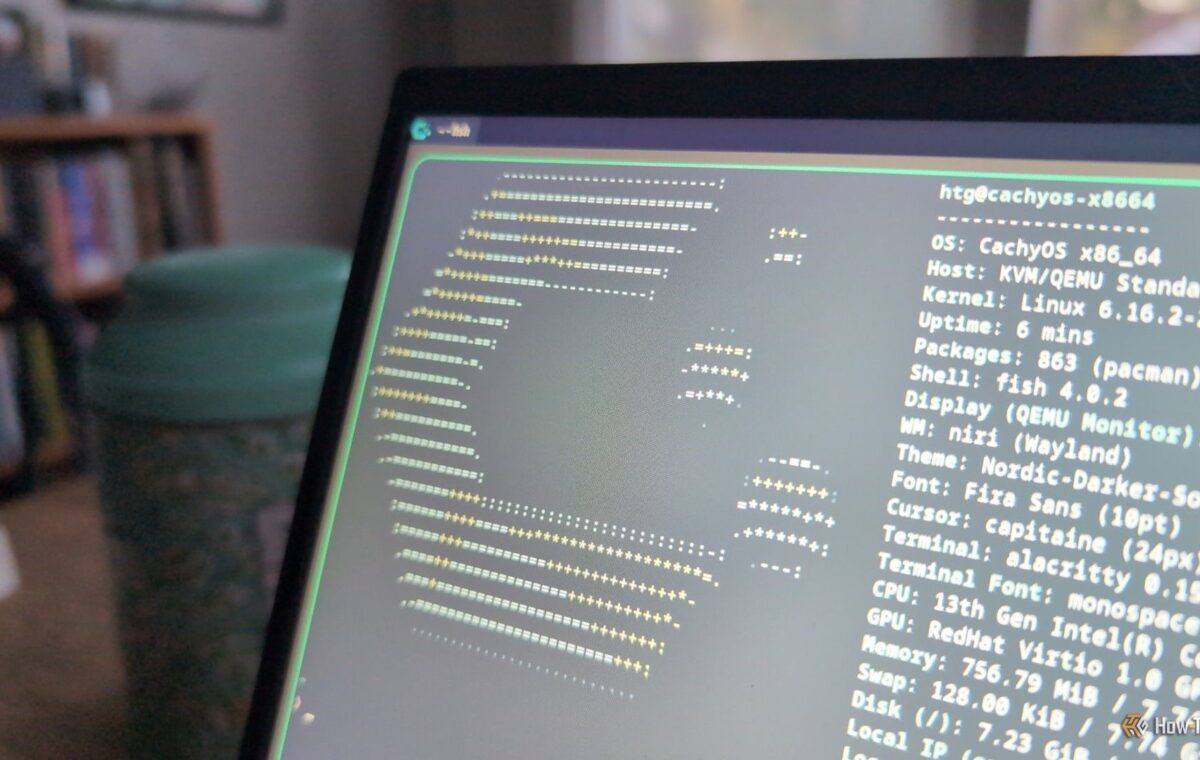
CachyOS has earned a reputation for being fast, but because speed is easiest to benchmark in frame rates, it’s often discussed in the context of gaming too.
However, CachyOS's real advantage shows up in other applications and workflows. If your machine spends its day compiling code, editing video, exporting files, or running a dozen heavy applications at once, CachyOS's advantages apply to you more directly than they do to someone trying to squeeze another 8 FPS out of a game.
At its core, CachyOS is just Arch Linux. It has all the same packages, AUR, and the same "bleeding edge" access that makes Arch what it is. The most significant difference is how you handle downloading and installing those assets.
CachyOS rebuilds most (if not all) of its packages specifically for more recent CPUs (v3 and v4 builds), trading backward compatibility for older hardware in exchange for optimized performance on modern processors. That gives you a performance edge in many common tasks a work PC might need to perform.
You also get a customizable kernel specifically designed to give you a responsive desktop experience. Critically, you don't have to break out a textbook and read 200 wiki pages to do that. CachyOS provides a pre-configured environment with snapshots and drivers available as soon as you boot.
Arch has Arch Installer, which is a big improvement, but CachyOS is still more friendly.
CachyOS's "usable out of the box" approach is an improvement over other versions of Arch. Normally, getting Arch running and learning to maintain it is a pretty significant hurdle.
CachyOS handles much of the tedium—partitioning, working with the bootloader, and driver installation (including NVIDIA)—and lets you choose your desktop environment without building everything from scratch.
Additionally, it automatically creates snapshots during installation and keeps a restore point. If something goes wrong while you're running an update, you can just roll back.
With the ability to customize your setup to maximize performance, it is natural to think that CachyOS would be a great gaming distro. In many ways, it is. You can squeeze some extra performance out of games, and the handheld edition is reportedly quite good.
CachyOS exists to provide a more approachable, intuitive way to get a general-purpose Arch distro up and running. Processing photos, compiling and testing code, or running virtual machines are all processor-heavy tasks that come up all the time if you work on your PC. Those sorts of tasks are exactly what CachyOS's rebuilt packages improve. If you look at the project's recent releases, you'll notice the focus on Python performance and math library fixes—the kind of thing that improves general or work performance rather than gaming performance specifically.
At first glance, CachyOS looks like another "Arch Linux but Easy" distro, but here's why I'm such a fan of it.
Gaming performance often depends more on proprietary GPU drivers (if you use NVIDIA), which aren't the kind of things that CachyOS can just rebuild and eke out a single-digit performance boost.
CachyOS's performance boosts come from its ability to match your software to your PC's hardware. In effect, you get to ditch the bloat and compatibility components you don't need.
However, you can't apply the same trick to games (or at least most of them). You're stuck with pre-compiled binaries that are designed to work on as many systems as possible. If you're lucky, it was built with native Linux gaming in mind. Otherwise, you'll need to lean on a compatibility layer like Proton, which has a marginal overhead that can slightly impact performance.