This is read by an automated voice. Please report any issues or inconsistencies here.
See more from the L.A. Times in Google Search. Set us as preferred
What is VistaVision? A simple answer: The film goes through sideways.
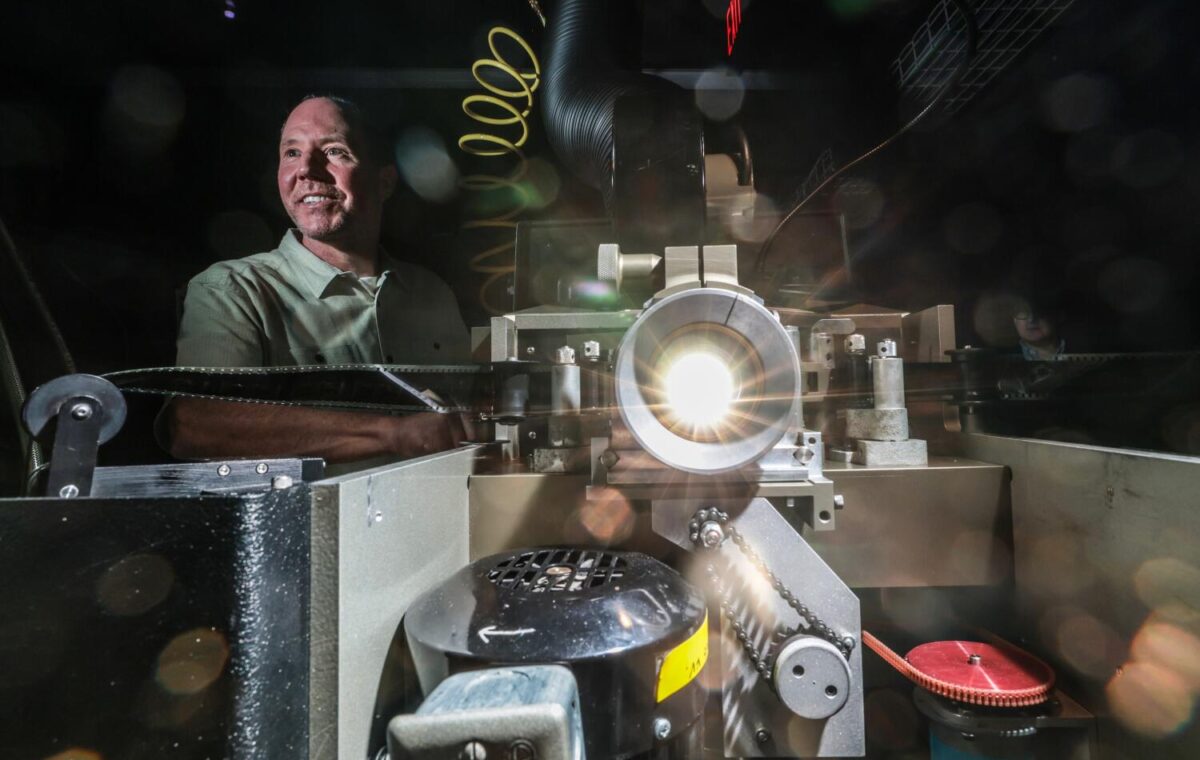
Both in the camera during shooting and in the projector during screenings, the VistaVision process turns the physical filmstrip on its side, running horizontally through the machine to create a larger image of richer depth and clarity.
After its heyday from 1954 to 1961 beginning with the Bing Crosby holiday musical “White Christmas” through Marlon Brando’s lone directing effort, “One-Eyed Jacks,” VistaVision did not completely disappear, but the cumbersome nature of needing special cameras and projectors made it impractical for wider use. Still, it would go on to be used for special effects work on the first “Star Wars” movie and many others.
And it has enjoyed an unexpected revival as a shooting format in the last few years, beginning with Brady Corbet’s 2024 “The Brutalist,” giving the low-budget production a far more lavish look. Paul Thomas Anderson’s “One Battle After Another” was both shot in the format and shown that way at a handful of venues worldwide.
“Presented in VistaVision,” a new series at the Academy Museum, begins Thursday with a 70mm screening of John Ford’s landmark 1956 Western “The Searchers,” starring John Wayne and Natalie Wood.
Collecting 16 VistaVision titles, the series follows a recent uptick in audience interest concerning projection formats. A video by “Sinners” filmmaker Ryan Coogler explaining aspect ratios and screen size became a viral hit; some fans used punchcards to note seeing the movie in all its possible exhibition formats. This summer has seen a frenzy around Christopher Nolan’s Imax-shot “The Odyssey,” with audiences clamoring to experience it in various permutations.
“In a way, we’re just picking up on that wave and riding it,” says K.J. Relth-Miller, the museum’s director of film programs. “We already knew that our Academy Museum audiences have an appetite for seeing film on film. And we know that a selling point for many of our screenings is the fact that it’s being presented in 35mm or 70mm. And so to have the opportunity to present something on celluloid in an even rarer format was just something we couldn’t pass up.”
The inspiration for the series began with the fact that the Museum’s holdings included an actual VistaVision projector built in the early 1990s for dailies screenings but which hadn’t been used for decades. Warner Bros. borrowed and refurbished the machine to show “One Battle After Another” for pre-release screenings on the WB lot. It then became the projector used at L.A.’s Vista Theater, one of only four theaters in the world able to show film in the VistaVision format. The projector returned to the museum a few months ago.
We’ve mapped out 27 of the best movie theaters in L.A., from the TCL Chinese and the New Beverly to the Alamo Drafthouse and which AMC reigns in Burbank.
One afternoon earlier this week, Bradley Morris, the Academy’s lead senior projectionist, was in the booth of the David Geffen Theater to test VistaVision footage from Cecil B. DeMille’s 1956 epic “The Ten Commandments.” As the machine whirred to life, the film strip moved from a large platter through a system of rollers, pulled sideways across the front of the lens. Astonishingly vivid images blazed forth onto the theater’s giant screen. (Yul Brynner, Charlton Heston and a seemingly endless army of extras enacted a complex ceremony.)
“It’s sort of a variation on what we already know,” says Morris of learning to work the projector. “It’s on its side and the mirror image. So it runs backwards to what would be sort of a logical assumption of its threading pattern.”
Mastering this unusual system has proved a challenge but an exhilarating one, with the print moving at 180 feet per minute, twice the speed of a conventional projector.
“It’s actually been a lot of fun,” Morris adds, low-key and affable. “There’s still loops and sprockets but it is different.”