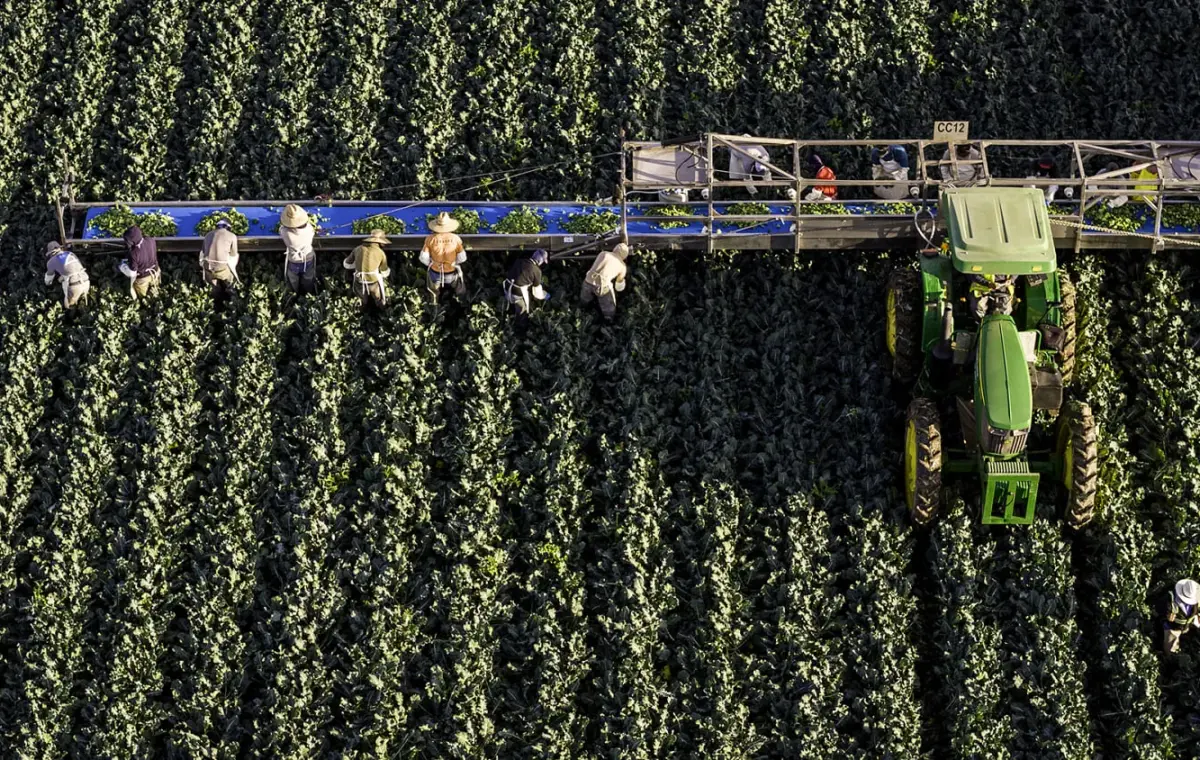
Yuma County, Arizona, grows 90% of the leafy greens the U.S. consumes in the winter. But the state relies on water from the Colorado River, which is at record lows.
The Colorado River fills America’s salad bowl. It’s a vital source of water to Yuma County, Arizona, which grows 90% of the leafy greens the country consumes in the winter — but it’s nearing a crisis point.
With the river’s water levels at record lows, Arizona is poised to take the biggest cuts: about 30% of its Colorado River supply in 2027 and 2028.
Those are the terms stipulated by the Bureau of Reclamation, which imposed a mandatory two-year plan after the seven states that use Colorado River water failed to reach an agreement. If the megadrought persists and water levels continue to fall, a 10-year management plan the bureau has proposed would allow even harsher cuts that could threaten the country’s winter greens.
“If you cut us off at the knees, or if you restrict the water, it has a national impact,” said Jonathan Lines, a member of the Yuma County Board of Supervisors. “It’s a national security issue and a food security issue.”
Arizona’s agriculture is one rather large ripple of the Colorado River crisis, whose full scale is almost impossible to grasp. About 40 million people in Western states rely on the river for drinking water, but it is shrinking from overuse, drought and climate change. Utilities also depend on it to generate electricity at the dams on Lake Mead and Lake Powell, where much of the water is stored, but both reservoirs hit record lows this month.
Arizona has boomed for decades on the back of the river, which has fueled both suburban expansion and high-tech desert farming. But as the cuts begin to reshape its agricultural economy, the state sits at a crossroads.
Winter produce thrives in Yuma County, which is a little bigger than the state of Connecticut, because of its fertile soil, ample sunshine and Colorado River water. In winter, nowhere else in the country has what it takes.
“It’s the sunniest place on Earth,” said Tanya Hodges, the executive director of the Yuma Center of Excellence for Desert Agriculture. (Yuma does actually hold the Guinness World Record for the most sunshine.)
“November through April in the United States, there’s very, very limited places to be growing,” Hodges said, adding: “This little 180,000-acre community is able to pretty much feed North America.”
So, each October, produce companies send their machinery, farm crews and shipping equipment from California’s Central Valley — which produces much of the country’s summer greens — to Yuma. From there, “about 2,500 to 3,000 semitrucks a day get loaded and distributed all across North America,” Hodges said.
The Colorado River cuts will cascade down a system of priorities that governs how much water people in Arizona receive in times of shortage.
The oldest claims get priority, and because Yuma has more senior water rights, that should protect the region next year, according to Sarah Porter, director of the Kyl Center for Water Policy at Arizona State University. After that, she said, all bets are off.
“The farmers can probably get their crops planted and irrigate them through April,” she said. “Will it be the same next year? I wouldn’t count on it.”
John Boelts, a farmer in Yuma County who is president of the Arizona Farm Bureau, said that if and when further cuts come, fellow Yuma farmers are likely to first sacrifice the rotational crops they plant to keep soil healthy, like alfalfa, cotton, durum wheat for pasta and silage to feed livestock.