Two years ago, I had the chance to test out the Viture Pro smart glasses. I was impressed by the chic design and the stunning display units, but there were a few minor hiccups that kept them from becoming an instant buy for XR fans. The asking price of $459, ultimately, made them a tough recommendation for anyone who is not a diehard enthusiast or doesn’t have the spare cash to spend. The successor, however, is an altogether different beast.
At an aggressive $299, the Viture Pro 2 sets out to match the display quality and brightness of pricier rivals, while folding in vision correction at no extra charge. The build quality is phenomenal for the asking price, and the software stack is also fairly rewarding, irrespective of the device in your pocket or backpack. I spent a couple of weeks using it as a private travel monitor and a gaming screen, and I came away convinced that it’s the entry-level pair of XR glasses to beat, provided you understand exactly what VITURE cut to get here.
Let’s clear up the name first, because it tripped me up too. The “Pro 2” label suggests a straight successor to the original (and far more expensive VITURE Pro from two years back. Thankfully, the second-generation is not a true successor. On the contrary, it’s the company’s new entry-level model. Since the first Pro, Viture’s premium stack shifted over to the Luma line, which now serves the baseline Luma model at $399, the Luma Pro at $499, the Luma Ultra at $599, and the head-tracking Viture Beast at $549. So despite the “Pro” in its name, the Pro 2 sits at the bottom of the range at $299.
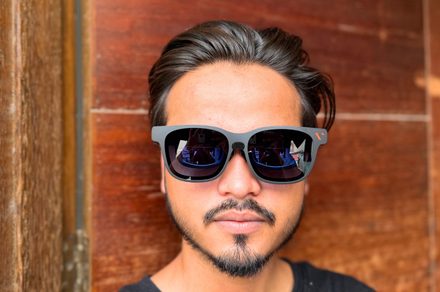
Alright, let’s move to the important bits. Viture has consistently made the most stylish pair of glasses out there, and this one is no exception. From the front, it looks almost identical to the Viture Luma Pro, save for the sides. Compared to its predecessor, the Viture Pro 2 is thinner and lighter. Morever, it doesn’t feel like the glasses are protruding too far away from the eyes, or even disproportionately big. My brother, who modeled for these product shots, has a relatively slim face. Despite that, the glasses feel like any other pair of wayfarers with thick skeletal styling.
The Viture Pro 2 rocks a matte black plastic finish to go with the tinted lenses, and they look and feel every bit as premium as pricier Luma models. Aside from a metallic orange V accent on the left endpiece and a glossy black oval above the nose bridge, there’s little to give the game away. You can see the birdbath prism assembly behind the dark outer lenses if you go looking, but to anyone glancing at me on a train, these read as ordinary tinted sunglasses, save for the wire dangling from behind the ear.
That low profile is a real asset if, like me, you’d rather not wear something conspicuous in public. Viture also resisted the urge to skimp on the box contents. The Pro 2 ships in an extremely well-built carrying case, alongside a small mesh pocket for the cable. The box also comes with a high-quality USB-C cable, an opaque snap-on lens cap that blocks ambient light, three sets of nose pads for dialing in the fit, and the usual quick-start guide and cleaning cloth. For a $299 product, the kit on the table is quite generous.
Thankfully, these glasses stay away from the proprietary magnetic connector seen on its pricier siblings, and go for a USB-C interface. It’s more secure and saves you the hassle of carrying yet another cable as part of your EDC that is also hard to replace. But yeah, a few cuts have been made to lower the price tag. First, the electrochromic dimming glass is gone.
In case you aren’t familiar, it allows the glass to electronically adjust the transparency. On the Viture Pro 2, you get a plastic-made cover that fully blocks the external view to offer the best display experience. Viture also dropped the Harman-tuned audio kit. The Pro 2’s speakers are still decent and balanced, but when pitted head-on, the models with Harman Kardon speaker units sound much better. The controls are pared back too, but it doesn’t impede day-to-day usage in any significant fashion.
Day-to-day comfort is the biggest factor that decides whether a head-worn display is something you actually reach for, or soon condemn it to eat dust in a drawer. Look no further than Apple’s uber-expensive Vision Pro and just how painful it is to wear for more than an hour in one go. Viture built the Pro 2 around comfort as a key priority, and that focus shows the moment you pick up its latest smart glasses.
The weight is the headline-grabber here. Tipping the scales at just 63 grams, Viture Pro 2 is noticeably lighter than the flagship Beast XR glasses and XReal’s rival One Pro. A difference of 14 to 25 grams doesn’t sound like much, but when that weight sits on your face anchored to the ears, it can make or break the whole experience. Wearing the Pro 2, I barely registered the glasses on my nose, and the reduced facial fatigue made it easy to forget I had a screen strapped to my face during a long flight.
The trick, however, is to try all the nose pad sizes and grips to find the combination that doesn’t press too hard against the nose bridge and doesn’t make you stare at a weird angle on the virtual display. Weight is only half the comfort equation, though, as the fit is equally important. If you position the glasses too high, too low, or off-center, the edges of the virtual screen blur immediately, especially along the bottom left and right corners.
Viture addresses this with a familiar multi-sized nose pad system. The box includes three sets. One of them is basically a fixed single-position pad, while the other two are clipped onto a metal post with three height positions per side. Getting the birdbath optics right keeps you looking through the optical sweet spot, which helps achieve edge-to-edge text clarity and keeps the glasses from sliding down or pinching.
The stem is thick, and your ears will definitely feel it.
The adjustable temple arms are a welcome upgrade on the Viture 2 Pro. Aside from the sideways flex, you can adjust the vertical angle across three positions with a satisfying click. Thanks to this engineering flexibility, the Viture Pro 2 can comfortably fit people with different skull sizes and facial proportions. I didn’t feel any pressure on the temple area, even after losing a few hours on stretch while binge-fatching Silo on Apple TV.
It’s a completely rosy picture through. Even though the nose and temple areas didn’t register any pressure after longer usage sessions, I definitely fatigue on the ear muscles. I pin that on the thickness of the stem, rather than the weight. All of this, once again, hinges on finding the best nose-pad size, display angle, and on-nose position so that you get the most comfortable viewing experience, and don’t have to fidget with the glasses every now and then.