Account subscription benefits alongside Premium Stories, Editorials,
Opinions and more. Unlock these with Subscription
The View From India
Looking at World Affairs from the Indian perspective.
First Day First Show
News and reviews from the world of cinema and streaming.
Today's Cache
Your download of the top 5 technology stories of the day.
Science For All
The weekly newsletter from science writers takes the jargon out of science and puts the fun in!
Data Point
Decoding the headlines with facts, figures, and numbers
THEdge
At the cutting edge of education and careers
Health Matters
Ramya Kannan writes to you on getting to good health, and staying there
Gender Agenda
Stories from beyond the binary.
The Hindu On Books
Books of the week, reviews, excerpts, new titles and features.
Updated – September 05, 2026 02:52 pm IST – KOZHIKODE
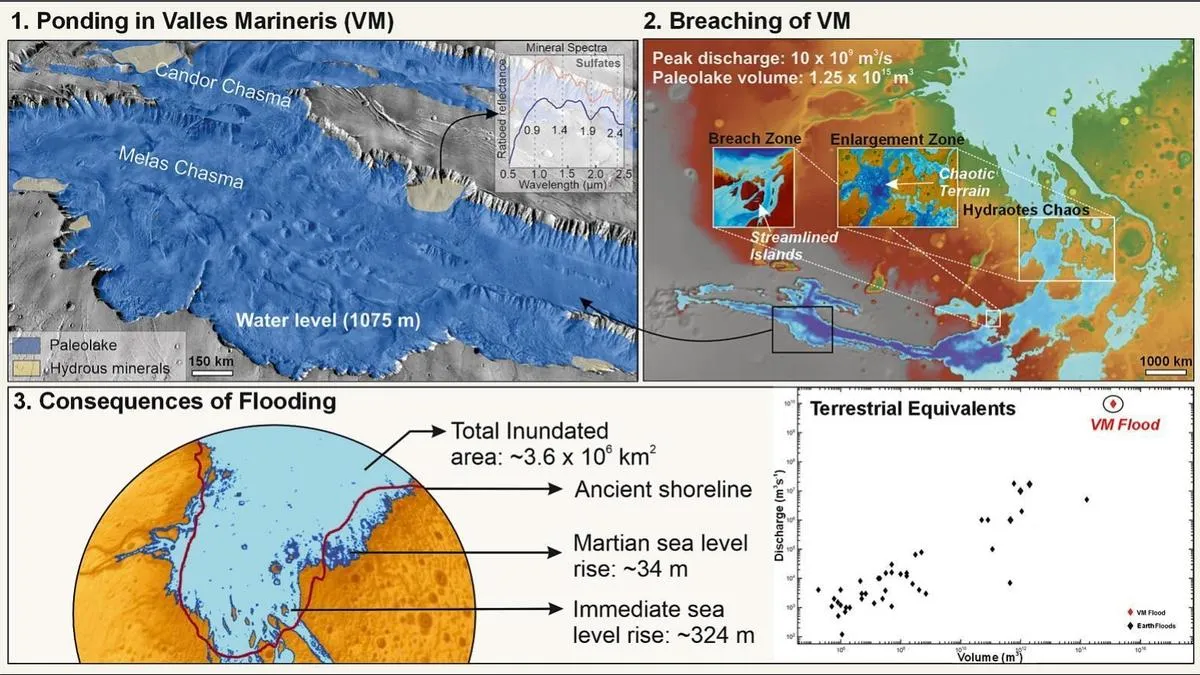
Valles Marineris stretches more than 4,000 km across Mars’s equatorial region and is thought to have once contained extensive bodies of water, including paleolakes. Researchers estimate that these waterbodies contained about 2,369 trillion cubic metres, with simulations suggesting that roughly half was released during the catastrophic breach.
| Photo Credit: Special Arrangement
The recent catastrophic flash floods in Nepal, apparently triggered by the collapse of a glacier rock mass that sent ice, rock, and sediment downstream, causing a sudden surge of water and debris in the river, highlight the destructive power of such events.
A vastly larger outburst flood occurred on Mars during the Late Hesperian to Early Amazonian, when the breaching of paleolakes in Valles Marineris, the largest canyon system in the Solar System, unleashed a massive deluge. The flood, which originated in the ancient canyon system, is estimated to have released 1,245 trillion cubic metres of water and may have raised the global mean level of the hypothesised ancient Martian ocean by about 34 metres, according to a new study published online in the peer-reviewed journal Icarus.
The researchers estimate that an equivalent discharge on Earth would have inundated about 3.6 million sq km of land.