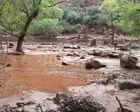
National Park Service confirms second death from weekend flash flood as area braces for more storms
A second death was confirmed by National Park Service officials on Monday after a flash flood sent a surge of water and debris through an area of the Grand Canyon over the weekend.
Dozens of visitors had to be evacuated by helicopter during the deluge, which consumed trails and infrastructure. Fifteen people are still missing or unaccounted for, as more heavy rain and thunderstorms in the forecasts threaten additional debris flows, flash floods or rock falls, the NPS said in a statement.
“With deep monsoonal moisture in place and already saturated soils in some locations, an elevated risk of flash flooding will be in place through Monday,” the National Weather Service (NWS) said.
Park officials are calling on the public to provide any information on those who may have been hiking or backpacking in the inner canyon near Bright Angel Creek, or campers with a reservation in the area.
Flash floods are not uncommon in the region, especially during the monsoon season from June to September when strong rains pummel the arid landscapes and can quickly fill narrow rock formations. Visiting the Grand Canyon – a crown jewel of the US national park system – can be particularly dangerous in the summer because of the risk of flash flooding that accompanies the monsoon, when clear days can give way quickly to thunderstorms and downpours.
The deluge that unleashed torrents of rain on hardened and sparsely vegetated steep terrain came as the Grand Canyon region – and the Colorado River basin that runs through it – continue to be mired in a severe drought that has fueled a widespread water crisis.
Scientists have long warned that the climate crisis will create stronger extremes and destructive shifts between wet and dry conditions. The sudden and strong rainstorm that fueled this catastrophic flood may have been been supercharged by the historic El Niño that has sharply increased sea surface temperatures in the Pacific Ocean, which has the ability to affect weather systems around the world.
The NWS has issued flood watches across a large part of the south-west, including in northern Arizona. Officials cautioned against visiting creeks, slot canyons, burn scars and low water crossings in the area, where flash floods can quickly develop.
Videos taken by hikers before they were airlifted to safety showed churning brown waters carrying large metal objects and other debris. Some crossed the bridges just shortly before they were consumed by the waterway.
“It must have been, like, 10 minutes afterwards – we crossed the bridges to get to the evacuation zone,” hiker Gabriel Burgeman told a local news station. “We were just barely in time to cross them before they got wiped out.”
The body of a 46-year-old man was recovered on Sunday evening near Crystal Rapids along the Colorado River, the NPS said, without providing additional details. At least one other body has been recovered, according to a statement posted on Facebook by the Grand Canyon national park without details.
Early assessments also showed roughly 40% of a key pipeline that provides drinking water for tourists and residents had been damaged or destroyed. The 12.5-mile (20km) long Transcanyon Waterline has endured dozens of breaks in recent years. A more than $200m repair and replacement project was well under way when the floods hit.
The pipeline moves water from one side of the canyon, down to its base, across a bridge and back up the other side of the rough landscape. Any effort to fix a break from rock falls or flash floods is time-consuming, precarious and costly, so addressing the latest damage will be complicated.
Emergency water restrictions began on Monday, closing down all overnight stay lodges and hotels within Grand Canyon national park, and spigots at campgrounds on the South Rim were turned off. Year-round residents were asked to conserve water. The park had water conservation measures in place even before the latest bout of flooding and damage.