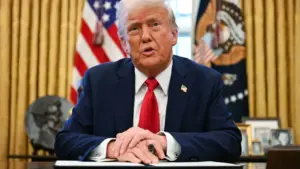
It is difficult to make sense of Donald Trump’s tariffs on international trade, since they are nonsensical, especially as he appears unshakably convinced that his tariffs are paid by the companies or countries exporting goods to the United States, rather than the American companies importing them. In the bold thinking of Trumpism, tariffs are both a revenue stream for America and punitive to other countries. All this squabbling over tariffs and counter-tariffs would disappear overnight if Canada just dropped its border and signed over its territory to the United States. Trump has had it in his head for quite some time that this could be his crowning achievement, his mark on history—a real estate deal of epic proportions.
We put ‘u’ in neighbour and you in Canada’s conversation. Enjoy a roundup of Canada’s best writing. Sign up for The Walrus newsletter and get trusted Canadian journalism straight in your inbox.
Trump broached the idea in a meeting at Mar-a-Lago with then prime minister Justin Trudeau and a small Canadian contingent on November 29, 2024, nine days after he had been re-elected president. He confirmed he would be imposing 25 percent tariffs on Canada but said there would be no tariffs if Canada were part of the US. No border, no levies. Dominic LeBlanc, then minister of public safety who had been present at the meeting, laughed nervously when he insisted to media that the president was teasing. Trump made clear he was not.
Four days later, he posted to his social accounts an AI-generated image of himself standing in a business suit at the summit of a mountain, looking out over a range of snow-capped peaks receding into the distance, as an enormous Canadian flag streamed beside him in the wind. It did not take long for LeBlanc’s nervous laugh to harden into a nation’s angry resolve.
The resolve got a rallying cry and a hashtag on March 1, 2025, three weeks before the federal election was called, when comedian Mike Myers appeared on Saturday Night Live, playing Elon Musk. At the closing credits, when the cast assembled onstage, Myers revealed a T-shirt reading “Canada Is Not for Sale,” flexed his elbow at the camera, pointed to it, and mouthed, “Elbows up!” He made the same #elbowsup! gesture the following week. The day before the election was called, the Liberals released a campaign video of Prime Minister Mark Carney and Myers in hockey jerseys talking about Canada while leaning on the boards at a rink.
This was in contrast to another national treasure, Wayne Gretzky, maybe the greatest hockey player in the history of the National Hockey League, who, almost overnight, fell out of national favour for reasons he could not understand but were obvious to everyone else. He was a friend of Trump’s, who offered him up as the governor of a future fifty-first state of Canada, posting to the world just before Christmas 2024 that he’d had dinner with Gretzky at Mar-a-Lago.
Gretzky did nothing to speak out against the very idea that Canada should be absorbed into the US. By February, Trump felt compelled to come to Gretzky’s defence. “Wayne is my friend, and he wants to make me happy, and is therefore somewhat ‘low key’ about Canada remaining a separate Country, rather than becoming a cherished and beautiful 51st State, paying much Lower Taxes, a Free and Powerful Military, no tariffs, and having a Booming Economy,” Trump posted to Truth Social.
Curiously, Trump barely mentioned Canada once the election was underway. He railed against Canada throughout March, complaining about the weak border that he falsely claimed allowed fentanyl and dangerous aliens to flood into the US and about Ontario’s threat to impose a surcharge on electricity sold to the US. On March 27, four days into the election, Trump threatened even more trade-inhibiting tariffs against the European Union and Canada if they conspired between them to do “economic harm to the USA,” but the next day, in an uncharacteristically respectful post, he said he had spoken with Carney, referring to him as “Prime Minister Carney,” said they agreed on many things, and seemed to assume Carney would win the election, as they would “be meeting immediately after Canada’s upcoming Election.”
Other than that, Trump kept his mouth shut about Canada over the course of the campaign, and the longer he did so, the more Conservative prospects improved. With only three seats making the difference, Trump may have prevented a Liberal majority by not raging against one. In the end, of course, he could not contain himself, and on the day of the election, he urged Canadians to vote for him and for joining the United States, as though he was their leader.
Carney presents a unique case for Canada of a federal party leader and prime minister running to re-elect a government that he himself had not been part of, and who had never even won a seat in the House of Commons.
Canada has seen other relative newcomers ascend to the highest political office. Brian Mulroney won the 1983 Progressive Conservative leadership despite never serving in Parliament, but he assumed the leadership of a party in opposition. John Turner became Liberal leader and prime minister without a seat in 1984, but he had been a cabinet minister in the governments of both Lester Pearson and Pierre Trudeau before leaving federal politics in 1976, and he lost the prime ministership two months after winning the leadership of the Liberal Party. A third relative novice is Pierre Trudeau, who was recruited to run as a Liberal candidate in 1965, and, only three years later, was sworn in as prime minister. But none of these compared to Carney’s assumption of the prime ministership as an entry-level position upon winning the Liberal leadership in March 2025 and winning the general election six weeks later.
While new to politics, Carney was not new to public life. After an early career in the private sector, and a short stint as a senior public servant, Carney became a national figure when he was named governor of the Bank of Canada in late 2007. He then moved to heading the Bank of England from 2013 to 2020, steering it through Brexit. Returning to Canada, Carney combined private sector commitments with continuing public policy activities and growing involvement with the Liberal Party.
Carney’s position as a two-time central banker allowed him to cultivate a leadership image of technical competence and independent thinking while avoiding overt politicization. Though central bankers are well-known to political, financial, and media elites, they attract less notice among the general public; when they do, it is often for negative reasons, such as high interest rates. A “technocrat” image is not often a popular image. Indeed, only two Canadian prime ministers have come from any kind of extended public service background, and not recently, namely William Lyon Mackenzie King and Lester Pearson.
However, Carney made the most of the opportunity. His relative youth (forty-two when he was appointed Bank of Canada head) and crisp appearance gave a sense of energy and vitality—an example of how white men are able to subtly differentiate themselves from the baseline norm. He was a clear communicator, able to master media sound bites and demonstrate wit and clarity. Most of all, his handling of major crises on his watch—the global financial crisis in 2008 and Brexit—allowed him to present an image as a problem-solver above ordinary politics and partisan and ideological debates: that is, a pragmatist of the highest order, able to perform under pressure.
Nevertheless, after returning to Canada in 2020, Carney was reluctant to act on his obvious interest in public office. He did not run in the 2021 election, nor did he join cabinet and run in a by-election, a common way for a high-profile individual to directly enter cabinet. One reason is presumably the sagging fortunes of the Liberal government under Justin Trudeau: it would have been risky to join a sinking ship. But a second likely reason is the limited likelihood of Carney’s pragmatic, technocratic image to propel him to the prime ministership.