The first thing that strikes you upon seeing the new Tomb Raider live-demoed on a massive 115” TV mere inches from your face, I can attest, is its visual fidelity: Legacy of Atlantis is absurdly pretty. Crammed with fine detail enough that every particle of dust and bat guano flitting through the stale air poses danger to your airways, it almost feels like it’s supposed to be funny when compared to the chunky textures and pointy polygons of the 32-bit original.
The game’s director Raul Siqueira puts it nicely during our session: “the secret to a good remake is knowing what to change, and what to leave well alone”. Absolutely. Preserving the essence of a thing is much more vital than slavishly recreating the original work, and this is certainly something that Legacy of Atlantis understands, aesthetically at least. It is unmistakably a modern interpretation of Lara Croft’s seminal adventure, an essential piece of gaming history arguably as important as Super Mario Bros. or Chuckie Egg (ask your dad).
This latest preview focuses on LoA’s interpretation of the Damocles Room, the infamous chamber of raining swords that caused instant death for the uncareful while sifting through the tombs of ancient Greece. It’s a frighteningly vertical space, one that cemented Tomb Raider’s reputation for traversal-puzzles and terrifying jumps that make your insides curdle. Legacy of Atlantis preserves these aspects and then some, the feeling of being a tiny speck of human in an impossibly deep cavern of flakey pillars and dusty godrays made all the more potent by the sheer graphical prowess on offer. That fine detail, that premium fidelity, it stretches off into the distance and pulls off a sense of scale that could only be hinted at on PS1 hardware. Or PS2 hardware. Or PS3, for that matter.
And these swords that dangle so menacingly, they’re big. They’re almost house-sized.. The big twist in this version of the Damocles Room is that, rather than being deadly obstacles, the swords are helpful almost to the point of politeness: they’re needed for traversing the space, as Lara can now perch on their hilts after they’ve dropped. And in stark contrast to bat poop, the dropping itself barely poses any danger. The swords are easily dodged, and their drops can be triggered from a safe distance by shooting at them, rendering them little more than another minor inconvenience that Lara gets to solve with hot lead.
Much like the poor leopard she encounters on the way here, on which the camera lingers majestically as she delivers a breathless “magnificent” right before shooting it in the face. I thought this was hilarious and burst out laughing involuntarily, which turned out to be massively out of step with the rest of the room. I even asked the devs about this in the following Q&A: “Is that meant to be funny?”
No, basically. While Lara has no shortage of handy quips, delivered with requisite English public-school plummyness by the wonderful Alix Wilton Regan, this is I’m assured a serious game with a serious tone. So anyone expecting a modicum of self-awareness from this third distinct version of Lara’s original adventure, not counting the recent remaster, will be disappointed.
It highlights a tonal mismatch between the various eras of Lara Croft that this game seeks to blend together. As a nexus point of Crystal Dynamics’ new “unified timeline” for the series, Legacy of Atlantis seeks to replace both the original game and 2007’s Anniversary in the PS1 and Legend timelines, while serving as a sequel to the Survivor Trilogy, which we last visited in 2018’s Shadow of the Tomb Raider. It requires a lot of mental gymnastics to imagine that all of these disparate Laras are the very same bored aristocrat, not least because each of them reflects the time they were conceived in. It’s clear that neither the original games nor the Legend timeline are occurring after the mid-2010s, as clear as it is that this new take on Lara’s original adventure isn’t happening in 1996.
You could argue that it’s all supposed to feel timeless and perpetual, like The Simpsons, but you can’t tell me that pointy PS1 Lara Croft looks like she knows what an iPhone is. There’s also an element of parody to the previous eras, as plenty of Indiana Jones and sixties spy tropes were playfully redeployed as foils for 90s Girl Power, and then again as welcome ballast to the prevailing dourness of post-9/11 Bond movies. A playfulness that the Survivor Trilogy dropped entirely, focusing sharply on the 2010s appropriate misery of being a teenager who unwittingly spends her gap year having to murder dozens of Russian mercenaries while worrying about whether her tetanus shots are up to date.
The point is, all of these flavours of Tomb Raider are distinctly of their time, which is absolutely fine. Smooshing them together into a paste is a weird decision and one that seems to be inspiring some questionable choices, like the inclusion of survival mechanics like crafting and skill trees in this redux of Lara’s original adventure, things that seem to be there just because the last game had them or, worse, because that’s what games are like now. Things that don’t make thematic sense: if this is 2013 Lara finally reaching her prime, her zenith, her most capable self – as the survivor trilogy always promised to be leading to – then why are we still spending the game unlocking her skills?
Why are we “surviving” at all, eating foraged meals cooked in the field, when this isn’t a survival scenario? Lara hasn’t been stranded here, she came to these ruins of her own accord, presumably in a rented jeep. It’s only Greece, you can go on Ryanair for twenty quid. This is a capable explorer who would have a meticulous itinerary and a bag full of protein bars and jerky, she wouldn’t be winging it on the basis of eating boiled moss.
Nor would this classically educated aristocrat seem to need a detective mode scanner thing that gives her puzzle hints and provides handy historical commentary. In fairness, its usage is entirely optional, and seems to be there to address a common criticism of the more recent Tomb Raiders, namely that Lara seems to spend a lot of time chatting to herself.
None of these things are dealbreakers, they’re just prominently questionable choices in a game full of them. As is the decision to employ, then defend, the studio’s use of generative AI in development. Granted, feelings in the community are mixed on this – some care, some don’t, most are probably blissfully unaware of the controversy – but it tends to go down like a shotgunned leopard with enthusiasts, and so using it at all feels like unnecessarily tainting your project before it’s even out.
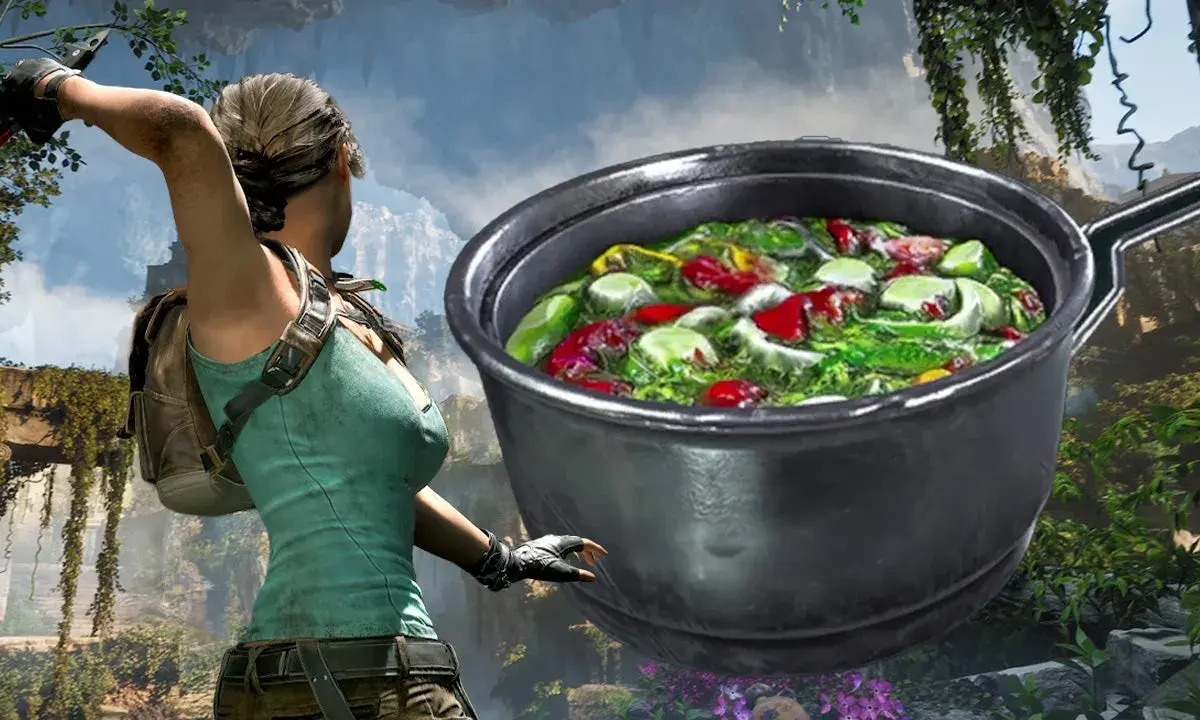
Because they’ve admitted to using it, it’s hard not to look for evidence of it. I’ll be blunt, the food crafting menus are looking very suspicious. Video game depictions of food are an art form in and of themselves, and often, they are notable for looking absolutely delicious. Who can forget the sweetrolls of Skyrim or the lavish gourmet meals conjured up by Ignis in Final Fantasy 15? In Legacy of Atlantis, though, the food looks kinda disgusting. Despite what the accompanying description says, Lara’s lunches all look rather aptly like slop. Mushy stews of unrecognisable plant matter and meat you’d hesitate to put in a dog.
To be clear, this is all circumstantial – we don’t know for sure if these elements are derived from AI, and the studio for their part has insisted that everything in the final game will be human made or human “refined” – but it demonstrates how damning even a faint association with generative AI can be. Especially if the results are this unappetising.
The game is still many months away from release, and what we’ve seen of it so far is by no means final. There’s time to iron out the kinks and excise the final traces of generative AI that may or may not be plaguing the current build (not that you can un-use genAI any more than a bat can un-shit a temple floor).