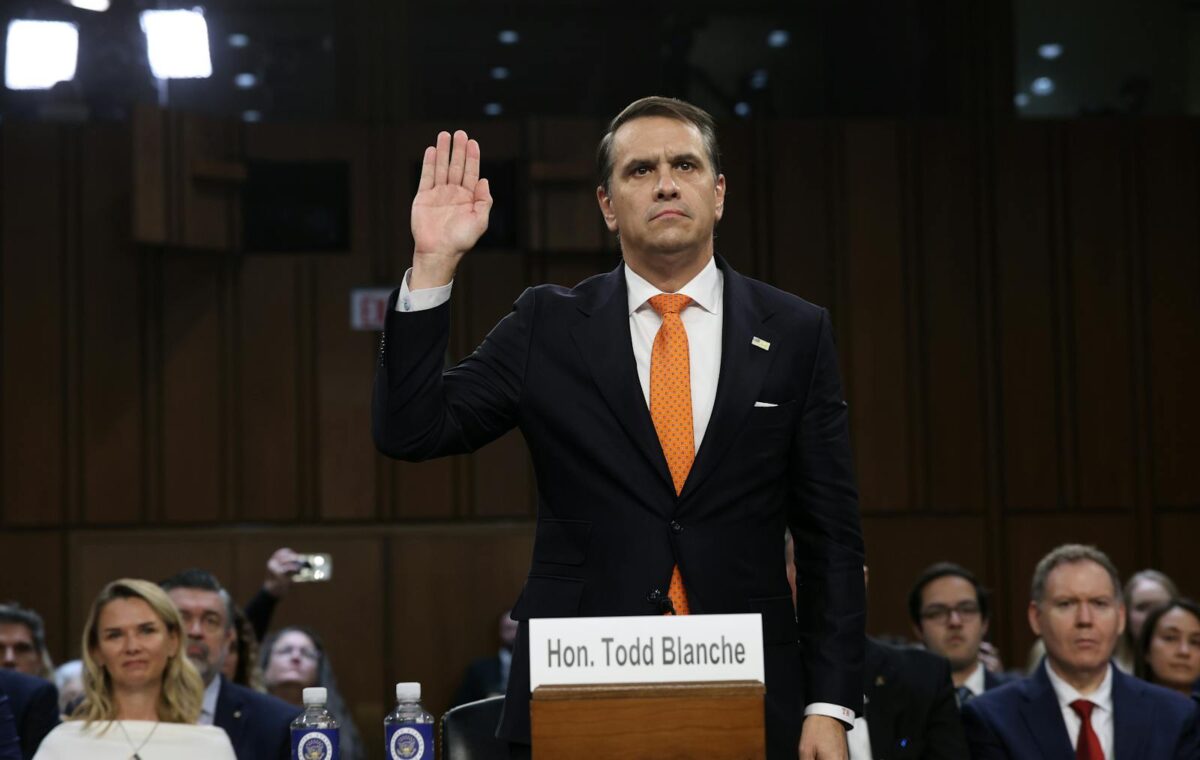
Newly-confirmed Attorney General Todd Blanche seems to want to resurrect President Trump’s $1.776 billion “Anti-Weaponization” slush fund by another name.
Blanche claimed that the fund was dead, while at the same time insinuating that the administration would look for other ways to offer payouts to insurrectionists and allies during his introductory press conference on Wednesday.
“The president has never gone as far as you have to say that the Anti-Weaponization fund is dead. Now that you’ve been confirmed narrowly, arguably because of that Anti-Weaponization fund … is it dead, and is it ever gonna come back?” a reporter asked.
Blanche offered a verbose, noncommittal answer.
Blanche: The president feels very strongly, as do I, that there were people who were victims of a DOJ that was absolutely weaponized. He feels very strongly he would want to make them whole, as do I. But it will not be through the anti weaponization fund.
pic.twitter.com/1DMWSMP9Uo
“I quibble with that, because the president said in the Cabinet meeting that it’s dead. He’s also said that he likes it. But he has also said it’s dead,” Blanche said. “As for me … I have testified under oath that it’s dead. I have testified in front of the House when I wasn’t under oath where I said it was dead. I have answered questions after my hearing where I said that it was dead. I rescinded the order that set up the weaponization fund, which means that it does not exist … I’m not sure how I can further say that the Anti-Weaponization Fund does not exist.”
“We also have said … that if Congress would like to make it a law, that we would support that,” Blanche continued, changing tack. “The president feels very strongly, as do I, that there were people who were victims of a Department Of Justice that was absolutely weaponized, and he feels very strongly he would want to make them whole, as do I. But it will not be through the Anti-Weaponization Fund.”
Within Blanche’s answer is a strong desire to gift reparations to Trump’s aggrieved supporters and friends through whatever means accessible to them—an alarming answer given that it was one of the issues his confirmation apparently hinged on.
The Los Angeles Lakers may soon be sold for $12 billion—and the Trump administration might have something to do with it.
ESPN reported Wednesday that Josh Kushner, the brother of President Donald Trump’s son-in-law Jared Kushner, and ex-Disney CEO Bob Iger have reportedly reached a deal with business executive Mark Walter to buy the NBA team just a year after Walter purchased it for $10 billion.
The timing is suspicious, as Walter is facing a loan fraud investigation by the Securities and Exchange Commission, as well as the U.S. Attorney’s Office in Manhattan, over $16 billion in private credit deals concerning insurance companies he owns. Walter also happened to visit the White House in June to be honored with the Los Angeles Dodgers, which he owns, for winning the World Series.
Did Trump cut a deal and get his son-in-law’s brother involved to help Walter out with some impending financial trouble? Josh Kushner is said to politically disagree with his brother and Trump. But he still would have been the main investor in the abandoned plan by FIFA President Gianni Infantino, who has cozied up to Trump, to sell stakes in the World Cup. Kushner would have to sell his minority stake in the Miami Heat to complete the Lakers deal.
Walter faces a serious threat to his business empire with the federal probes, according to The Wall Street Journal. Trump’s second term has been marked by visible corruption involving business executives and wealthy foreign leaders close to the president, and that appears to be extending to professional sports.
After a tense month in which she drew the ire of President Trump, U.S. Attorney for the District of Columbia Jeanine Pirro has called a special grand jury to Washington, D.C.
A special grand jury is a judicial body made up of 23 American citizens that exists to conduct large, sometimes yearlong investigations usually centered on government corruption or organized crime. They can also issue a report regarding the potential “preponderance of evidence” upon the conclusion of their investigation, something a regular jury can’t do. Anyone named in their investigation may later testify in front of them.