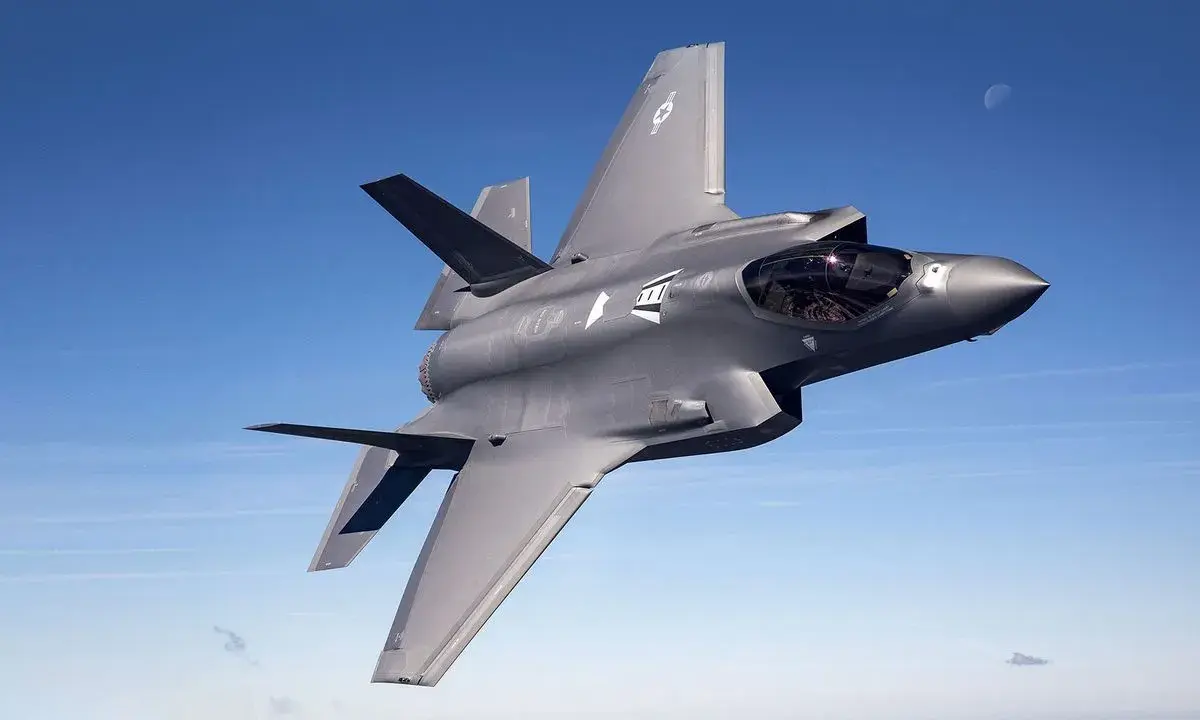
F-35 pilots each get a $400,000 helmet connected to six infrared cameras mounted to the airframe of their fighter jet
When you purchase through links on our site, we may earn an affiliate commission. Here’s how it works.
Every F-35 pilot in the US Air Force gets their own custom-fitted $400,000 helmet, which lets them peer through the cockpit mid-flight to see what's going on in the surrounding airspace and the ground below.
This is possible through six infrared cameras embedded on to the flight's exterior, broadcasting a 360-degree video stream straight into the pilot's visor. Pilots say it's like being able to see through the hull of the aircraft, as if it were made of glass.
Lockheed Martin's F-35 Lightning II is one of the world's most expensive fighter jets, priced anywhere between $80-110 million USD. These are single-seat, supersonic, stealth fighter jets designed for air strikes and electronic warfare.
Each fighter jet also comes equipped with a Gen III Helmet Mounted Display System (HMDS). A single F-35 Gen III helmet costs four times more than what the older F-16 jets came equipped with. To be more specific, an investigation by Air Force Times in 2015 put their per-unit pricing at roughly $400,000.
Given that the United States Air Force has a contract with the helmet manufacturer, Collins Elbit Vision Systems, to build thousands of these helmets — that makes the combined project cost for the headgear alone in the billions of dollars.
What do Air Force pilots get for the exorbitant price tag? When looking down through the visor, they get a real-time view of the airspace and ground below, the closest that the US military has come to X-ray vision.
Mark Welsh III, a retired four-star general who served as the Air Force's 25th Chief of Staff, remarked that "the helmet is a workspace," adding "It's an interpretation of the battle space. It's situational awareness. Calling this thing a helmet … we've got to come up with a new word."
Sign up to the TechRadar Pro newsletter to get all the top news, opinion, features and guidance your business needs to succeed!
The new F-35 Gen III helmets were designed by Collins Elbit Vision Systems, a joint venture between Collins Aerospace and Elbit Systems of America. Through their contract with the F-35 Joint Program, Collins Elbit has so far shipped more than 3,000 units of these helmets to the United States Air Force.
Each helmet is custom-built to match an individual pilot's skull and facial structure, assigned right away during training, and retained by the pilot for all future flight runs.
The flagship feature of the Gen III helmets is that they let Air Force pilots see through the floor of their aircraft, using a Distributed Aperture System (DAS) designed by Northrop Grumman. This system consists of a set of cameras and built-in sensors, all connected using a software module that lets pilots track nearby aircrafts or missiles. Pilots can even lock on to targets as far as 800 miles away simply by looking at them.
Apart from the mounted display system and cameras, F-35 helmets are also equipped with digital night vision and thermal imaging. The visor uses high-resolution LCD lenses for improved picture clarity, plus the helmet itself is equipped with head and eye tracking systems to adjust to the pilot's motions.
Earlier versions of the F-35 helmet suffered from jittery visuals and ejection issues, so much so that the Pentagon funded a backup program with BAE Systems in case Lockheed Martin wasn't able to deliver.