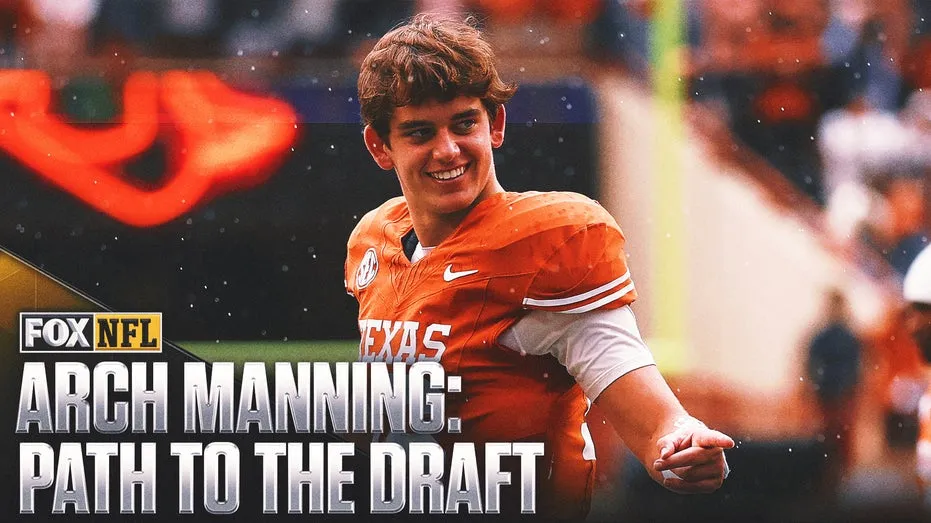
Texas quarterback Arch Manning enters his redshirt junior season as the most celebrated and scrutinized quarterback in the country and thus is the most intriguing NFL prospect. But he's not a shoo-in to be the No. 1 overall pick of the 2027 NFL Draft.
There is no denying Manning’s appeal. He’s supremely talented, boasting an ideal blend of size, arm talent and mobility with the Hall of Fame bloodlines every QB-needy NFL franchise would seemingly love to build its team around.
But is it as simple as Manning, whose 2026 season kicks off Saturday against Texas State, "just staying healthy" before earning the distinction of being the top pick next spring?
Arch Manning is aiming to become the third member of his family to be the No. 1 pick in the NFL Draft. (Photo by Parker S. Freedman/Getty Images)
To put it bluntly, no. In a class this gifted, no one can afford to simply rest on their résumé. Not Manning nor Ohio State phenom receiver Jeremiah Smith nor any of the top QBs.
But, if Manning can improve in three particular areas, I believe he will follow in his famous uncles’ footsteps and hear his name called first on draft day.
Like most quarterbacks drawing attention from NFL scouts, Manning will ultimately get drafted because of his ability to accurately throw the football long distances. It is easy to assume that if a quarterback is accurate on longer passes, he’ll also be precise on shorter throws.
That was not the case with Manning last year, however. In fact, he was arguably at his worst on the shortest throws — a flaw that simply must be corrected if he is to earn an early first-round selection next spring.
The so-called quick game — i.e. slants, bubble screens, pop passes — is as fundamental to the modern era of football as shooting 3-pointers is to modern basketball.
These routes have gained importance in recent years with today’s elite pass-rushers and all the exotic scheming and blitzing done to pressure quarterbacks immediately. Signal-callers absolutely must be able to get the ball in and out of their hands efficiently.
Manning was surprisingly inaccurate on several short throws last year, espeically early in the season. (Photo by Tim Warner/Getty Images)
When operating out of the shotgun — as Manning typically did in 2025 — quarterbacks are taught to first secure the snap and then simultaneously turn their feet in the direction of the intended receiver while spinning the ball to allow their fingers to grip the laces. Once the ball is comfortably in their grasp, a quick, strong throw should be out long before the pass rush has any chance to get home.
Experienced quarterbacks can make these throws seem like little more than extended handoffs, collecting and distributing in one fluid motion.
Manning is as quick as you’ll see in this regard. In fact, he’s quicker than most. However, his technique was off and therefore so was his accuracy. Manning didn’t consistently pair his upper and lower body last season, failing to either grip the laces or turn his feet properly (or both), resulting in the ball spraying erratically. These issues were further exacerbated by a sloppy sidearm release that left potential pass-catchers struggling to pick up the ball in flight. With less distance for the ball to cover, receivers had a hard time locating and corralling throws that came in at the head or knee level just as often as they did near the chest, as intended.
Manning’s inconsistent accuracy forced receivers to adjust, contributing to a whopping 22 charted drops by Texas receivers, per PFF. It also disrupted opportunities to create yards after the catch.