You have reached your maximum number of saved items.
Since 1972, the Pilbara town of Karratha has held an annual fête known to locals as the FeNaclNG Festival.
Originally started as a fundraiser for the Karratha Lion’s Club to support local community projects, the family friendly carnival-like event has grown over the years to celebrate its 54th anniversary in 2026.
While locals love the Pilbara’s answer to a classic agricultural show, one of the first things newcomers or out-of-towners notice about the festival is its unusual name.
“FeNaClNG” – mind the capitalisation – is drawn from three of the natural resources that helped build the mining town into the modern-day city it officially became in 2014.
Fe is the chemical name for the iron that made the Pilbara famous, NaCl the compound of the salt that was also mined in the region during its early days, while NG stands for natural gas, from the rich, albeit controversial, North West Shelf.
While the three resources that combined to form the festival’s name continue to provide for the city, there are arguments to be made that a fourth should be added into the mix.
In March next year, fertiliser company Perdaman’s Ceres urea project is set to come online, with full production scheduled to begin in June – just before next year’s 55th anniversary of the FeNaClNG Festival at the end of July.
Backed by the Commonwealth, the operation is set to provide around 2.3 million tonnes of urea each year once at capacity.
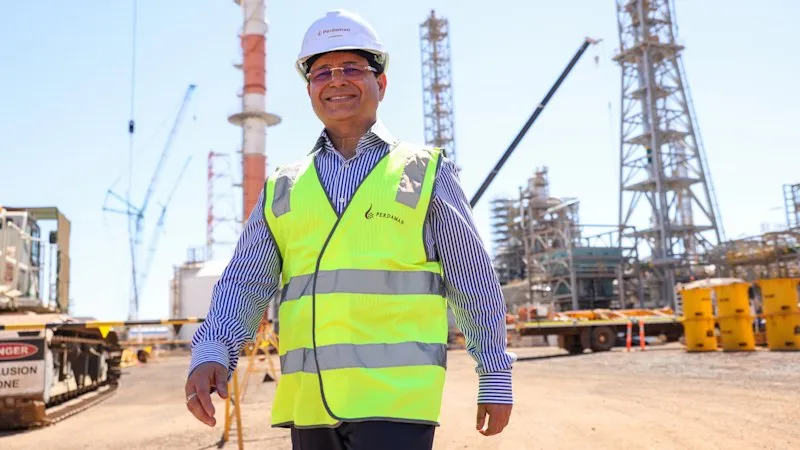
Company chairman Vikas Rambal said the nation’s reliance on imported fertiliser was laid bare when the US war in the Middle East led to blockages in the Strait of Hormuz.
While the majority of Australia’s attention was focused on the impact the war had on the price of fuel, the nation’s farmers had more pressing concerns, with more than 90 per cent of urea imported from overseas.
The Ceres project aims to ease concerns that a similar situation in the future will be avoided.
“Farmers love me,” Rambal said to journalists during a visit to the site this week.
“If we don’t have fertiliser in this country, farmers are helpless. It’s a must-have in any country.”
Ceres will use local seawater and LNG from Woodside’s nearby North West Shelf projects to create its urea.