Social media platforms face public ire after fatal crash involving teenagers filming themselves driving on wrong side
Videos often begin with the camera panning across a glowing dashboard as a gloved hand starts the ignition. The camera turns to show figures with masked faces in the rear seat, who are also filming, and swivels back to show the windscreen. Beyond it, a dark cityscape.
The engine throbs, headlights puncture the night and the journey begins, first down a suburban road, then a motorway. The speedometer shows acceleration, the needle juddering as the car gathers velocity.
The destination is irrelevant, for this is a show – an exhibition of audacity, lawlessness and recklessness that draws viewers to TikTok and other social media platforms with the possibility of chases by police and dramatic crashes.
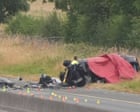
Such videos are part of a macabre trend that has astonished and outraged Ireland in the wake of a collision last week that killed five teenagers – who were driving the wrong way down a motorway – and critically injured a family of four, prompting debate about policing, criminal justice, social services and social media regulation.
“You have to ask: how do five young men gravitate to each other and decide this is a good idea? Where have we gone wrong as a society?” said Graham Kavanagh, a former officer with the police force An Garda Síochána, who used to pursue car thieves. “No one is born bad, but sometimes you might encounter a fella as young as six or seven and you know trouble is waiting for them.”
In the early hours of 16 August, a group of young males broke into homes and cars in County Kildare, south-west of Dublin. Police believe these were the masked occupants of a BMW who then appeared to try to bait patrol cars into a pursuit.
At approximately 3am, the BMW was driving the wrong way down the M9 when it crashed into a Hyundai, injuring three sisters, Ella Hendricken, Niamh Kinsella and Alma Kinsella, in their 30s and 20s, and Alma’s seven-year-old son. They had been on their way to Dublin airport for a family wedding in the UK.
The boys who died – Joe Carthy, 15, Kamil Pustkowski, Jack Kennedy, Alex McCarthy, all 17, and Jeremy O’Brien, 18 – were known to police. Three were also known to the child welfare agency Tusla. Several had previously posted videos of reckless driving, previously known as joyriding.
Seeking excitement and admiration from peers through such behaviour was not new, but social media had escalated and amplified the phenomenon, said Mary Aiken, a professor of forensic cyberpsychology at the University of East London.
“I would describe it as hybrid behaviour. While driving the car, they’re simultaneously filming and capturing content for posting later or live streaming. They have one foot in the real world and one foot in cyberspace.” Cyberspace is psychologically immersive and could amplify a predisposition to taking risks and ignoring consequences, said Aiken. “They’re thinking about the likes, they’re thinking about kudos.”
The tragedy had provoked polarised responses.
An outpouring of solidarity for the injured family fuelled a fundraising appeal that has raised more than €660,000 (£565,000). A vigil was planned in County Carlow on Friday evening.
Much online commentary about the five boys, in contrast, has been abusive, prompting relatives to withdraw funeral notices. The first funeral, for McCarthy, was held on Friday in Athy. Family members wore T-shirts with his photograph and a horse-drawn carriage transported the casket. Police monitored from a distance.
A digest of the morning's main headlines from the Europe edition emailed direct to you every week day