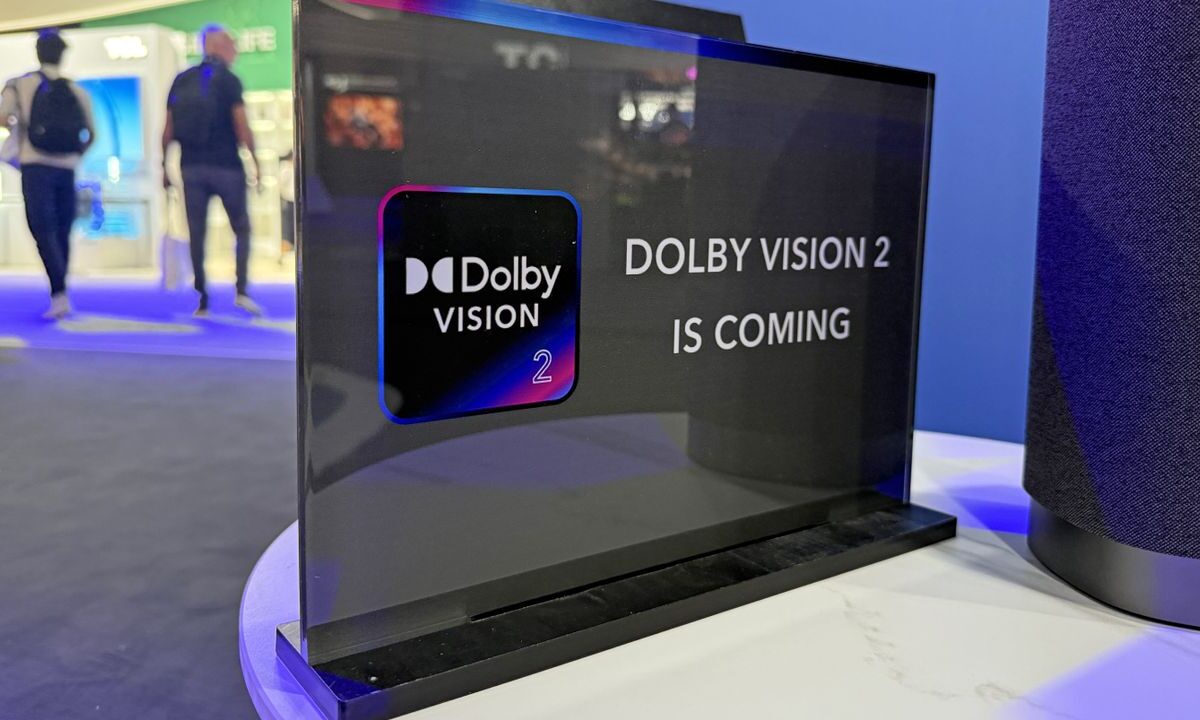
Streaming services will be able to upgrade Dolby Vision to Dolby Vision 2 without a remaster, but some data can't be added automatically
When you purchase through links on our site, we may earn an affiliate commission. Here’s how it works.
If you're wondering where all the Dolby Vision 2 media is going to come from, we've got good news: it's already here, at least partly. Dolby Laboratories told me that it's created a process that can upgrade existing Dolby Vision media to add most features of the new HDR standard using an automated process based on the existing mastering data — and there are only two key features that are excluded, because they're areas that depend on new input from creators.
With Dolby Vision 2 arriving on TVs from this month, I caught up with Dolby Laboratories' director of business strategy, Jonas Klittmark, to find out the details: what it could do for 4K Blu-rays, what benefits it'll bring to streaming and most importantly of all, what to watch.
One of the biggest concerns with Dolby Vision 2 is that creators just won't be inclined to master video for it when it doesn't have widespread support — but it's unlikely to get widespread support if there's no content. But it turns out that existing Dolby Vision masters can be adapted to use many of its features without being reworked.
"There is a bunch of new features in Dolby Vision 2 that don't rely on new content at all," Turkstra told me. "Because you already have all the Dolby Vision content in the world… the streaming providers will have more to say about this later, but the existing Dolby Vision library will start to get converted and the new metadata for Dolby Vision 2 will be added."
Klittmark estimates that there are around 33,000 movies and TV show episodes available in Dolby Vision. "There's no realistic chance that all that content is going to get remastered from scratch," he says.
"The cost of doing that is just astronomical. So what we're offering instead is a semi-automated way of doing it where we're using modern techniques such as machine learning to assist in the creation of the additional metadata that's needed to make the most of Dolby Vision 2."
He elaborated that "many of the features, including the image engine, including the new version of LightSense, the intensity control, the pro settings, and sports optimization, all of those features can work through a combination of existing metadata."
Sign up for breaking news, reviews, opinion, top tech deals, and more.
That metadata is based on existing mastering data, and as will all of Dolby Vision 2, the next-gen data is in addition to the existing data; it doesn't replace it, so the automation won't affect the visuals of, or compatibility with, TVs that have the first generation of Dolby Vision but not the second.
The two exceptions to the automated upgrade are Authentic Motion, which enables creators to control how strong your TV's motion processing is applied on a moment-to-moment basis, and Precision Black, which is designed to address dark scenes that looked great in the creators' mastering suite but appear too dark on TVs.
Klittmark said: "Authentic Motion is an example of a feature where it's just too sensitive. I don't know if you've been following the fairly polarized debate about motion that has been playing out over the years, with Tom Cruise making public service announcements, and things like that. That feature is so sensitive that we don't generate that metadata, it has to be manually authored."
I've seen Dolby Vision 2's Authentic Motion in action, and I think it's a great addition — it means that judder can be removed in scenes that need it, but motion smoothing can be deactivated in scenes that don't. I suspect that actually it probably could be automated to good effect, but as Klittmark says, I don't thing anyone would really trust that, so it's best that Dolby is leaving that to humans.
When it comes to Precision Black, Klittmark says this can't be automated because in order to get it right you need to know all about the creator's environment: "how dark was their ambient light, what kind of reference monitor were they using, et cetera… that cannot be speculated about or generated, so that needs to come manually from the creative."