In 2026, virtual reality hardware faces an uncertain state of play
Hi! I'm Rick Lane, and you might remember me from such columns as Reality Bytes, RPS' erstwhile monthly goggle at the world of virtual reality. I've spent the last couple of years trapped between the second and third dimensions, my flattened body doomed to forever spin to face the camera. But RPS has whipped out its bicycle pump and popped me back into stereoscopic 3D, so I can seek revenge tell you all about the state of VR in 2026.
And boy, what a state! The headlines make for grim reading. VR headset shipments are in decline. Notable VR studios are either laying people off or being shut down outright. And VR's hitherto biggest champion is going all Distracted Boyfriend, ogling passing market trends in its ethically dubious smart glasses.
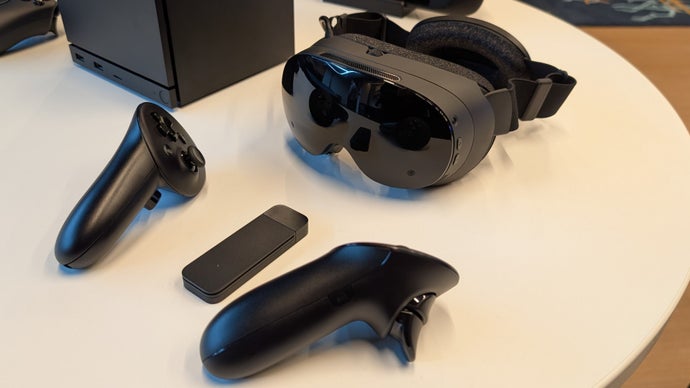
The all-in-one Steam Frame headset is on the way – very soon, if rumours are to be believed – but in short, things don't look great. Then again, things don't look great anywhere in the games industry, so why should VR, gaming's most niche market, be any different? To truly understand the state of the VR scene, we need to try to separate the generally bad from the specifically bad. When we do that, it becomes clear that VR broadly isn't faring any worse than the industry at large, and in some areas at least, is healthier than you might expect.
Let's start with the hardware itself. As I mentioned, shipments of VR headsets are currently in decline, with a 17% drop in shipments in the first quarter of 2026. That's a steep drop, though it's worth bearing in mind the VR headset market hasn't been especially well fed in the last couple of years.
Between 2019 and 2023, Wikipedia lists twelve VR headsets having launched, including all three Meta Quests. Since 2024, it lists just two headset launches: the Apple Vision Pro, and the Samsung Galaxy XR. This list does ignore some high-end headsets like those manufactured by Pimax. But such devices are a niche within a niche, unlikely to account for a vast number of sales.
With a dearth of new product, it's understandable that people won't be buying as many headsets. But the nature of the devices being launched tells another story – one of a general shift away from the mid-range, all-in-one gaming headset. HTC, at one point Meta's primary competitor in VR's middle ground, has seemingly abandoned headset development entirely, while recent headsets like the Vision Pro and the Galaxy XR were not designed with gaming foremost in mind.
Instead, VR devices have shifted increasingly to the extremes. At one end, you have a knotty mix of AR/XR goggles and AI-powered Smart Glasses taking the bones of VR tech and applying it to other functions (like recording people without their knowledge or consent). At the other end, you have the premium devices like Pimax's headsets, eking a profit out of established VR converts and hardcore simulation enthusiasts willing to spend thousands on a new device.
This may just be a temporary situation. New, theoretically mid-range hardware is coming down the pipe. The question is whether it will still be mid-range by the time it arrives, and whether those devices will be sufficient to revert the downward trend of headset sales.
With no meaningful competition to speak of, Meta's dominance of the VR market has continued unabated. Combined, the Quest 3, Quest 2, and Quest 3S represent more than two thirds of the VR user base on Steam, while Valve's own Index is used by just 11% of VR players.
Meta's own VR gaming ecosystem also seems relatively healthy, though we only have Meta's word for this. In 2023, reports claimed that Meta saw over 6 million monthly active Quest users. According to the company, Quest usage has grown consistently since then, and was at its highest ever as of 2025.
While all of this is positive, it's important to put this context of Meta's broader VR market. Only 1% of all Steam users play VR games, which includes Quest users, Valve Index players, and people still running on HTC Vive.
With the Horizon Store, Meta has the advantage of a captive audience, but there is still a question over how viable an enterprise VR gaming is for its biggest fish. Meta said that last year, the number of apps that made more than $1 million in gross revenue on the Horizon store last year was over 100. To be clear, that's all apps for all time, not new apps released in 2025. Nonetheless, that's a minimum of $100 million from the Horizon Store, and some games, like the wildly successful Beat Saber, likely made significantly more than $1 million.
In isolation, then, the Meta store seems to be a steady earner. But it's crucial to factor in the galactic boondoggle that is Meta's failed pursuit of the Metaverse. Reality Labs has chalked up a staggering $80 billion in operating losses – and at that lower estimate, those one hundred apps would have to continue earning $1 million in revenue for 800 years in order for Reality Labs to break even.
Obviously, Meta have more money coming in than that, but at $402 million in sales this quarter versus more than $4 billion in operating losses, the numbers still don't add up. As such, Meta finally admitted defeat on the VR side of Horizon Worlds in June, shutting it down as a virtual reality platform (Horizon Worlds continues to exist as a smartphone experience, where it does at least make some money).
Source: Read the original article on www.rockpapershotgun.com