Published: 20:40 BST, 1 September 2026 | Updated: 13:15 BST, 2 September 2026
For decades, Parkinson's disease has been diagnosed using a laborious process of neurological and physical examinations.
But now, researchers in India say the disease could be detected with up to 99 percent accuracy using little more than a drawing test.
The disease is a devastating neurological disorder where neurons become damaged, causing progressively worsening tremors and movement problems that eventually rob patients of their independence.
Suffered by one million Americans, the disease is thought to be rising in the US, which experts have blamed on pollution and pesticides.
In their research, the team analyzed results from a previous study that involved 66 people, including 31 with Parkinson's, who were asked to complete two drawing tasks.
In these tests, participants traced spirals and then meanders, or angular-shaped continuous lines. They also held a biometric pen that tracked their hand movements.
Overall, those with Parkinson's were much less able to trace the lines than those who did not have the condition.
For the new study, the team extracted this data and used it to train a model, which they said could now be used to detect Parkinson's.
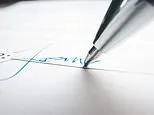
Researchers say that a handwriting trait could be used to detect Parkinson's disease
In Parkinson's, the breakdown of neurons can cause symptoms including tremors – movements outside the person's control – which may leave sufferers unable to hold a pen steady.
Nearly all Parkinson's patients experience tremors, which may emerge early in the disease or during its later stages.
Other conditions can also cause tremors including hyperthyroidism, low blood sugar, certain medications and withdrawal from substances including alcohol.
The team said in their study: 'Handwritten images provide spatial characteristics of stroke irregularities, tremor-induced distortions and shape deviations.
'In contrast, sensor-based handwriting signals capture motor behavior, which includes velocity fluctuations, pressure inconsistencies and coordination.'