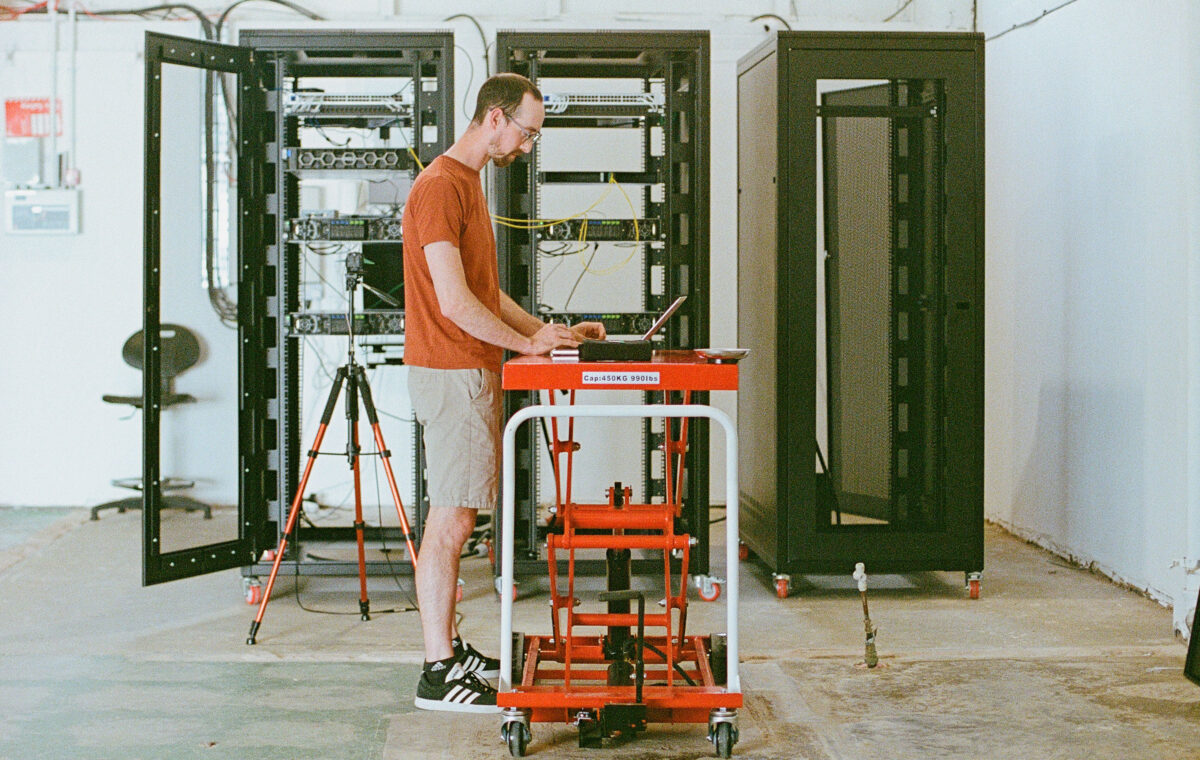
In the corner of a nondescript office in Sheffield, a city in the north of England, a compact server full of Nvidia chips is whirring away.
It’s a microcosm of the huge data centers springing up all over the globe: town-sized, energy-guzzling computers that are the worldly manifestations of frontier AI models.
Here in Sheffield, on these eight chips, engineers from the consultancy Amodo Design are piloting a monitoring system that they hope, one day, might find its way into every data center, allaying the fears of AI researchers who are concerned that the technology they are building may destroy the world.
In late July, more than 1,300 employees of frontier AI companies signed an open letter warning that their AI is quickly becoming so powerful that humans may soon no longer be able to control it. Slowing the pace of AI development, they warned, may become vital in order to allow more time for safety research, and thus avert catastrophe. But slowing down, they wrote, is essentially impossible, due to intense competition between companies and countries. The AI race is stuck in an arms-race dynamic, these top scientists say, in which one team slowing down would only hand victory to rivals that don’t.
The letter’s main request—one so important to 1,300 of the world’s top AI researchers that they called publicly for it—was for the U.S. government to support an international effort to build tools that would enable all sides to slow down the AI race.
So far, only a small group of people are working on this effort. There are fewer than 50 engineers in the world working full-time on building so-called “AI verification” tools, Amodo CEO Tom Milton estimates—nine of them at Amodo—plus a few dozen more policy researchers scattered among a handful of companies and research institutes. Meanwhile, trillions of dollars, and the combined might of the world’s biggest tech companies, are now dedicated to making AI systems more powerful as quickly as possible. Efforts to build slowdown tools are funded mostly by academia and philanthropy. (Amodo’s work in this area is funded by the Survival and Flourishing Fund and Longview Philanthropy, two grantmakers that have donated heavily toward reducing AI-related risks.)
“It is surprising that very few people are doing it,” says Milton, a 28-year-old who fell into the field almost by accident several years ago, when Amodo was commissioned to do some work in the area.
In Sheffield, three workers are huddled around their compute cluster, under an air conditioning unit that is running on full-blast. Their small-scale prototype may be running hot, but it isn’t ready yet. Many technical obstacles remain in its way, plus a bigger political one: it won’t be useful unless the U.S. and China come to the table and agree on an AI slowdown treaty, Milton says.
For now at least, such an agreement looks unlikely. But Amodo’s engineers are keenly aware that political choices are downstream from what is possible. Treaties that curtailed the Cold War arms race were only possible because new technologies, like satellites and seismometers, allowed each side to verify the other’s compliance. Milton expects a similar moment to arrive for AI. When that moment comes, he wants to be ready.
Halfdan Holm, an Amodo staffer, adjusts the server rack that is running Amodo's recomputation algorithm in Sheffield, England Courtesy of Tom Milton—Amodo
Nobody knows how an AI slowdown treaty might look, but Amodo’s engineers believe it will probably require monitoring data centers, given that these are the places where AI physically lives.
The current prototype that Amodo is building could make it possible to gain two assurances about a data center that might be helpful in the years to come, Milton says.
First, that a data center is only being used for inference. That means the running of existing AI models, rather than the training of new, more powerful ones.
Second, that a data center is running a particular, agreed-upon model—for example, one that has passed certain safety tests, perhaps ones that have been set down in law.
To demonstrate how this might work, an Amodo engineer logs into the whirring server rack, where he spins up two separate systems, each containing an open-source AI model made by OpenAI.