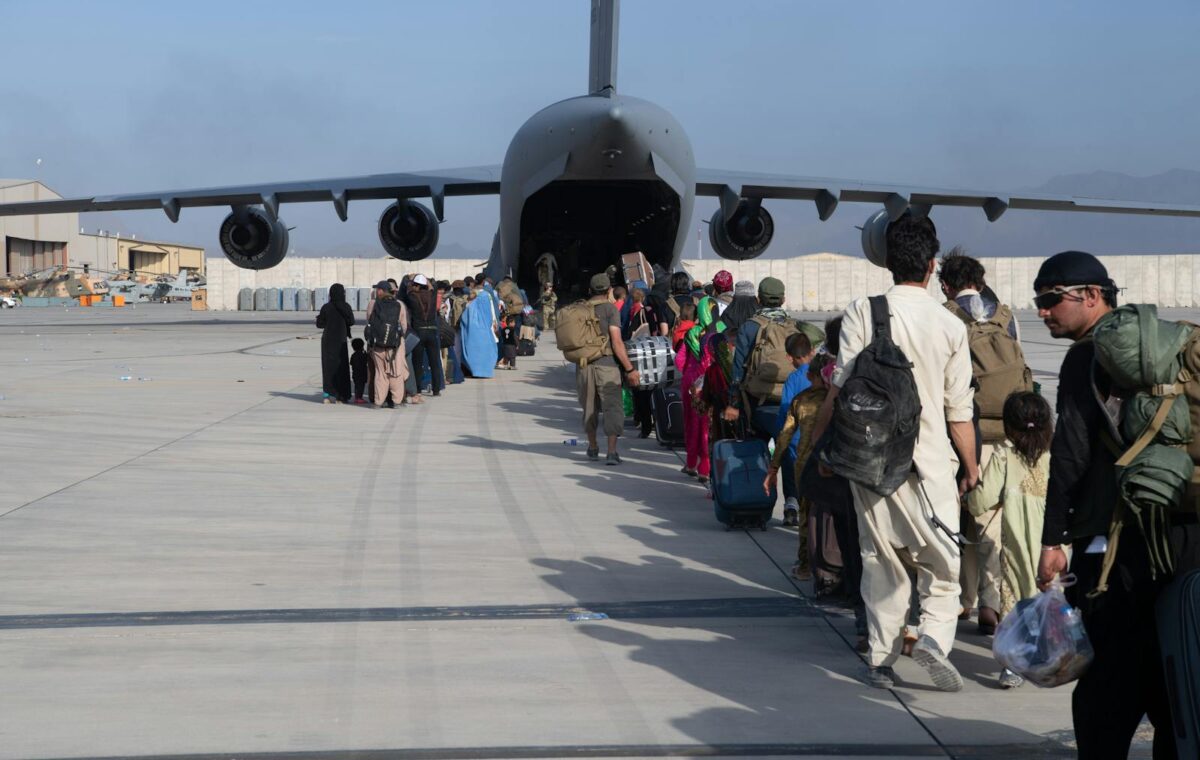
Five years ago this month, when the U.S. military withdrew from Afghanistan and Kabul fell to the Taliban, Sayed Sadat was out of the country earning his master’s degree at a university in Germany. Having worked with the American government as a lawyer in Afghanistan, Sadat believed it would be relatively easy for himself and his wife to apply for asylum in the United States.
Despite beginning his application in 2021, he did not arrive in the U.S. until 2024. Because his wife was included in his asylum application, he expected that she would join him shortly after he arrived. She had previously been informed by the United Nations International Office of Migration in Jordan that she would be able to receive a visa, then be evacuated first to the United Arab Emirates and the United States. But conditions changed before she could leave Afghanistan: President Donald Trump took office in January of 2025.
It wasn’t long before she heard the bad news. Sadat’s wife received word that the Trump administration had suspended resettlement of refugees. As a result, she would be unable to leave Afghanistan for an indefinite period of time. Sadat has not seen his wife in five years.
Along with halting the refugee resettlement program, the Trump administration has suspended visas and immigration requests for all Afghan migrants, and included Afghanistan in a travel ban that makes it nearly impossible for any Afghan—including family members of asylum seekers already in the country—to enter the U.S. Even for those relatives who have seen their petitions approved, the State Department refuses to issue travel documents in accordance with the travel ban.
“Every day, when she’s calling me three times a day, she’s asking me six times a day: ‘Is the travel ban over, and is the family reunification open now? When is the time that we’re going to be reunited?’ I don’t have an answer for her,” said Sadat. Meanwhile, he has been unable to obtain his green card because of the pause on visa processing.
Sadat’s situation is common for Afghans living in the U.S., nearly 200,000 of whom arrived in the wake of the U.S. withdrawal from Afghanistan. Tens of thousands were admitted through humanitarian parole, a temporary legal status for evacuees. Others arrived as holders of Special Immigrant Visas, or SIVs, reserved for allies who assisted the U.S. military during the war in Afghanistan. To Afghans and their supporters in the U.S., including many American veterans with whom they worked alongside—an alliance that puts those who assisted U.S. forces at risk now that the Taliban has resumed control—the administration’s policies and congressional inaction are a betrayal of trust.
Speaking in a press call, Sharif Ali, the president of the International Refugee Assistance Project, a legal aid and advocacy organization that represents refugees said, “As we take stock of whether the U.S. has lived up to its obligations and promises to the Afghans who worked and served alongside American military personnel and partners—often at great personal risks—the clear answer, unfortunately, is a resounding no.”
In July, a federal judge ruled that the Trump administration must allow the family members of asylum seekers, like Sadat’s wife, to be permitted to enter the U.S. The State Department has appealed the decision and requested a motion to stay the court’s order.
“It is really hard to achieve that sense of permanency and belonging when your family’s still separated and you don’t know that they’re safe, or you know that they’re not safe,” said said Kristyn Peck, the CEO of the Lutheran Social Services of the National Capital Area, a regional refugee resettlement organization.
Sadat also hears stories from fellow community members as an intake and administrative coordinator in the Sacramento office of World Relief, a refugee resettlement organization. Family separation weighs most heavily on these clients, as their relatives of all ages are stuck in Afghanistan or neighboring countries. Sadat said that sometimes he will hear from parents that their children in Afghanistan feel abandoned, and will no longer speak to them. The uncertainty has contributed to a frustration within the Afghan community writ large, and a sense that they have been left behind by the American government.
“They’re, like, emotionally hurt. Their feelings are hurt, they don’t believe that anything will happen soon. As I don’t expect that anything will happen soon,” said Sadat. “I even heard from one of the Afghan community members here, they said, like, ‘We were betrayed.’”
The Trump administration also removed a previous exception for SIV holders to the travel ban, who are already stuck in an approval process that has been found in court to be unlawfully slow. Shawn VanDiver, the founder and president of #AfghanEvac, an organization that was founded in 2021 to facilitate the arrival of Afghans into the U.S., said [in a press call] that nearly 180,000 people have been approved for visas but are still waiting for interviews.
“They finished all of the paperwork. All they needed is an interview, a medical check, and a visa printed. That’s not a backlog. A backlog is what you have when you’re working through cases. This is what you have when you just stop it,” VanDiver said. He added that roughly 3,000 relatives of current active-duty American service members are stranded outside of the United States, including 150 in Camp As Sayliyah, a refugee camp in Qatar. The 1,100 Afghan families currently living there have been vetted by the U.S. government.
The Trump administration has also ended Temporary Protected Status for Afghans, leaving around 11,000 Afghans in the U.S. unable to work and facing the threat of detention and deportation. Even those with seemingly secure legal status have been subject to new scrutiny. The Department of Homeland Security has sent notices to hundreds of Afghans with green cards who arrived through SIVs saying that the approval letters that formed the basis of their applications have been revoked.
Afghan refugees are also being subject to re-vetting and re-interviewing. Peck recalled a recent conversation with an Afghan man who approached her at an Iftar dinner, the celebration of the end of Ramadan. He had received the summons for a re-interview on a Friday, and it was scheduled for the following Wednesday, giving him just a few days to prepare. The organization’s legal team was able to represent him at his interview, which lasted for five hours.