A horrific knife attack on a street in June sparked another summer’s night of racial violence, stoked by loyalist groups. How did the unrest erupt – and why do many fear it will happen again?
Shortly after 10.30pm on Monday 8 June, as a summer twilight lingered over Belfast, a horrific scene unfolded on Kinnaird Avenue: a man straddled and repeatedly stabbed a figure lying on the ground in a bloody assault that ended only after onlookers intervened.
Others captured the drama on cameraphones and uploaded the footage to social media. Once seen, the grainy images were hard to forget, and by dawn on Tuesday 9 June they were ricocheting around X, WhatsApp, Facebook, Telegram and other platforms.
Many commentators highlighted one aspect: the assailant was black, the victim white.
Police had a suspect in custody – he was initially identified as a refugee from Somalia, later corrected to Sudan – but this did not stem a cascade of outrage. What, commentators demanded to know, about other foreign men of “military age” in Northern Ireland? Had they been “vetted”? What “alien culture” had they imported?
By 9.30am a message – an exhortation – was being widely shared. “All business to close at 5.30pm tonight. No excuses.” It listed 25 locations around Northern Ireland for people to gather at 7pm. “Please forward [to] all men of the age of 18 and over. Wear dark clothing … and be prepared to fight or be arrested.”
Far-right agitators, such as Elon Musk and Stephen Yaxley-Lennon, known by his alias Tommy Robinson, amplified calls to protest, and those interventions were prominent in the coverage that followed.
Through a combination of interviews with witnesses and people who responded to the unrest, on-the-ground reporting in loyalist strongholds and at far-right rallies in Northern Ireland, and analysis of messages sent by figures connected to the extreme right, the Guardian has established the most complete picture yet of how a single incident of horrific violence precipitated the crisis. And it suggests that organisers in Belfast needed no encouragement or direction. This was their show.
Drawing on previous eruptions of violence – this was to be the third consecutive summer of racial disturbances in Northern Ireland – the organisers issued further instructions: leave mobile phones at home and deactivate dashcams and doorbell cameras.
By early afternoon, schools were sending children home, public transport was halting and steel shutters were clanging down over foreign-owned barber shops, supermarkets and other businesses.
As families sat down for dinner, crowds gathered at designated roundabouts and intersections in loyalist areas across the city.
At about 7.30pm a woman with a megaphone on the Shankill Road recited the Lord’s Prayer to several hundred people, some draped in union flags. They marched through terraced sidestreets and halted outside the home of a Romanian family. A nearby Black family, anticipating trouble, had already fled and asked neighbours to move their car.
The Romanian family’s windows had been “put out” twice before, but the family had refused to leave. The previous night’s stabbing had nothing to do with the Romanians but somehow alchemised into what one woman in the crowd called “the last straw”.
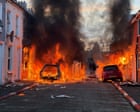
Dozens of boys and men wearing hoods and masks surged forward. Some launched bricks through windows, others shoved fireworks through the letterbox. A woman inside, visible to the crowd, watched helplessly as her home came under attack. The family’s car went up in flames, then men in balaclavas broke down the door.
Women and children in the mob observed proceedings. “There’s wee girls inside,” said one. In contrast to race riots in England and Belfast in 2024, and in Ballymena last year, the violence was not recorded or streamed on mobile phones. A teenage boy who ignored the injunction against filming was dragged aside and chastised.