An underpowered Tensor chip and odd game glitches keep the Pixel 11 Pro from nabbing the top spot on our gaming phone rankings.
In 2025, I lauded the Google Pixel 10 Pro for its bright, vibrant display that was great to game on. Now, its successor has arrived, and although it looks identical — with some slight hardware changes — the luster has worn off. The Google Pixel 11 Pro feels underpowered when it comes to gaming, and odd glitches that emerged while playing make it harder to recommend for gaming on the go.
The Google Pixel 11 Pro is unquestionably the best phone Google has ever released, with its AI-powering Tensor G6 chip, a trio of great cameras with refined photo software and an expansive list of generative AI features. With all these advantages, the 11 Pro is one of the best phones out there for taking pictures. But its hardware and software edge doesn’t extend as much to gaming as other phones do, such as the Samsung Galaxy S26 and its Snapdragon 8 Elite Gen 5 chip.
In practice, the Pixel 11 Pro struggles with higher graphics settings within games, and will pop up warnings about overheating and battery drain when I pump it up above the lowest resolution, frame rate and detailing. It’s a bit surprising given the phone’s premium price.
Unfortunately, that price has gone up, though in a roundabout way. Google got rid of the 128GB entry option for its entire lineup, so the $1,099 starting price for the Pixel 11 Pro with 256GB of storage is the same price as last year at that storage level — you just can’t pick up a lower-storage configuration for under $1,000 anymore. That’s especially limiting for mobile gamers, since installing multiple titles can quickly eat through the available storage. The action RPG Genshin Impact alone takes up 55GB.
When reached for comment, Google confirmed that the raised storage and price reflects the impact of the RAM shortage, driven by AI, which has made components more expensive across consumer tech. But it bites the Pixel 11 Pro phones in another way: That new entry model comes with only 12GB of RAM. You’ll still get 16GB with the 512GB and 1TB storage options ($1,219 and $1,499 respectively, $50 higher than last year’s prices), but it’s a bummer after last year’s 10 Pro series all shipped with 16GB.
Google says that this reduction in RAM doesn’t matter as much, since its 11 Pro phones are faster and smoother than last year’s thanks to optimizations in silicon and software. I wasn’t able to test this claim, as the Pixel 11 Pro review unit Google sent me had 512GB of storage and 16GB of RAM, but it’s worth keeping in mind.
With those considerations, the Pixel 11 Pro starts off with compromises, which progressed as I spent more time gaming on the phone.
As with last year’s Pixel 10 Pro, the new Pixel 11 Pro stands out among other phones with its 6.3-inch OLED display. Details are crisp with its 2,856×1,280-pixel resolution and colors are vivid with HDR10 Plus support.
Once again, the 3,600-nit maximum brightness sets the Pixel 11 Pro’s screen apart from competitors, allowing me to play in direct sunlight and brightening up dark rooms. Other phones are catching up, with screens on this year’s Samsung Galaxy S26 at 2,600 nits and the iPhone 17 Pro Max at 3,000 nits. But the Pixel 11 Pro keeps its lead, showing a stunning array of colors and details from games of all genres.
The phone itself is comfortable enough to hold and play. While it’s physically identical to the Pixel 10 Pro from last year, the metal frame ringing the sides feels slightly more polished, leading my fingers to slip on it while gaming — perhaps the tiniest nitpick I’ve ever had with a phone. The wide camera bump on the back of the Pixel 11 Pro rises up enough to make for a decent finger hold, though unavoidably touching the bump’s metal rim and glass becomes a problem when the handset heats up during high-graphics gaming (more on that later).
The dual speakers at the top and bottom of the device pump out admirable sound. Like a lot of phones, the speaker on the bottom edge of the phone can be easily covered by a finger when holding the handset sideways to play games, which cuts off half the audio — unfortunate, but not uncommon.
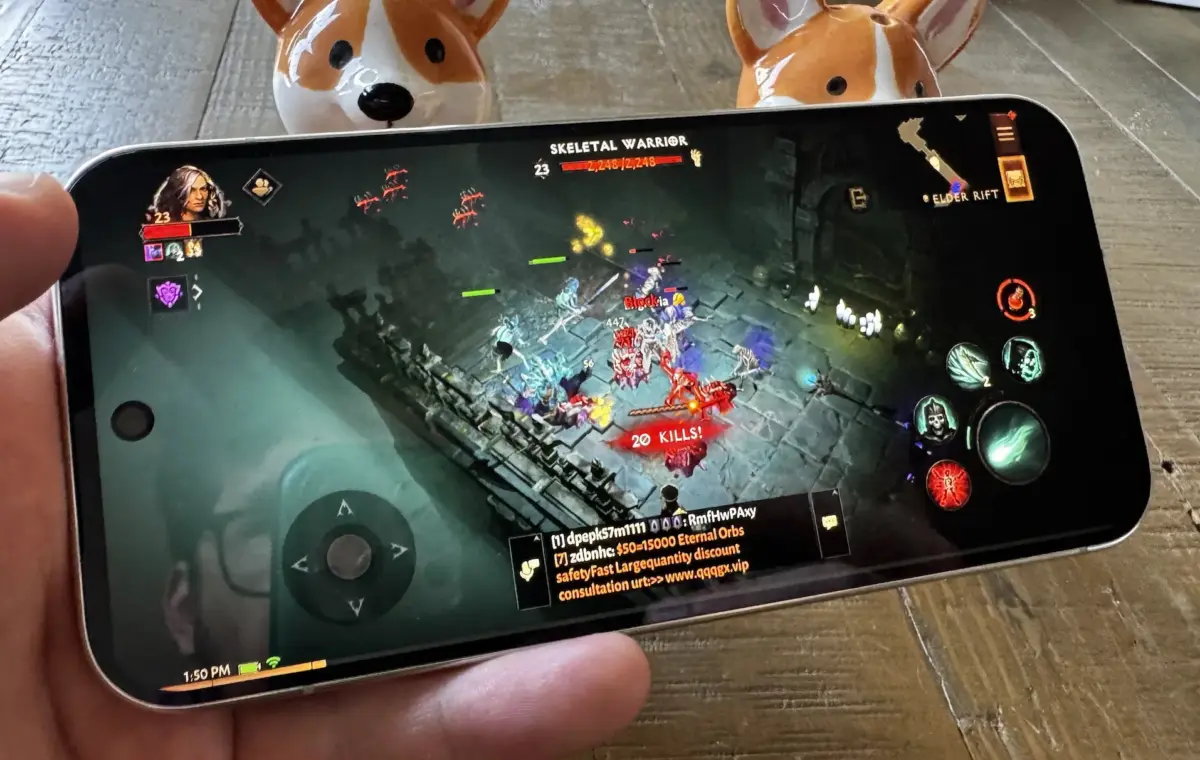
What is extremely rare in gaming are the sound issues I ran into while playing the action RPG Diablo Immortal, in which the audio occasionally switched into an echoing, garbled mess. I’d never experienced this before.
Most games have touchscreen controls in the form of parts of the screen converted to digital buttons, which are suitable, if clunky, necessities when playing on an all-glass display. The Pixel 11 Pro had suitably responsive touch controls, and the only trouble was with my own fat thumbs incorrectly pressing one part of the display instead of another. A physical wrap-around controller is a big upgrade for most games, and I relished using my Backbone One to play Dead Cells and others that rely on fast responses with a range of options to dodge or attack.
Unlike some other premium Android phones, the Pixel 11 Pro has magnets embedded in its rear cover (playfully called Pixelsnap) that makes it compatible with a lot of accessories, including wireless chargers. I was able to snap on an official Apple MagSafe charger and play while juicing it back up, which was convenient — and helpful. The phone’s 4,850-mAh battery lasted awhile through gaming, but its wired charging maxes out at 30 watts, which is slower than other phones, but I worry about the heat buildup if it were any faster. Its Qi2.2-supporting wireless charging tops out at 25 watts. Being able to top up in the middle of a play session was nice, even if it doesn’t match the faster 45-watt ability of a phone such as the Samsung Galaxy S26 Plus or even the 60-watt charging of the Galaxy S26 Ultra.