Published: 10:50 BST, 6 August 2026 | Updated: 10:51 BST, 6 August 2026
For centuries, the dodo has been the butt of jokes, its name becoming shorthand for anyone considered dim-witted, hopeless or destined to fail.
But it turns out the famously ‘stupid’ bird may have been getting a bad rap all along.
Scientists now say the extinct species was no less intelligent than modern pigeons – birds capable of recognising human faces, solving puzzles and even learning to read simple words.
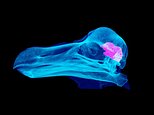
Researchers used CT scans to reconstruct the brains of dodos and compared them with those of other pigeons.
They found the region linked to cognition and memory was exactly the size expected for a pigeon of the dodo's body size.
The findings challenge the long-held belief that the flightless bird was a feather-brained simpleton. And it may have even possessed a rare ecological trait – the ability to see in the dark.
‘Our findings challenge the longstanding stereotype of the dodo as a clumsy, foolish daytime forager,’ Professor Vera Weisbecker, from Flinders University, wrote on The Conversation.
‘Instead, we may need to picture it navigating the dim Mauritian forests at sunrise or sunset and behaving with the same level of intelligence as its living pigeon relatives.’
A CT scan of a dodo skull, with the brain visible in pink. Scientists found the region linked to higher thinking was exactly the size expected for a pigeon of the dodo's body size
The findings challenge the long-held belief that the flightless bird was a feather-brained simpleton. Pictured: A reconstruction of the extinct bird (stock image)
The flightless birds evolved on the island of Mauritius without any natural enemies and reportedly approached humans out of curiosity rather than fleeing from them.
Professor Weisbecker, along with Professor Andrew Iwaniuk and researcher Sara Citron from the University of Lethbridge, said the birds may simply have had no reason to learn to be afraid.
‘Early accounts even describe people holding a captured dodo and letting it cry out so others would wander over,’ they said.
For their study, they carried out high-resolution CT scans of perfectly preserved dodo skulls – of which there are only three in existence.