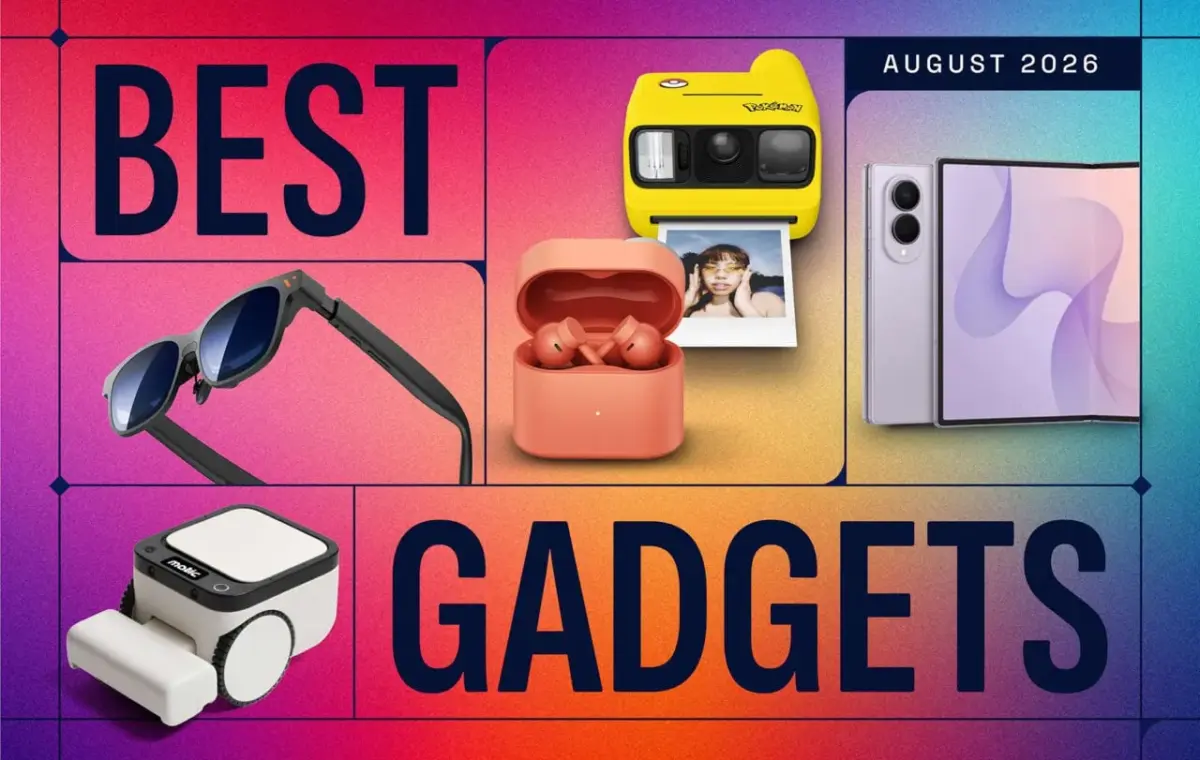
It’d be easy to misconstrue August as the calm before the storm when it comes to gadgets. Next month ushers in new iPhones, a deluge of smart home gadgets from IFA 2026, and most likely new smart glasses by way of Meta Connect, which is a lot, to be sure. But just because September is going to be an onslaught doesn’t mean August is a flyover.
This month, we ended up with a few fun surprises, including Pokemon tie-ins, flashy robovac updates, and one of the most fun phones we’ve seen in a long time. Here are all the gadgets you may have missed if you were conserving your energy and attention span for September.
The Matic isn’t totally new hardware, but an impressive update compels me to put it on this list anyway. Thanks to a new feature called Matic Cues, the Matic robot vacuum gains the ability to act on voice commands. Those commands go beyond your typical “run the vacuum,” too.
With Matic Cues, you can spot clean by pointing to a location and saying “clean this.” You can even have Matic’s robot vacuum follow you to a location to show it something by saying, “Hey Matic, follow me.” I haven’t had a chance to test it for myself, but Matic says the voice commands work across more than 70 languages and even different dialects.
Voice commands have been around for a long time, but we’ve not quite seen them show up in robot vacuums like this before. It’s a bright spot in the U.S., too, where the future of robot vacuums is a little less than bright.
Polaroids are already pretty cool, so adding Pokémon into the equation just feels unfair for our wallets, but that’s exactly what happened this month with the Polaroid x Pokémon collection.
With these instant cameras, Polaroid is giving its Polaroid Go cameras a Pokémon twist. My personal favorite is the Pikachu version that is, of course, bright yellow and comes with a strap that looks like Pikachu’s tail. If that doesn’t quite catch you, there’s a Sylveon edition that’s blue, pink, and white, and a red-and-white Poké Ball version that pairs nicely with a Poké Ball-shaped case you can buy for an additional $25.
I don’t know what else to say, guys; it even has a Poké Ball shutter button. I’m helpless against the cute, battle monster nostalgia.
The QuietComfort Headphones (2nd Gen) might not have “Ultra” in the name, but they still hammer home the appeal of Bose’s QuietComfort line. The active noise cancellation (ANC) is formidable, the sound is good, and they are as comfortable as the name suggests.
For me, the highlights are the color (I love the two-tone “Dewdrop Mint”) and the size. These are a bit smaller than the QuietComfort Headphones Ultra (2nd Gen), and they fit my head perfectly. They’re still a bit pricey at $360, but the ANC is still better than a lot of other wireless headphones around the same price range, so if cancelling noise is a big priority, then these wireless headphones are worth a look.
See Bose QuietComfort (2nd Gen) at Amazon
The king is back with Insta360’s new X6 360 camera. Thanks to excellent low-light quality, battery life, and tons of gimbal modes, we gave this action camera high marks. As Gizmodo staff reporter Kyle Barr notes, this camera isn’t breaking new ground; it just does everything a bit better than the competition.
That being said, this is a $700 action camera, so for that price, you’d better hope that it impresses. If you have the money, though, the improved 1/1.1-inch sensor and the great 360-video processing make this a top option in the action camera space.
AR glasses are hot right now, and the competition has been fierce. While the space is dominated by Google’s involvement with Aura—its upcoming XR glasses with Xreal—lesser-known companies like Viture are proving to be formidable. For proof, look no further than the Viture Pro 2.
At $299, these AR glasses are a great mix of sharpness, brightness, and functionality. Thanks to a companion app, you can take advantage of some spatial-esque computing and can even convert videos and pictures to 3D. One unique addition you won’t find from RayNeo or Xreal is built-in diopters, which can adjust the display for your vision—this is especially useful for nearsighted people.