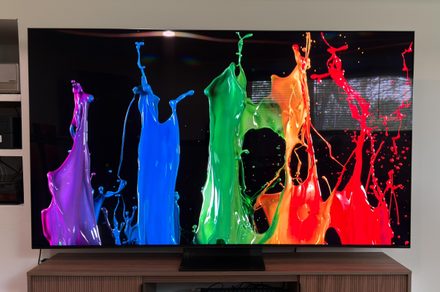
Two months ago I reviewed the TCL QM8L and called it the TV to beat for 2026. The QM7L sits one rung below it in TCL’s lineup for this year, and at $2,499 for the 85-inch model I tested, it’s the least expensive way to get the company’s Super Quantum Dot (SQD) panel technology.
It uses the same SQD quantum dots and color filter as the QM8L and X11L, plus the QM8L’s 26-bit backlight controller and Gemini-powered Google TV. The main differences are in what TCL trimmed to get the price down. A standard HVA 2.0 Pro panel replaces the QM8L’s WHVA 2.0, the dimming zones and brightness ceiling come down, and only two of the HDMI ports run at full HDMI 2.1 bandwidth.
After several weeks with the QM7L as my daily TV, I think TCL cut in the right places, yielding a budget-friendly unit that rivals some flagships. The main compromise you’ll actually notice is built-in audio that’s merely ok. Though for $1,500 less than the 85-inch QM8L, I think most people will be happy to make that trade.
Quick take: Familiar TCL design and a backlit remote without the QM8L’s extras
The QM7L looks a lot like last year’s QM7K. It has a brushed gunmetal frame with thin bezels on the top and sides and a chin along the bottom. The panel is a little over two inches thick, and the back is plastic.
The two-piece center pedestal sits on furniture far narrower than the panel and has two height positions to fit a soundbar underneath. The heavy reliance on plastic is to be expected at this price point.
The remote is the same basic design as the QM7K’s. It’s heavy on plastic with a brushed finish and backlit buttons. You get streaming shortcuts and an input button, but not the brightness rocker from the QM8L and X11L remotes, which I used constantly at night. I seem to have an aversion to using auto brightness. Don’t ask me why.
The inputs face out from the right edge, so you won’t have to blindly reach behind a mounted TV, and they’re joined by USB 3.0 and 2.0, Ethernet, optical out, and an ATSC 1.0 tuner.
Only HDMI 1 and 2 run at full bandwidth for 4K at 144Hz, while 3 and 4 top out at 4K at 60Hz. Thankfully, eARC duties fall to HDMI 4, so plugging in a soundbar won’t use up one of the faster ports.
Gamers get 4K at 144Hz, 288Hz at 1080p, VRR, and ALLM. Third-party lag testers put the QM7L around 10 milliseconds at 60Hz.
Quick take: Wide color and plenty of brightness on a standard VA panel
I’ve explained SQD in my X11L and QM8L reviews. The short version is same-color LEDs, smaller quantum dots, and a new color filter, so color holds steady even as brightness climbs. The QM7L retains all of this even at its lower price point.
The QM7L measured a Delta E of 2.6 in Filmmaker Mode at 100 nits with all processing off. That’s good, and in the same neighborhood as the QM8L, though a step back from the QM7K’s 0.8 last year. Below 1.0 is invisible to the naked eye, so while the QM7K didn’t need a calibration, the QM7L could benefit from one.
Gamut coverage is the QM7L’s biggest strength. It covers ~97% of DCI-P3 and roughly 90 percent of Rec. 2020, the same coverage I measured on the QM8L. That’s the best you’re going to find at this price point outside of OLED.
Brightness in SDR is more than any living room needs. I measured just over 700 nits full screen and well past 2,000 nits in a 10% window with the backlight maxed. The glossy panel does pick up direct reflections, but the brightness helps make them less distracting in dark scenes.