Find this story in your account’s ‘Saved for Later’ section.
The Sirens of Titan isn’t as iconic or ingrained in our pop-culture lexicon as other Kurt Vonnegut works, like Slaughterhouse-Five or Breakfast of Champions, but it is just as prescient in its satirical bent while leaning more heavily into the pulp sci-fi imagery of the ’40s and ’50s. (Hence its overwhelming influence on such sci-fi satirists as Hitchhiker’s Guide author Douglas Adams and Rick and Morty creator Dan Harmon.) The novel’s protagonist, Malachi Constant, finds himself at the center of a plot to “save the world” through a staged Martian attack, uniting the citizens of Earth against a common enemy and, in the process, creating a false mythology to guide humanity toward a brighter, more cooperative future. Near the end of the novel, some of human history’s greatest achievements are revealed to be mundane telepathic communications of a faraway alien race, forcing Constant to ask himself, What do you do when the story of your life and the lives of everyone you know were just threads in the tapestry of some big grift from outer space?
With each passing episode of its second season, Sugar has been leading its title character to the same mind-and-spirit-shattering dilemma. The private investigator from space, reuniter of lost siblings as penance for losing his own on an extended trip to planet Earth, discovers his long-lost sister, Djen (Maeve Whalen), was the mad scientist behind the curtain all along. The grand arbiter and enemy of everything he ever believed. The season finale opens with a flashback to the moment Djen’s first breakthrough on the “Acalica project.” Those “four circles” — recently revealed by Professor Stanley to be tropospheric nodes — have succeeded in altering the atmosphere of the Atacama Desert in Chile, sprouting a rich garden of strawberries in the middle of the barren sand.
“No one can know about this,” she tells her companion, presumably a local human scientist. They’ll tell the world when the time is right, but first the tech has to be tested in other environments. She steps away from the scene to call her brother John, saying good-bye without really saying good-bye as Henry Thorpe arrives with a pair of armed men to shoot down their human witness.
Back to the present, and John Sugar gets to live out a classic case-closed fantasy where all the dirty cops and enablers are brought to justice, from Vega’s deputies to the medical examiner to the chief of staff and even the assemblywoman who secured government-housing grants for Vega’s scheme and looked the other way. Sugar confronts her at a ceremonial funeral for the unknown deceased, a fittingly dramatic setting for our guy to have the final word as FBI agents roll up on the assemblywoman. But John Sugar the man and Sugar the series have only begun to address the naïveté at the heart of America’s faith in law and order, and the idolatrous image of the “honest policeman” that is its lifeblood. “Jonathan Siegel called you our next great defender of the defenseless,” Sugar tells the assemblywoman with an air of chastisement. His judgment, though well-placed, rings hollow in the face of the systemic corruption he (and we) are still unable to acknowledge fully.
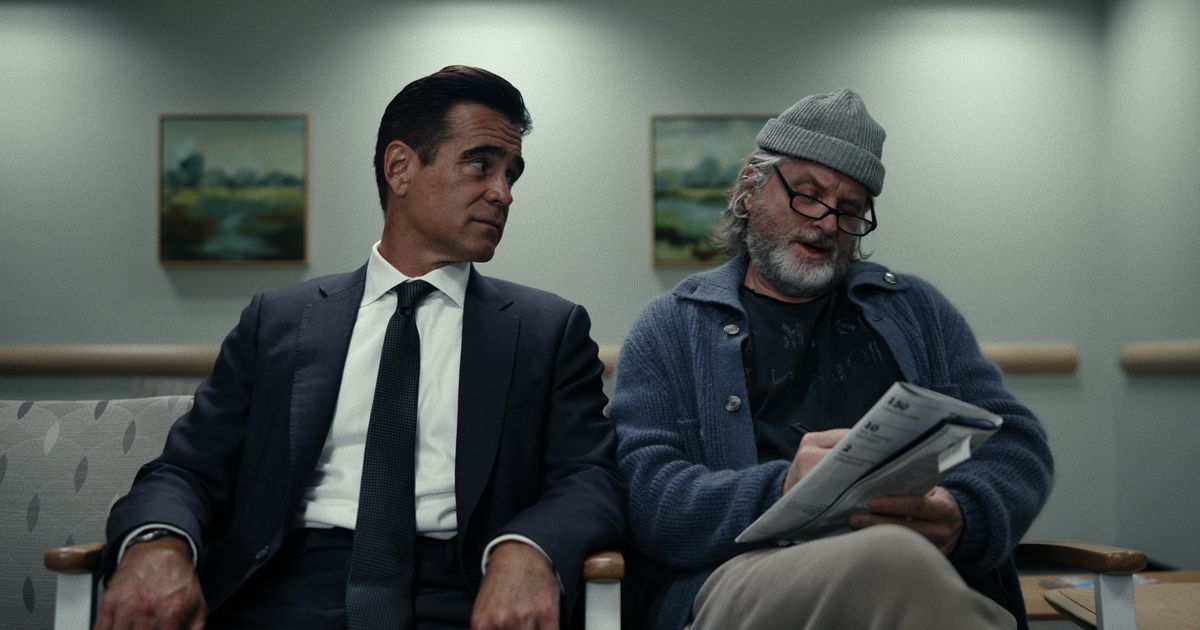
Then again, I suppose we are in the sci-fi realm of bringing our entire existence and place in the universe into question here, criminal-justice system and all. “Everyone now knows how to find the meaning of life within himself,” begins The Sirens of Titan. “But mankind wasn’t always so lucky.” With justice served, Sugar finds himself feeling hollowed out, sitting in a radiologist’s waiting room with Flybjerg. No longer affording himself the excuse of self-defense, he describes the blind rage that overtook him when he killed Vega, like an invading force that left a black hole in his fracturing human psyche. “I can’t reconcile who I thought I was,” he tells Flybjerg, who comes back with a final bit of cowboy wisdom through the grumbles and coughs of a man slowly dying of a Doc Holiday–vintage case of tuberculosis (or “consumption,” if the parlance of the silver-screen frontier serves): “Sometimes all we can be is just a little bit better than the alternative.” The human condition expressed in blunt, fundamental terms. The way toward light is still forward, no matter how far back you’ve sunk into darkness.
For now, the light of John Sugar’s life in black-and-white turned ambiguously Technicolor is Charlotte. A brief montage of Sugar testing the new, wider boundaries of his colorful humanity — getting his hands bloody in an underground boxing match, pining over images of a home long lost in a makeshift mausoleum of film-noir paraphernalia — ends on a date at the beach where Charlotte invites Sugar to come with her to her new assignment in Milan. “See what it’s like … See what we’re like,” as she puts it. What’s keeping Sugar here, anyway? Case is solved; all his friends are gone. Charlotte mentioning that last bit is what tips him off — some combination of the personal sting of it and the suspicious emphasis on Sugar’s conveniently unmoored status, all cases and concerns in L.A. seemingly forced into the rearview. Time for the big reveal.
Sugar drops Charlotte off at the hotel then suits up for a final confrontation at Senator Pavich’s mansion only to find her there waiting for him. Then it’s all slow steps, quick cuts, and warping walls under Dutch angles as Djen reveals herself and her master plan. The Acalica project went against their space traveler’s observe-and-report prime directive, so, aided by Henry Thorpe, Djen exposed Ruby and the other aliens, forcing them to leave Earth and her to create an environment-saving technology unabated. As for her brother, John, he was new to Earth and couldn’t be trusted to join in on Djen’s master plan. “You didn’t know this place yet,” she says. “You hadn’t seen what I’d seen, not just the beauty but the horror too, the cruelty. Their disregard for the sanctity of nature … I couldn’t just stand by and watch this planet die.” Sugar absolutely nails the golden rule of “A good villain is right.” Sugar tells her that she’s changed, and it scares him. The most likely truth of the matter, though, is that his big sister hasn’t changed at all, but he’s finally seeing her for who she is, past the saintly façade conjured in a grieving little brother’s heart.
Pavich, Stanley, and a small group of elite observers (presumably all or mostly human) gather for a demonstration of the four circles outside. Rain, snow, and light fall on the crowd, nestled in the Hollywood Hills. “They think that this is for them. They have no idea this is for us,” Djen tells Sugar as he drifts out of consciousness, having just been drugged by Charlotte. Her eyes flash a menacing blue as the scene switches to a film-noir black-and-white. As his mind retreats to the hues of old movies, Charlotte breaks the fog with a glimmer of humanity. “Meet John Sugar. Have a conversation. Write down your impressions and send them to me. That’s all. The rest was me. The rest was true.” Hard to say whether this was a real confrontation or hallucination, but Charlotte’s words ring true in light of the evidence of their romance thus far. Much of Charlotte’s true identity remains a mystery, but should Sugar land a deal for a third season, there’s certainly enough to suggest this love story would continue.
Where does this all leave John Sugar for now? “Maybe somewhere I expected all along,” Sugar says, evoking the bittersweet ending of The Third Man, in which the hero “waits by the side of the road for the girl he loves to rush into his arms. But the hero is a fool … and his love walks by without even a look.” So what do you do with the wasteland you’re left with? Malachi Constant finds the answer to this question at the end of The Sirens of Titan, when free will, as we understand it on Earth, is revealed to be one big cosmic joke. “A purpose of human life,” he concludes, “no matter who is controlling it, is to love whoever is around to be loved.”
Sugar comes to more or less the same conclusion in conversation with Jonathan Siegel, our benevolent old-school movie mogul from last season. James Cromwell’s humanity-affirming vocal tone and cadence make for a fitting Greek-chorus delivery as he eats his lunch from the center of an empty movie studio. Sugar speaks of his fears of the “assimilation” his alien peers warned him about — the longer they stay on Earth, the more it can change them. For good. Does committing acts of which he thought himself incapable before he came to Earth a sign that he’s losing himself? There’s no avoiding the experiences of this world changing you, for good or ill, Siegel argues. But that’s the path toward oneself, not away. “How do you seem to me?” Siegel asks. “You seem like Sugar.”
And so, with all the bright-eyed, bushy-tailed confidence of a boy reunited with his long-lost pup, Sugar decides to stick around and settle in — go to the dark park, meet new people, maybe find a new case, and most certainly “love whoever’s around to be loved.” Sugar leaves his hotel room to meet the bright new day just as his space-communication box blinks with the promise of a new message. And whether what remains of Djen’s diabolical plot is ultimately revealed in future chapters, the lost spaceman has landed on solid ground.
By submitting your email, you agree to our Terms and Privacy Notice and to receive email correspondence from us.