Using advanced neutron imaging, researchers scanning fossils from Queensland uncovered clues about the complex food chain of prehistoric Earth.
When you purchase through links on our site, we may earn an affiliate commission. Here’s how it works.
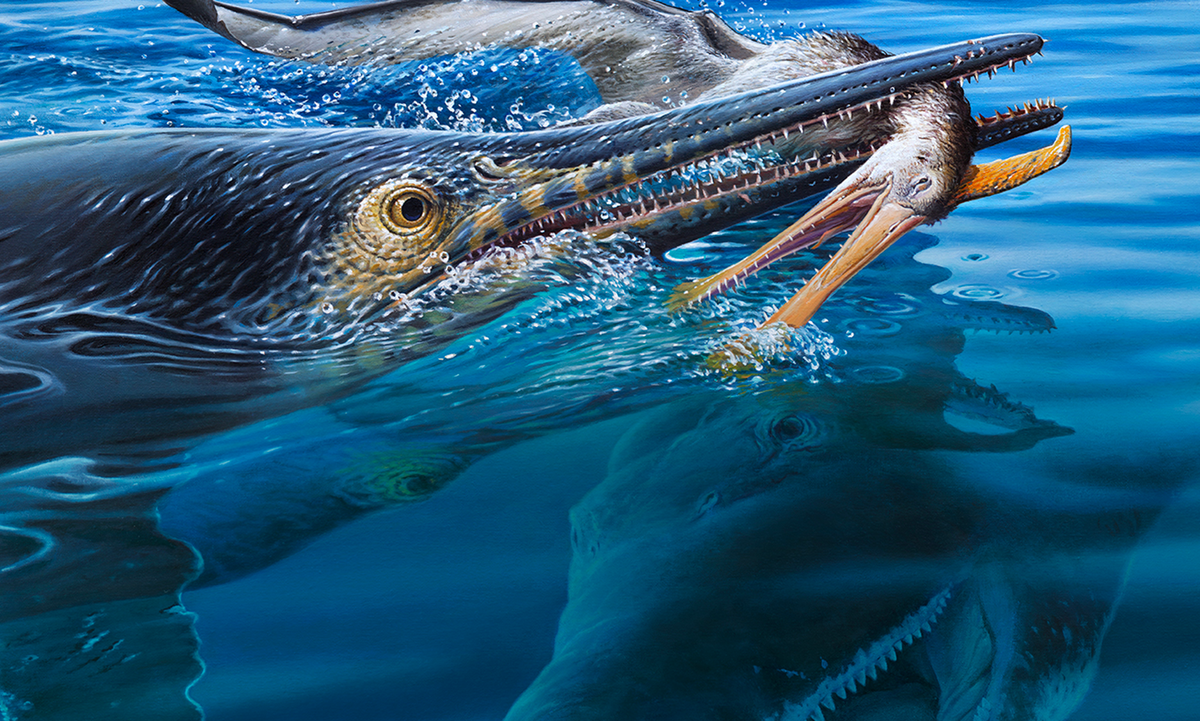
An illustration of an ichthyosaur eating a pterosaur, while a pliosaur lurks beneath.
An ichthyosaur fossil found in Australia's outback may preserve a rare snapshot of a prehistoric food chain. Around 100 million years ago, the enormous marine reptile swallowed a flying pterosaur before being attacked by a giant ocean predator, new research suggests.
The fossil set, nicknamed "BOB" or "Bag of Bones," belonged to a 20- to 23-foot-long (6 to 7 meters) ichthyosaur, an animal that belonged to a group of dolphin-shaped marine reptiles that lived alongside the dinosaurs during the Mesozoic era, from about 250 million to 90 million years ago. But in a new study, researchers discovered fragments of a pterosaur's jaw — along with fish and cephalopod remains — preserved inside the animal's body cavity.
The finding is the first confirmed evidence that ichthyosaurs ate pterosaurs, an extinct group of flying reptiles that ruled the ancient skies, according to the new study, published July 28 in the journal Gondwana Research.
The fossils may also hint at the ichthyosaur's violent end. Its skeleton — discovered in 2019 in Queensland's outback — contains shattered bones, missing ribs and large crushing injuries. Researchers think the gruesome wounds may have been inflicted by Kronosaurus queenslandicus, a colossal crocodile-like apex predator that lived 120 million to 100 million years ago in the ancient Eromanga Sea in Australia.
Fossilized stomach contents are a rare find because they can be preserved only under very specific conditions.
"Rapid burial after death is essential to prevent decay and scattering of remains," study co-author Matt White, a research associate at the University of New England in Australia, told Live Science in an email. "The animal must have died soon after its last meal so stomach acids don't fully digest the prey."
The ichthyosaur fossil set "BOB" gets scanned.
Researchers used advanced neutron imaging to peer inside BOB's stomach contents without breaking any of the fossilized formations. The scans revealed hidden bones and helped scientists determine that the remains were likely associated with the ichthyosaur's digestive system.
Get the world’s most fascinating discoveries delivered straight to your inbox.
White said that advances in imaging technology are making it possible to uncover evidence that would previously have remained hidden inside fossils.
"Scanning techniques have also improved, which has enabled us to see inside specimens and reveal what they potentially ate," White said. The methods can also reveal "the shape of various organs" and internal bone structures, he added.
The pterosaur remains were found near the front of the ichthyosaur's body cavity rather than in their expected position as digested prey, which White and his colleagues think may be because the ichthyosaur struck the seafloor headfirst shortly after its last meal, shifting some of its stomach contents forward.