By STACY LIBERATORE, US SCIENCE & TECHNOLOGY EDITOR
Published: 19:30 BST, 5 August 2026 | Updated: 19:48 BST, 5 August 2026
Dangerous toxins are spreading across the American West, bringing an invisible threat capable of reaching deep inside the human body.
Wildfire smoke and particulate advisories were in force across Oregon, Washington, Idaho, Wyoming, Colorado and Nevada on Wednesday.
Air quality had fallen to unhealthy levels in several areas as smoke poured from fires burning across the Pacific Northwest and elsewhere in the West.
Some warnings were scheduled to expire Thursday or Friday, while large sections of Oregon and Washington remained under advisories until further notice.
Officials said shifting winds were carrying smoke across state lines, filling the air with fine particles and reducing visibility.
Residents in the worst-affected areas were advised to stay indoors, shut their windows and doors and avoid strenuous outdoor activity.
The microscopic particles can bypass many of the body’s natural defenses, lodge deep within the lungs and, in some cases, enter the bloodstream.
Children, pregnant women, older adults and people with heart disease, asthma or other respiratory conditions face the greatest risk.
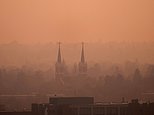
Dangerous toxins are spreading across the American West, bringing an invisible threat capable of reaching deep inside the human body
Wildfire smoke is a complex mixture of gases and particles released when trees, vegetation, buildings and other materials burn.
The greatest threat comes from fine particulate matter known as PM2.5, named because each particle measures no more than 2.5 micrometers across, roughly 30 times smaller than the width of a human hair.
Larger particles are often trapped in the nose or throat, but PM2.5 can travel through the airways and reach the tiny air sacs deep inside the lungs where oxygen passes into the blood.
Some of the smallest particles may cross into circulation, potentially affecting organs beyond the respiratory system.