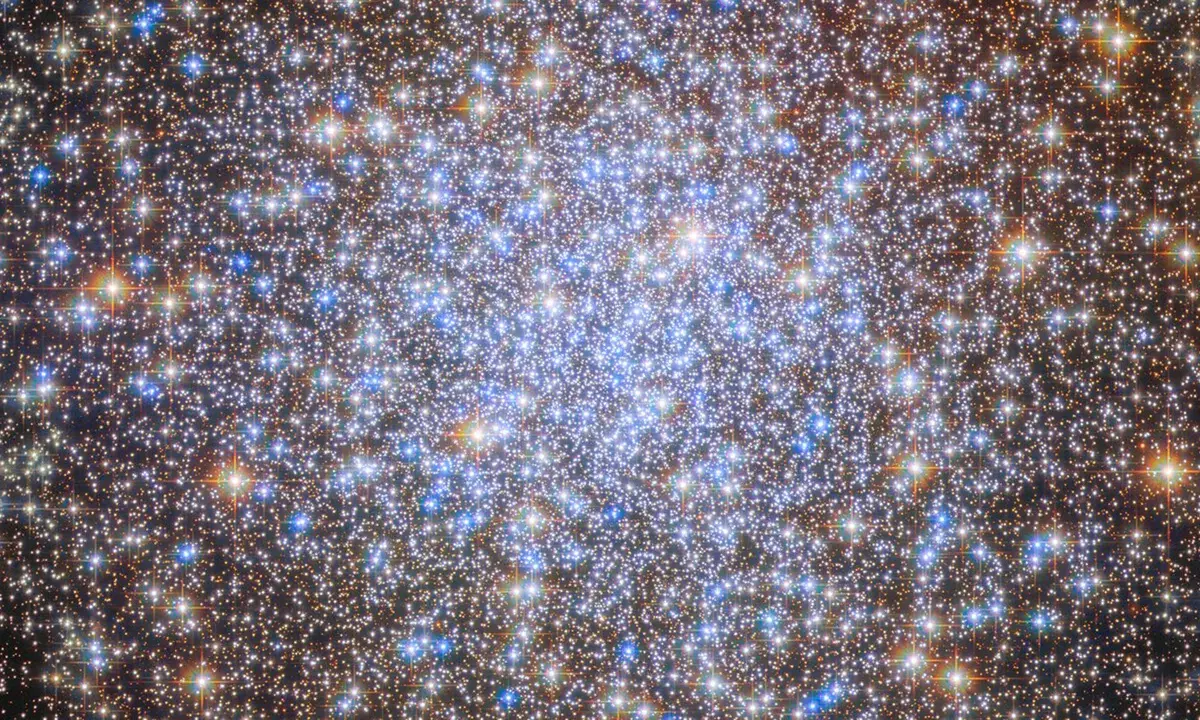
A dazzling new Hubble image of NGC 6723 poses one of astronomy's biggest questions: How did the Milky Way's oldest star clusters form?
When you purchase through links on our site, we may earn an affiliate commission. Here’s how it works.
NGC 6723 is a globular cluster, an ancient inhabitant of the Milky Way galaxy.
What it is: NGC 6723, the "Chandelier Cluster"
Where it is: 27,000 light-years away, in the constellation Sagittarius
In this single Hubble Space Telescope image, tens of thousands — possibly millions — of stars bound tightly by gravity sparkle as one. This is NGC 6723, a glittering globular cluster about 27,000 light-years away, in the constellation Sagittarius.
Also known as the Chandelier Cluster, this swarm of stars is one of about 150 known globular clusters that orbit in the halo of the Milky Way, though others may remain hidden behind thick cosmic dust or crowded star fields at the galaxy's bright core.
Globular clusters like NGC 6723 are among the most ancient structures in our galaxy. What baffles astronomers most is the age of the stars within them. These clusters often contain stars older than 10 billion years, with some dating back almost to the beginning of the universe itself 13.8 billion years ago. They likely formed early in the history of the Milky Way, billions of years before the thin disk of stars where the sun now orbits took shape.
It was once thought that all stars inside a globular cluster formed at the same time, from the same material, during a single burst of star formation. If that were true, the stars would have the same age and chemical composition.
However, Hubble's view demonstrates that this is not the case. The cluster is densely packed at the center, where many bright-blue stars appear concentrated, while orange stars are more prominent toward the edges. Blue stars are younger than orange stars, suggesting that globular clusters can have complex histories, with different populations of stars and subtle chemical differences among them.
Hubble first observed NGC 6723 in visible and near-infrared light as part of a major survey of 65 globular clusters in 2013. It found that massive stars sink toward the center of a cluster, while lower-mass stars drift outward. In 2013 and 2014, Hubble studied NGC 6723 to search for small chemical differences between stars and to measure the spread of ages of stars within the cluster. Two epochs were found, with the second burst of stars happening about 634 million years after the first.
One leading idea is that globular clusters formed when enormous gas clouds collapsed rapidly in the early universe. However, recent simulations also suggest that some globular clusters may be the surviving cores of ancient dwarf galaxies that were stripped of their outer stars by larger galaxies. Either way, they're a fossil remnant hinting at how galaxies evolve.
Get the world’s most fascinating discoveries delivered straight to your inbox.
Globular clusters are not unique to the Milky Way. They are found around many kinds of galaxies, including spirals, giant ellipticals and dwarfs. The Andromeda galaxy, the nearest large spiral galaxy to the Milky Way, is estimated to host about 460 globular clusters, while the giant elliptical galaxy M87 contains roughly 15,000 globular clusters, according to NASA.
Jamie Carter is a Cardiff, U.K.-based freelance science journalist and a regular contributor to Live Science. He is the author of A Stargazing Program For Beginners and co-author of The Eclipse Effect, and leads international stargazing and eclipse-chasing tours. His work appears regularly in Space.com, Forbes, New Scientist, BBC Sky at Night, Sky & Telescope, and other major science and astronomy publications. He is also the editor of WhenIsTheNextEclipse.com.