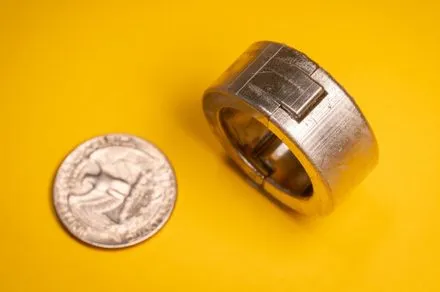
We have entered the age of biohacking now. And no, I am not talking about the extreme cases like Bryan Johnson, who is spending millions of dollars on ambitious health and de-aging goals. The average audience for wearables is now asking for more. They are feeding the sensing data collected by smartwatches, bands, and rings to AI agents, and pulling in more insights about their bodies. I created one such dashboard for myself using Claude in less than 10 minutes to make sense of the data collected by my smart ring.
But there is only so much you can do with these wearables. And that’s owing to the limitations of the underlying light-based sensor. These sensors started with measuring heart rate, and in a decade, they made impressive advancements and can now measure ECG, blood pressure changes, temperature fluctuations, and blood oxygen saturation levels. They can’t, however, dig into the biochemical side of things, the kind of stuff that requires a hospital visit or sophisticated medical gear.
When it comes to health and wellness, light-based analysis of the human blood is not the holy grail. Far from it, actually. There are a bunch of other fluids that are a treasure trove of health data. Saliva, urine, tears, and cerebrospinal fluid are among them. But in the realm of wearables, sweat has long been seen as the next big avenue for biosensing, especially for mass-market wearables. The challenge? It’s an entirely different kind of engineering challenge.
We are dealing with fluids here, and to perform a chemical analysis, one needs nothing short of a mini lab. Microfluidics is the field that has been trying to create these mini labs. Caltech researchers recently made a skin patch that can measure cholesterol levels using a sweat sample. The folks over at Pennsylvania State University also developed a similar patch back in 2023. But cramming all that sensing kit into something as small as a ring that enables continuous monitoring (and that too, for multiple chemicals at the same time) has been a daydream, so far.
Enter Tamoghana Saha, whose team at the University of California San Diego has developed a smart ring that can keep an eye on glucose, ketones, vitamin C, uric acid, lactate, and even alcohol levels by reading a sample of your sweat. And it’s not a one-off analysis. The ring, which the team calls the Continuous Health Analyzing Ring Module (CHARM), can perform continuous sweat analysis for a spell of 12 hours per charge, and maintain its calibration for a spell of two months.
It’s a huge milestone that just needs some time and polish.
The ring is bulky. It’s not waterproof. It has not been validated in clinical settings on human subjects. It can’t do multi-day monitoring. But it’s still a ring, with upgradability and repairability as a key design principle. But above all, it’s living proof that chemical analysis of your sweat is now possible right on your index finger. And it’s going to be far more versatile than a typical smart ring that can only perform a proxy light-based analysis of the blood flowing in the vessels under your skin.
Digital Trends sat down for an interview with Saha to discuss the CHARM ring, the challenges, and what it says about the future of smart rings. Let’s start with the basics. The CHARM smart ring is capable of measuring glucose, ketones, vitamin C, uric acid, lactate, and alcohol levels from your sweat. That’s a sizeable selection of biomarkers, and what they can reveal about your health and fitness levels is even more diverse.
Check out this brief overview of what an analysis of these chemicals can reveal about body health and recovery in response to medication, diet changes, and workouts in general:
Here’s the most encouraging bit. What you see in the table above is just surface-level analysis. Once you combine it with data collected from other wearables — let’s say a smartwatch or fitness band — the potential is nearly endless. Interestingly, that’s also a long-shot goal for the team at UC San Diego.
But why not just focus on the current crop of light-based sensors you get on the likes of the Apple Watch Series 11 or Oura Ring? Why explore sweat instead of taking an optical peek at the blood vessels?
“We wanted to target nutrition and diabetes in general, because if you take the individual biomarkers, their sensing mechanisms are quite well established,” Saha tells Digital Trends. “This project was mostly about showing that if you miniaturize everything, you can integrate the necessary sensors, and you can shove everything into a small form factor like that of a ring.”
It wasn’t just the technical feasibility that was a crucial victory here. The team also demonstrated that a small portion of our finger was enough for sweat analysis, and that you don’t necessarily have to stick a sensor patch on a wider area like your biceps, thighs, or back.
“I think, through this paper, we conveyed that, first of all, your ring location area, which is called the proximal phalanx, is a viable location to do sweat sensing, which people hadn’t done. I think this was a major, major message that we wanted to send out to everyone who works in these fields.”
And finally, it’s the convenience of having a non-invasive, low-effort system to analyze sweat without you even noticing it. “Unlike other existing sweat-based wearables, which mostly function with exercise, or use chemical stimulation (they inject a drug that makes you sweat), we work with passive sweat.”