I would like to be emailed about offers, events and updates from The Independent. Read our Privacy notice
Scots across the country have come out in the hope of witnessing a once-in-a-generation solar eclipse – but many were left disappointed when it was covered by a blanket of cloud.
More than 90% of the sun was obscured by the Moon between about 6pm and 8.15pm on August 12, the most it has been blocked above UK skies since the total eclipse in 1999.
It is expected to be the fullest eclipse over local skies until 2081.
Crowds of skywatchers gathered at viewing events across Scotland on Wednesday evening eagerly awaiting the rare celestial phenomenon.
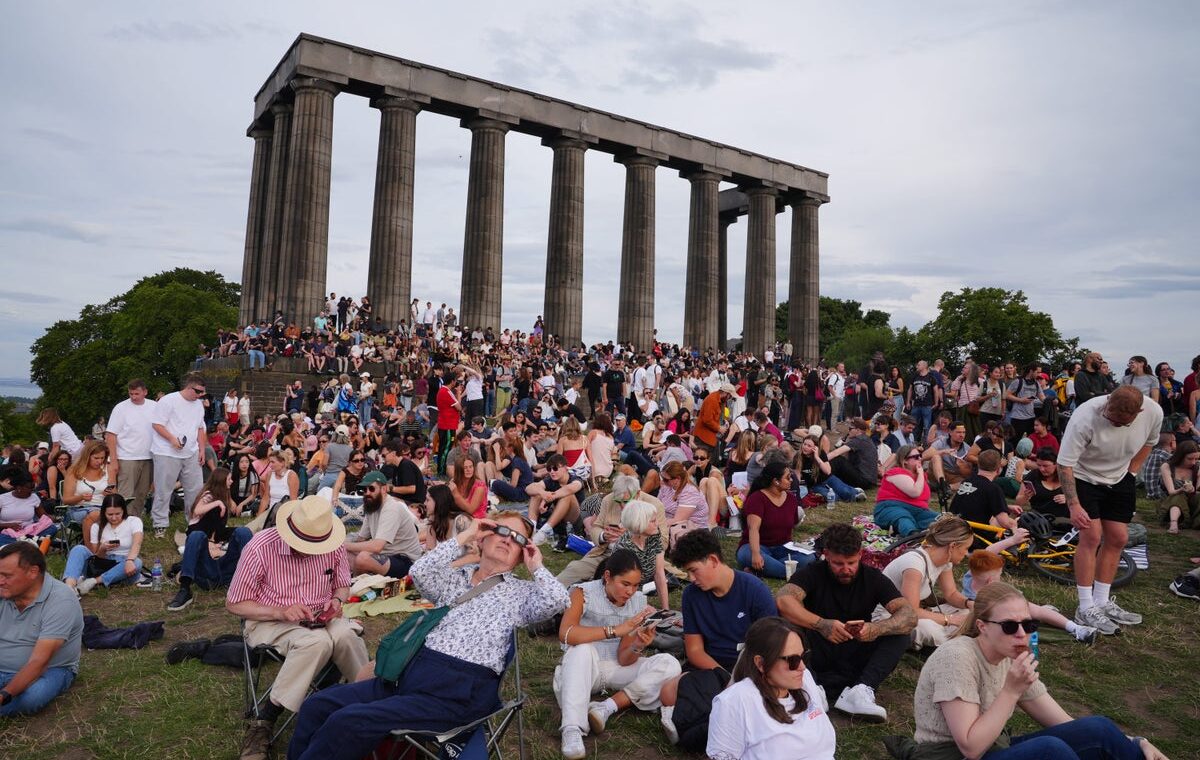
People packed onto the summit of Calton Hill in Edinburgh, where the city’s astronomical society had organised a viewing event.
People formed a long queue at the observatory gates at the start of the evening hoping to collect a sought-after pair of eclipse glasses – but supplies ran out at about 6pm.
Others had brought kitchen colanders or home-made devices made from cereal boxes or sheets of paper for viewing the eclipse indirectly.
The eclipse began shortly after 6pm, with the “peak” extent of the sun’s coverage happening at slightly different times in different areas of the country.
It peaked in Inverness 7.03pm, when 90.74% of the sun was obscured, while in Edinburgh the peak came at 7.06pm, when 90.71% of the sun was covered.
Some western areas of the country saw more than 92% coverage.
Ahead of the eclipse, the Met Office said cloud cover across the country meant people in the bulk of Scotland had a “reasonable chance” of seeing the eclipse.
However, those in the far north west of the country were described as having only a “low chance”.
The forecaster said: “North-west Scotland will see the poorest conditions, while cloud breaks across Scotland, Northern Ireland and northern England should allow many to observe it.”
The skies above Edinburgh were covered by hazy clouds throughout the period of the eclipse, with the sun completely hidden behind thick cloud in the 15 minutes or so leading up to the peak.