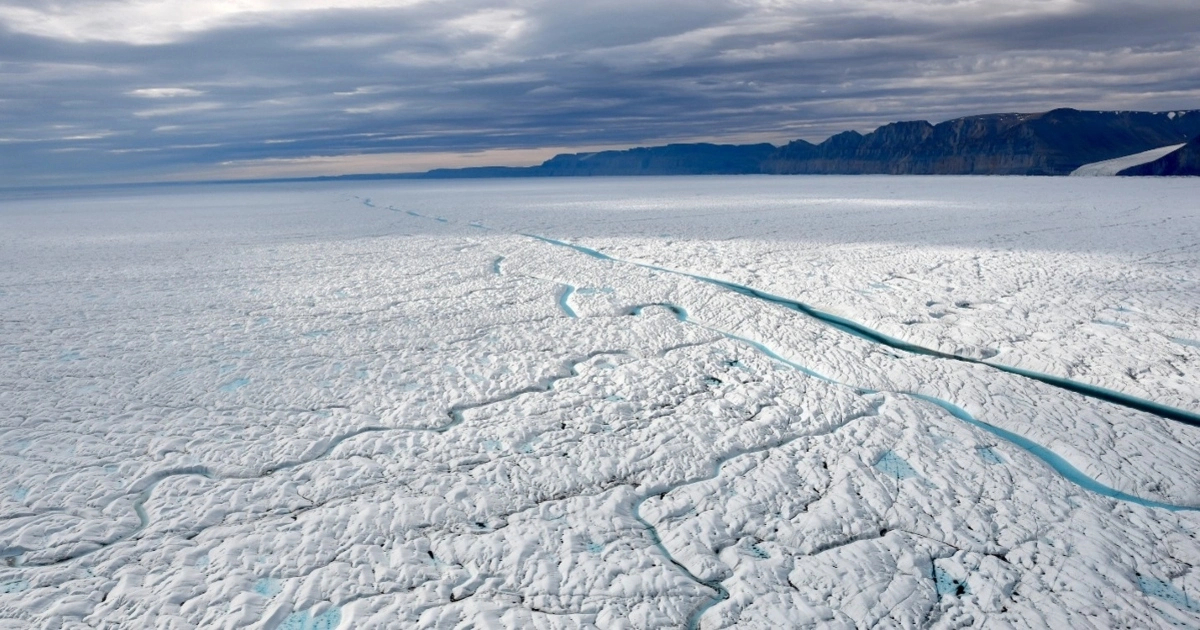
Innovative scientists based in Stirling are part of an international team monitoring a major glacier break in Greenland, which has remarkably created an ice island as big as Manhattan in New York City.
The group, which includes a University of Stirling duo, Dr Anna Crawford and Dr Iain Wheel, warn that two even larger ice islands are expected to break away in the near future.
The scientists report that a 76.4 sq km section of Petermann Glacier in northwest Greenland calved – when a glacier splits, and a large piece breaks off – on August 4, marking the glacier’s largest loss of floating ice since 2012 and the largest Arctic calving event since 2020.
The newly-formed tabular iceberg, estimated to be up to 150 metres thick, presents a rare opportunity to study how large Arctic ice masses form, drift and break apart over time, according to researchers.
Dr Crawford, Senior Lecturer in Physical Geography at the University of Stirling, is excited by the “rare” discovery.
Flights subsidy row shows islanders' transport needs are still being forgotten
New exhibition celebrates Linlithgow's place in story of curling
Boss Scotland's academic entrepreneurship scheme reveals global hopes
What the largest-ever Scottish Budget reckoning reveals about risks of devolution
She said: “While large, tabular icebergs are relatively common in the Southern Ocean that surrounds the Antarctic Ice Sheet, Arctic ice islands are far rarer. By studying Arctic ice islands, we will gain knowledge that can be transferred across Polar regions.”
The calving event was detected by Adam Garbo, a PhD student in glaciology at the University of Ottawa, as part of an international collaboration between the University of Ottawa, the University of Stirling, Environment and Climate Change Canada, Lancaster University and the University of Leeds.
Scientists used long-term satellite monitoring that has tracked changes at Petermann Glacier since 2019. Researchers have been following the glacier’s floating ice tongue, documenting the growth of fractures and monitoring signs of instability over several years.
Adam Garbo said: “Petermann Glacier has long been one of Greenland’s largest remaining ice tongues. We’ve anticipated this break for years and seeing it finally happen is remarkable.”
Satellite imagery from the European Space Agency’s Sentinel-1 mission showed clear deterioration along the centreline of the ice tongue on August 3. By the next day, the new ice island had detached from the eastern side of the glacier.
Researchers say the recent calving is unlikely to be the last. Two additional large ice islands are expected to detach from Petermann Glacier in the near future as long-developing rifts continue to cut across the ice tongue.